
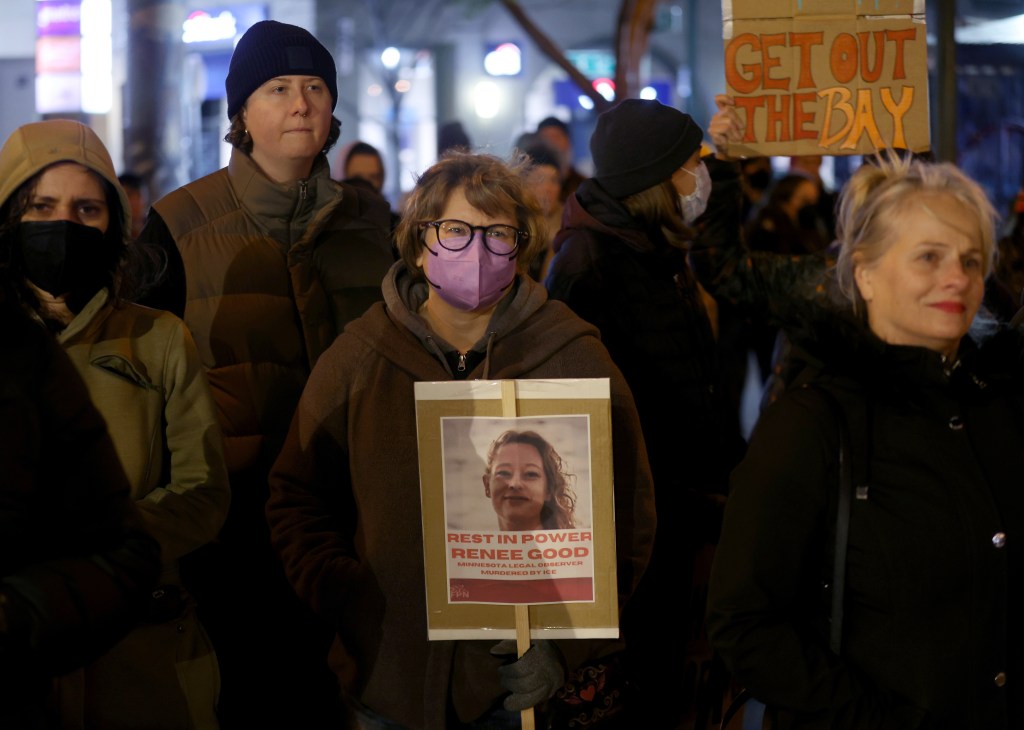

The killing of Renee Nicole Good — the Minneapolis woman shot Wednesday by an Immigration and Customs Enforcement agent — is reverberating far beyond Minnesota, heightening fears among Bay Area legal observers and immigrant-rights advocates who regularly document federal immigration enforcement and monitor whether agents treat people humanely.
For members of the Santa Clara County Rapid Response Network, a coalition of nonprofits that operates a hotline for reports of ICE activity and connects residents with legal and community support, the risk is not theoretical. They have lived it.
Yesenia Campos was only a few months into volunteering with the network when she was detained by ICE on Oct. 30 while observing agents in San Jose.
Campos said she was collecting contact information for people being detained so their families could be notified when an agent ordered her to step back. When she did not move quickly enough, she said, the agent detained her. Other volunteers were present and documented the encounter.
“As responders, we know that there’s a risk,” Campos said at a news conference Thursday. “We know that we may potentially confront ICE. Now we know that they are unpredictable. We know that some of them are untrained, so we don’t know how they’re going to react in our presence.”
Campos and her colleagues stress that their role is strictly observational — never to interfere. In civil-rights circles, that work falls under the broad definition of legal observing.
“A legal observer is any member of the community who intends to observe and document police behavior,” said EmilyRose Johns, president of the National Lawyers Guild San Francisco Bay Area chapter.
While organizations such as the National Lawyers Guild and the American Civil Liberties Union offer training and guidance, Johns said there is no formal certification required. The right to observe and record law enforcement activity in public is protected by the Constitution.
“You are documenting, as dispassionately as possible, what is occurring,” Johns said. “And the reason that that is so valuable … is demonstrated in the awful murder of Ms. Good,” Johns said.
Johns pointed to what she perceived was a stark disconnect between the federal government’s initial account of the shooting and what video recorded by bystanders and other legal observers appears to show.
Homeland Security Secretary Kristi Noem described Good as a “domestic terrorist” on Wednesday, saying she attempted to run over an ICE agent as she tried to drive away. President Donald Trump echoed that characterization in an interview with the New York Times, saying she “behaved horribly” and “ran him over.”
But videos captured by other observers and members of the public show an ICE agent approaching a Honda Pilot that was stopped on a snowy road and ordering the driver — later identified as Good — to open the door before grabbing the handle. When the vehicle began to move forward slowly, another agent standing in front of the SUV drew a firearm and fired at least two shots through the windshield while stepping backward.
After the shots, the SUV veered into two parked cars. The agent who fired left the scene, and the videos do not clearly show whether he was struck by the vehicle, though multiple major news organizations Thursday reported that he was not.
Minnesota officials have said the footage contradicts the federal government’s initial version of events.
“What was very clear,” Johns said, “is the other legal observers, the other people who were observing and video recording that interaction with ICE, their video is critical at dispelling the false narrative.”
She added: “It’s unclear how this would even have been covered, how Ms. Good would even get a sliver of justice, how her three children would get a sliver of justice, if there weren’t other legal observers out there at the same time. But it is more critical than ever and people should do everything they can to take care of each other, take care of themselves, and protect themselves in the face of this.”
For immigration advocates in the Bay Area, Good’s death has intensified long-standing concerns about intimidation and retaliation against those who monitor federal agents.
Stephanie Jayne, another member of the Santa Clara County Rapid Response Network, said ICE agents have pulled her over, photographed her license plate and documented her movements while she was doing observer work.
“This intimidation is intentional,” Jayne said. “It is meant to make us afraid to show up, but we continue to show up anyway.”
She said the network exists because ordinary residents choose to act — by getting trained, documenting encounters and standing with immigrant families during enforcement actions.
“You do not need to be fearless to be a responder,” Jayne said. “I know I’m not. You need to be committed to the belief that what is happening is wrong and that silence only allows it to continue.”
The Associated Press contributed to this report.


Leave a Reply