
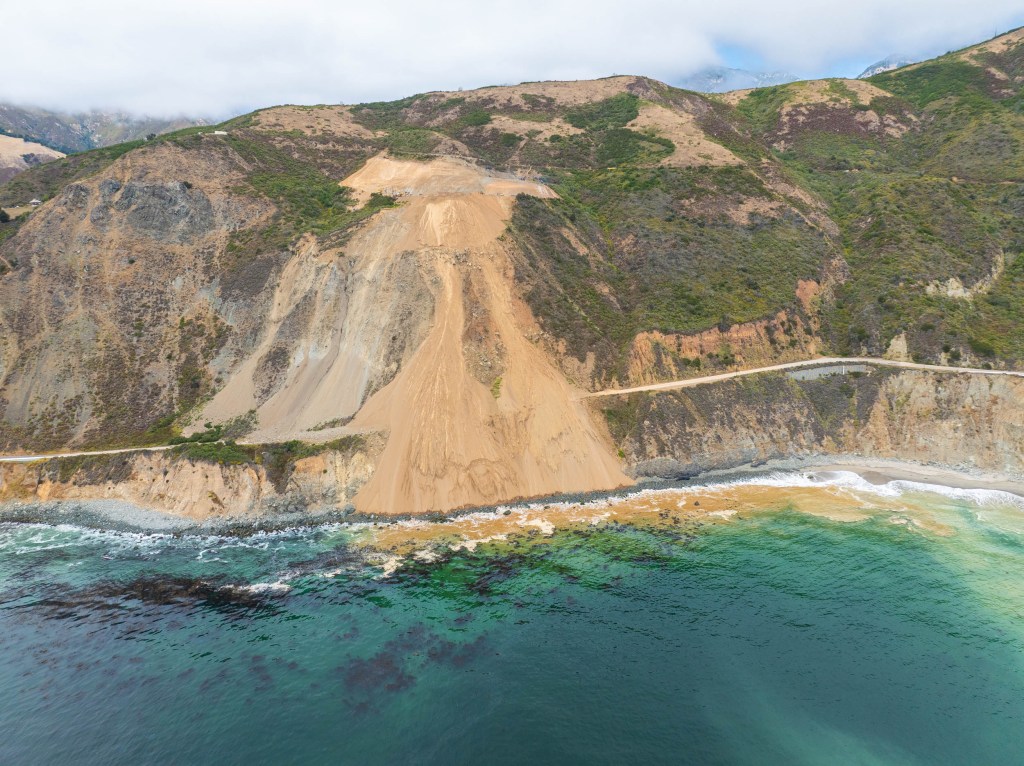
In a milestone affecting one of the most scenic drives in the United States, Caltrans crews have finished clearing a massive landslide blocking Highway 1 in Big Sur.
The winding two-lane roadway reopened at noon Wednesday, allowing motorists to drive along the coast the entire way from the Bay Area to Southern California for the first time in three years.
“This vital corridor is the gateway to California’s coast and the lifeblood of the Big Sur economy, and today it’s restored,” said Gov. Gavin Newsom.

The closure of the road — the longest in its history since it was first constructed in the 1930s — was caused by atmospheric river storms in 2023 and 2024 that sent millions of tons of rock and dirt off steep hills onto the breathtaking route that clings to the edges of cliffs overlooking the Pacific Ocean.
The biggest slide, called Regent’s Slide, occurred about 45 miles south of Carmel and 2 miles north of Lucia in Monterey County, on Feb. 9, 2024. An atmospheric river storm slammed into the coast of Central California and Southern California, dumping more than 10 inches of rain in parts of Big Sur with winds up to 90 mph. The rain saturated soils, causing trees to collapse, sparking power outages and sending landslides onto Highway 1 in multiple places.
The Regent’s Slide originated 450 feet above the roadway.
Adding to the disaster: There was already a slide nearby to the south, Paul’s Slide, which had closed Highway 1 in January 2023 and was so big it wasn’t cleared until May 2024.
The one-two punch had blocked full access along the coast since January 15, 2023. In a typical year, 5 million people from across California, the United States and the world visit Big Sur, driving an economy built on tourism, from hotels like the Post Ranch Inn to famous restaurants like Nepenthe, and spectacular scenery highlighted by Bixby Creek Bridge, McWay Falls and the Ventana Wilderness.
Because it was impossible to drive continuously along Highway 1 between Northern California and Southern California, many unprepared visitors were required to turn around when attempting to travel from the Monterey Bay Area to Hearst Castle, Morro Bay, and other locations south of Big Sur. The detour was hours-long, inland through the Salinas Valley.
“Businesses have been impacted,” said Ryne Leuzinger, chairman of the board of directors of the Big Sur Community Association, a non-profit group. “Some people who live here had their job on one side of the closure and lived on another. There were a few kids who live on the other side of the slide from their school. Today is a happy moment. It’s a matter of convenience and resetting the connection for the community.”
He noted that this weekend included the Martin Luther King Jr. Holiday.
“The weather is going to be sunny,” he said. “It’s a good time to visit.”
Rockslides and mudslides occur fairly regularly in Big Sur, where the Santa Lucia mountain range rises steeply from the Pacific Ocean. Most are cleared and fixed within a few days or weeks.
But clearing the Regent’s Slide and rebuilding Highway 1 proved to be a huge engineering challenge.
Caltrans removed more than 500,000 cubic yards of rock, dirt and other debris from the sheer cliff face at Regent’s Slide — an amount that could fill roughly 50,000 average-sized dump trucks.
There were times when the material continued to slide by as much as 1 foot a day, said Kevin Drabinski, a Caltrans spokesman.
About 80 workers, using bulldozers, ground sensors, drones, explosives, and other tools, had to carefully move tons of rock and dirt, pushing it down the side of the cliffs onto the beach below.
To reduce the risk of a catastrophic accident, they used unmanned, remote-controlled bulldozers and excavators at times.

In May, the workers, from Papich Construction, a San Luis Obispo County contractor recently acquired by Granite Construction in Watsonville, began driving 60-foot-long steel bars called “shear dowels” deep into the ground to try to stabilize the site, which is surrounded by ancient landslides and other problematic geology.
They drilled more than 4,600 of the steel bars into the slope, surrounding them with grout, to reinforce the hillside.
“We’ve left a stable hillside,” Drabinski said. “And there were no injuries. We’re very proud of that.”
The job was originally estimated finish in March, but was completed early.
“We had a run of good weather in October and November,” Drabinski said. “And with the dry weather in the past few weeks, we were able to make a final push. We didn’t lose many days. As recently as yesterday, we were striping the highway.”
Some minor work will continue for the next few weeks, but the road will remain open, he said.
In recent years, landslides, wildfires and big storms have battered Big Sur.
Leuzinger, who has lived there for 9 years and who commutes to work at Cal State Monterey Bay, said Big Sur residents are hardy. His organization raised money to help residents who couldn’t get to work during the slides. This week, they painted concrete barriers that help with parking near Bixby Creek Bridge so the barriers would blend in better with the natural surroundings.
“The only constant is unpredictability,” he said. “If we’re not in a disaster, we are preparing for the next one. It’s a beautiful place. But it really takes fortitude and resilience and patience to live here. People move here for the beauty of the landscape and stay for how amazing the community is. The level of camaraderie and support from neighbors is unique.”


Leave a Reply