
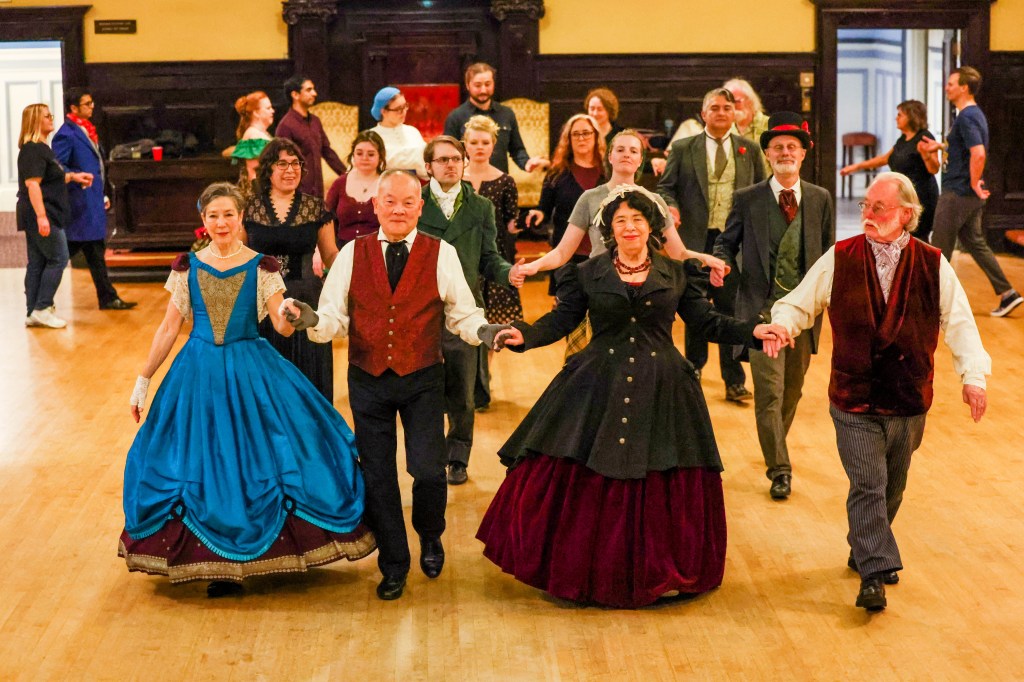
John Ruzicka wasn’t quite himself when he stepped into the large, stately room at the top of a grand staircase in the Elks Lodge in downtown Alameda.
On that Tuesday night in November, as on most Tuesdays, the room was being used as a classroom for Ruzicka and more than two dozen others to learn the dances and social etiquette of the 19th century English ballroom. Ruzicka had dressed for the part. Donning a Regency-era men’s tailcoat, waistcoat and ruffled shirt, the theater actor, writer and director from Livermore was cosplaying Fitzwilliam Darcy, the aloof romantic hero of Jane Austen’s “Pride and Prejudice.” More specifically, his outfit was inspired by a suit that Colin Firth wore while playing Darcy in the beloved 1995 BBC series adaptation of “Pride and Prejudice.”
For the next two hours, Ruzicka danced with a swirl of partners. Some also had dressed up, displaying elegant gowns they had sewn themselves, made with glimmering fabrics and featuring shoulder-baring necklines and voluminous skirts, puffed up with petticoats or crinoline. All together, this combination of costumes and period dance — with waltz music by Johann Strauss I — created a vision of a long-ago time in Europe or America, when balls and village dances provided a key way for people to socialize.

These Tuesday dance classes are organized by Period Events and Entertainments Recreation Society Inc., an Alameda-based nonprofit founded in the 1990s by the husband-and-wife duo James and Cathleen Myers. During the classes, James plays the traditional role of dance master. “And waltz!”, he said while teaching the Paganini Waltz. The couples twirled — one, two, three, four — as James continued, “Right, left, right, left. Turn! And waltz! Pass on the right. Slide on the left. Link arms!” Cathleen also acted as dance mistress by demonstrating the steps and helping James provide encouragement and brief explanations for a dance’s historical context.
“I had been wanting to get back into dancing and more historic dance,” said Ruzicka, who described himself as a big fan of Austen, Charles Dickens and Shakespeare. After a theater colleague told him about PEERS, he found his way to a PEERS ball and to his first class in early 2024. “When I went to the first lessons, I got hooked, and I’ve been coming ever since.”
The students include men and women of all ages, from Gen Zers in their 20s to baby boomers in their 60s and older. What evidently draws them to PEERS classes isn’t just the dance but a chance to spend time with other people who share their love of history, literature, theater, movies, period fashion or doing a grown-up version of dress-up and play-acting.

Theo Lamb, 20, of Alameda, has her group of friends but was looking for a new way to exercise, get out of the house and meet new people. “Everybody was super nice. I love the dancing, even though I wasn’t very good at it at first,” she said, explaining that she also likes making her own costumes. “The dancing is awesome. It’s so elegant and pretty.”
The Bay Area is a mecca for social dancing, from salsa to line dancing to modern ballroom, said Richard Powers, a choreographer and dance historian who teaches social dance classes at Stanford University. Powers said people of all ages, including Stanford undergraduates, are drawn to social dancing because it emphasizes human interaction — in contrast to the sense of isolation people may feel in a world of screens, AI-generated realities and political and cultural divisions. Vintage dance is especially appealing to people looking for that brief escape to times and places that seem more gracious and friendly than our own, Powers said.
In the classes, the Myers duo focuses on teaching dances that were popular in the 1800s, including the waltz, polka, mazurka and quadrille. The couple has occasionally explored earlier styles, going as far back as the Elizabethan era, but they are more likely to jump to 18th century country dances or all the way to the 20th century with ragtime, the Charleston, the one- and two-step and the foxtrot. They also organize regular dance parties and events that pay homage to different eras or themes: Victorian, Gilded Age, Edwardian, “My Fair Lady,” “The Great Gatsby,” 1930s swing, “Haunted Mansion” and “Film Noir.”
The Myers and other PEERS dancers also play an important role at the annual Great Dickens Fair held at Cow Palace in Daly City every December. As the Fezziwig Party Dancers, they re-create the famous dance scene in “A Christmas Carol,” when the Ghost of Christmas Past encourages Ebeneezer Scrooge to recall a joy-filled holiday party at his former workplace.
Working at the Dickens Fair in the 1980s, in fact, inspired the Myers to start PEERS. After previously meeting at a science fiction convention in Los Angeles, James moved from New Orleans to San Francisco to be with Cathleen, and they married in 1983. Cathleen had grown up doing vintage dance, thanks to her parents, while James picked it up after meeting Cathleen.

While immersing themselves in vintage dance, Cathleen and James had their day jobs. She taught classics, while James still works in business as a contracts manager. For James especially, PEERS has provided a creative outlet, which he and Cathleen say is an incentive for a lot of their members. “I think there are a lot of dancers in our group who are in the high-tech industry, and dancing is a nice relief,” Cathleen said.
“This is the place where nerds can express themselves,” said Andrew Beaubien, an audio software engineer from Oakland, who has long pursued side passions as a singer, musician and musical theater performer. He was one of the Fezziwig Party Dancers at the Dickens Fair last month. At the Tuesday night class, he dressed up in a 19th century men’s tailcoat and top hat, while his real-life partner, Anaïs Wong, donned a white, off-the-shoulder gown that floated around the floor. (For the record, PEERS members don’t usually dress up for the Tuesday night classes, but did so for this particular class because photos were being taken.)
Wong, a psychologist who has previously studied ballet and more contemporary styles, seconded Beaubien’s view of the allure of period dancing. After she and Beaubien met through a friend, he asked if she’d be interested in accompanying him to a dance group that specializes in historical re-enactments. “Nerdery, costumes, dancing?” she recalled. “I’m like, ‘Oh yeah!’”
Professionally, Wong attests to the “self-care” that PEERS classes provide to participants. People can enjoy a good workout, gain self-confidence by mastering a new physical skill and live out dreams they may have abandoned when they left behind adolescence to begin “adulting.” “I think a lot of us also are wanting to put on a show,” she said.
To be part of the “show,” PEERs members learn steps, turns, passes and glides that appear simple but are woven into intricately beautiful variations that mirror the social milieu of ballrooms from 70, 100 or 200 years ago. Anyone who’s read 19th century novels or watched their screen adaptions knows that ballroom dance scenes tend to be loaded with drama, social jockeying and, above all, romantic intrigue.
After all, the ballroom was the chief place where unmarried men and women could properly interact and scope out suitable marriage prospects. For that reason, the dances were designed to let these young people get a good look at one another, mix with as many partners as possible and maybe enjoy some conversation and flirting while on the dance floor. Fans of that BBC version of “Pride and Prejudice” may remember the sparks flying between Darcy and Elizabeth Bennet when they first danced together at the Netherfield Ball. Of course, at that early point in the story, the two hid their growing attraction for each other behind smoldering glances, verbal sparring and elegantly executed dance moves.
But one thing about Elizabeth and Darcy at Netherfield: They probably wouldn’t have been dancing a waltz, according to James and Cathleen Myers. As usual after a Tuesday night class, the Myers and other PEERS members gathered for drinks in the Elks Lodge Rathskeller, where the couple offered some brief commentary about the waltz. While Austen may have been familiar with the waltz, the dance was still considered scandalous in certain segments of society in the early decades of the 19th century when she was writing. That’s because it involved an unprecedented amount of physical contact, with men and women facing each other and holding each other by the shoulders and waist.
James explained that even Lord Byron, the morally challenged Romantic poet who died in 1824, was shocked by the waltz, writing a poem that warned of its “slippery steps” and “freely” ranging hands. “Lord Byron was scandalized?” Ruzicka exclaimed in disbelief. “He was the most scandalous person!”
Cathleen theorized that the growing popularity of the fast-moving polka in the 1840s, especially in the aftermath of revolutions sweeping across Europe, helped make the waltz widely acceptable, including to parents who decided to stop worrying that it would endanger the morals of their adolescent children.
Meanwhile, when it comes to the romantic underpinnings of the ballroom, Cathleen acknowledged that relationships have started at PEERS events. That was the case for Beaubien and Wong, who got to know each other driving back and forth to classes. “At the Dickens Fair, we’ve had proposals on the dance floor,” Cathleen said.
But most PEERs members are just looking for a way to get out, dance, maybe display their DIY costuming skills and meet friendly new people. “It’s a wonderful group,” James said, while Cathleen added, “They’re very good at getting the shy people out of their chairs and dancing.”
If you go: PEERS hosts vintage dance classes on Tuesday evenings at the Alameda Elks Lodge at 2255 Santa Clara Ave. The 7 p.m. class is designed for newcomers, while the 8 p.m. class is for more experienced dancers. The cost is $10 for both hours. For more information about PEERS classes, balls and other events, visit peersdance.org.


Leave a Reply