
By STEVE DOUGLAS, AP Sports Writer
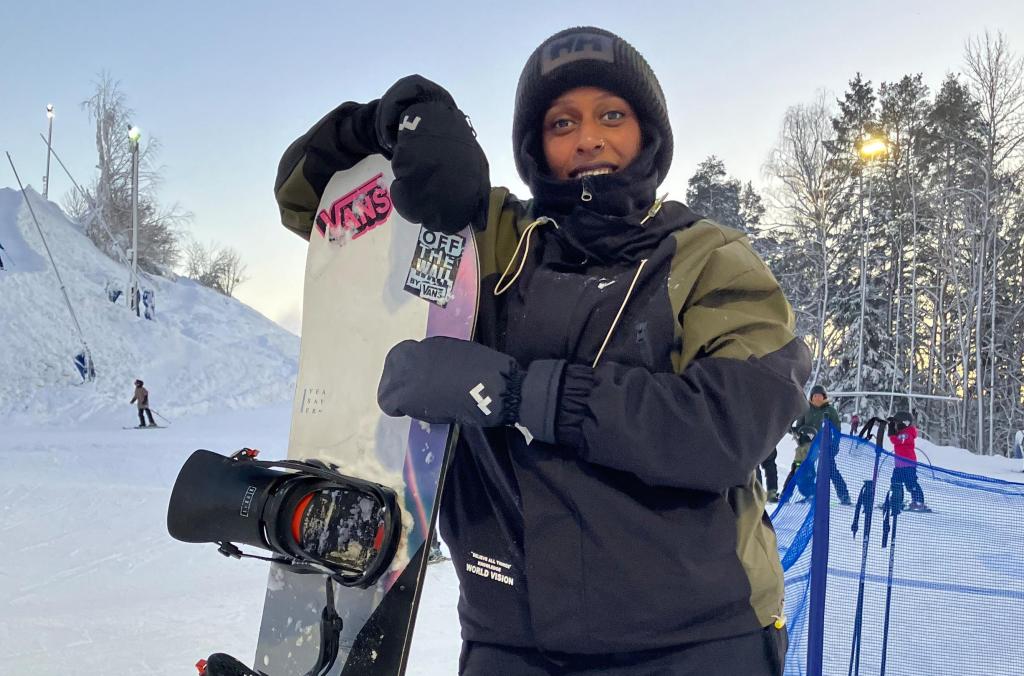
VASTERAS, Sweden (AP) — Maryan Hashi remembers the thoughts running through her mind when she began hitting the ski slopes in northern Sweden. As a Black woman from Somalia, she felt like an “alien.”
“Am I wearing the correct clothing for this? Does it fit? Do I look weird? Am I snowboarding correctly? Do they think it’s weird I’m on the slope?” she said. “But I carried on — I felt if I didn’t, I was never going to commit to anything in my life.”
A few years later, snowboarding is the 30-year-old student’s big passion and it is helping her integrate into her adopted country’s society better than she could ever have imagined.
What she’d love now is to see other migrants experiencing the same joy.
Immigration from Africa and the Middle East has transformed the demographics of Europe in recent decades. And while the growing diversity is reflected in many sports such as soccer — Sweden’s men’s national team has several Black players including Liverpool striker Alexander Isak — it hasn’t made a dent in winter sports.

At the Milan Cortina Winter Olympics, Sweden is sending a team made up almost exclusively of ethnically Swedish athletes, with NHL player Mika Zibanejad, whose father is from Iran, a rare exception. That hardly reflects the diversity of the Nordic country: About 2 million of its 10 million residents were born abroad, about half of them in Asia or Africa, according to national statistics agency SCB.
The lack of athletes of color at the Winter Olympics — and in winter sports in general — has been a recurring theme in the U.S., which is sending one of its most diverse teams to the Games. It hasn’t gotten the same attention in Europe.
The Olympic rosters of France, Germany, Switzerland and other European winter sports nations look a lot like Sweden’s: overwhelmingly white and lacking the immigrant representation seen in their soccer or basketball teams.
Researchers point to social, financial and geographical barriers, and believe a big cultural shift is needed for anything to change.
“It takes not years but decades,” said Josef Fahlen, professor of sport pedagogy at Umea University in Sweden.
Entering a ‘white’ sport
Hashi was 14 when she came to Sweden with her family in 2009. They settled in Skelleftea, a mining city around 770 kilometers (480 miles) north of the Swedish capital, Stockholm, where winters are long and temperatures can be extremely cold. She found it a culture shock and said it was “scary” to integrate with native Swedes because of language difficulties, so her friendship group consisted of fellow migrants from Somalia and other African countries.
Only in 2018 did she discover there was a ski slope five minutes from her home, after a co-worker suggested she try snowboarding as part of a pilot integration project run by the municipality.
“When you don’t have information or access or nobody around you does it — snowboarding is basically a white sport — and when you’re not correctly integrated into the community, you don’t know much about it,” Hashi said.
She initially felt out of place but grew to love her daily trips to the slope, even when numbers dwindled in the group. She even started to teach kids and her immigrant friends — those who’d been skeptical about Hashi doing an activity that’s “not our thing” — how to snowboard.
“I’ve made my mind up,” Hashi said, “that snowboarding is going to be a part of my family.”
The crucial role of parents
The single biggest influence on children getting into — and maintaining an interest in — a particular sport is their parents, according to Fahlen. That, he said, is the “simple” explanation for the lack of diversity in the ski slopes in Sweden and across Europe.
Pointing to Isak, whose parents are from Eritrea, or tennis players Mikael and Elias Ymer, whose parents migrated to Sweden from Ethiopia, he said the children of non-European immigrants are unlikely to be introduced to sports that their parents are not familiar with.
“Take the example of Isak finding his way into football — it makes total sense because football exists in Eritrea. Skiing doesn’t,” Fahlen said.
Fahlen regards the lack of diversity as not a “winter sports problem but a cultural issue” and said it’s important for kids to see winter sports athletes with a different skin tone.
“It’s a matter of horizon,” Fahlen said. “We need to show it’s possible to be a skier even if you might be from Tunisia or the West Bank.”
There are also financial and geographical factors at play. Immigrants in Sweden typically live in major urban areas, away from skiing hubs in the mountains, and are often in less-privileged economic positions. Participating in winter sports can be expensive because of the need to buy or rent equipment and clothing, and paying for travel and a ski pass.
Improving access for immigrants
Academics believe more needs to be done by winter sports to improve accessibility for immigrants and underserved communities.
“It’s a fact that the best integrative force in society is team sports and sports clubs, where kids can go to do useful things together with others,” said Stefan Jonsson, a professor in Ethnicity and Migration Studies at Linköping University. “There is so much research saying if we want social and ethnic integration, this would be the primary thing.”
Asked about its attempts to get more people from diverse backgrounds into skiing, Sweden’s ski federation said “we want to be better” and added that “inclusion is something we strive for.”
The federation is proud of its “Alla På Snö” (“Everyone On Snow”) program, which since 2008 has reached an estimated 30,000 children every year and offers students free equipment and access to slopes. Also boosting general accessibility is the growth of Sweden’s Leisure Bank project, where people can borrow sports equipment including skis and ski boots for free for 14 days. The founders equate the banks to public libraries.
Neither specifically targets immigrants, however. For Hashi, it’s a missed opportunity to widen the talent pool.
“Open the door for us,” Hashi said. “We’re going to take care of the next generation for you.”
AP Olympics: https://apnews.com/hub/milan-cortina-2026-winter-olympics



Leave a Reply