
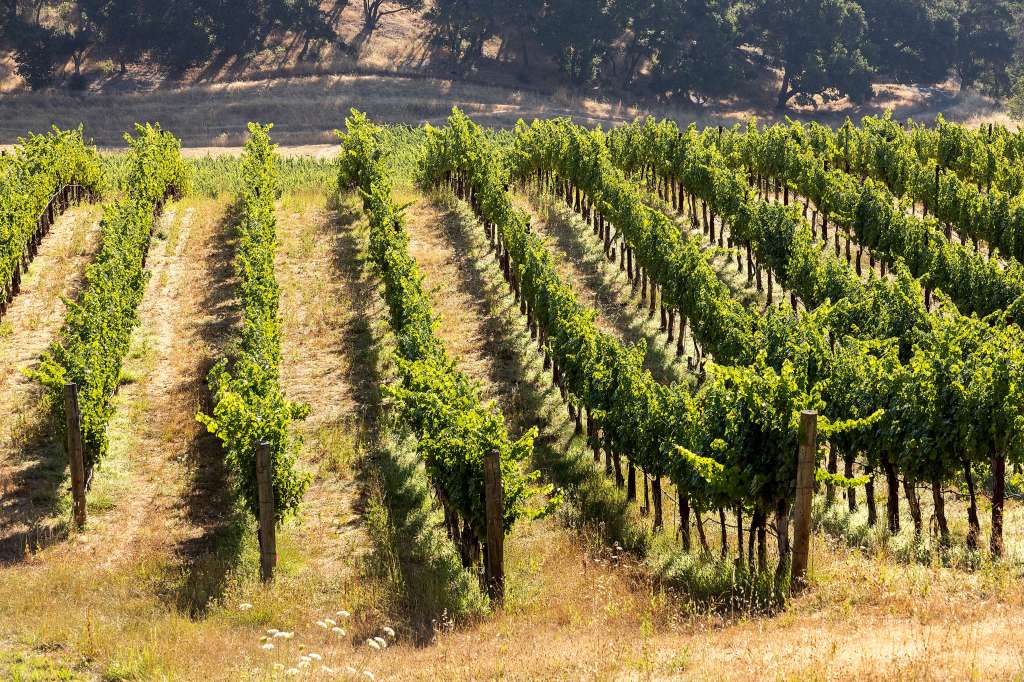

Sonoma County grape growers weighing a shift to regenerative practices now have some hard numbers to work with.
A study published this month in the American Journal of Enology and Viticulture tracked costs and revenues at four vineyards in Russian River Valley and Alexander Valley, comparing conventional management against regenerative approaches like no-till farming, composting, and integrating sheep for grazing. The verdict: over a 30-year vineyard lifespan, the two approaches come out roughly even financially—with regenerative running just 2 to 8 percent lower in net present value.
That’s assuming yields stay the same. And that’s the key assumption growers will want to scrutinize.
“The economic viability of RA depends largely on keeping stable yields or achieving price premiums to counterbalance any potential yield decline,” the researchers write.The study was a collaboration between UC Davis, UC Berkeley, and the USDA’s Agricultural Research Service, with data provided by Jackson Family Wines, which operates the four vineyards. Alexandra Everson, a JFW employee based at the company’s Santa Rosa headquarters, is a co-author.
The math
Researchers interviewed vineyard managers in 2023 and collected yield data from 2022-2023 across sites growing Pinot noir, Chardonnay, and Cabernet Sauvignon. They built financial models projecting costs and revenues over three decades.
The conventional vineyards in the study aren’t industrial operations spraying with abandon—they follow California Sustainable Winegrowing Alliance certification protocols. So the comparison is really between “sustainable-conventional” and regenerative.
The regenerative approach eliminated tillage in the alleys, swapped synthetic fertilizers for compost, ditched herbicides for mechanical weed control, and brought in sheep to graze cover crops. That meant buying different equipment upfront (a compost spreader instead of a mower and disk), paying for compost and grazing services, and planting a different cover crop seed mix designed for sheep forage.
Annual operating costs ran slightly higher for regenerative—about $306 per hectare more—because compost and sheep services cost more than the mowing, tilling, and herbicides they replaced. But those costs shrank considerably when researchers factored in the value of nutrients from compost and manure, reduced soil erosion, and potential carbon credits.
Do it yourself
Here’s where the study gets interesting for growers thinking long-term: the economics shift dramatically depending on whether you outsource regenerative services or bring them in-house.
Contracting out compost purchases and sheep grazing resulted in a negative net present value of $1,756 per hectare over 30 years. But growers who produce their own compost from winery waste and maintain their own sheep flock came out ahead—a positive $557 per hectare.
Making compost on-site from grape pomace, stems, and lees costs about $27 per megagram, compared to $70 per megagram for purchased compost. That’s a 61 percent savings, plus you’re not paying disposal fees for winery waste.
The sheep math is trickier. A 10-animal Dorper flock for a 4-hectare vineyard runs about $10,000 to set up (buying sheep, fencing, shelter, a guard dog) and $3,500 annually to operate. Revenue from lamb and mutton sales brings back $1,200 to $1,800 per year. You’re not getting rich on sheep, but they’re eliminating your mowing and herbicide bills entirely while fertilizing as they go.
The researchers chose Dorper sheep for their low maintenance, compact size, and calm temperament in vineyard settings. Ewes can lamb up to three times in two years, and the breed sheds naturally—no shearing costs.
The caveats
The study assumed regenerative and conventional vineyards would produce identical yields. That’s optimistic. European research on organic conversion has shown yield drops of 23 to 35 percent in early years, though California’s lower disease pressure makes direct comparisons tricky.The researchers ran sensitivity analyses showing that a 10 percent yield drop could still pencil out if grape prices rose 20 percent. But a 20 percent yield decline with no price premium puts growers in the red.
Vine density and age matter too. Older vines and tighter spacing may not adapt as well to the transition. And some rootstocks—like the low-vigor 101-14 used at several study sites—may struggle in the more competitive growing environment that comes with robust cover crops and no herbicides.The researchers suggest growers establishing new vineyards have an advantage: they can choose rootstocks, spacing, and trellis systems suited to regenerative management from the start, potentially avoiding the yield dips that come with mid-life transitions.
The bigger picture
Sonoma County had over 62,000 acres of vineyards as of 2021. The county’s wine industry has been under pressure from changing climate conditions—longer droughts, more extreme heat events—that regenerative advocates argue their approach can help buffer through improved soil health and water retention.The study doesn’t quantify those resilience benefits directly, but it does note that regenerative practices support carbon sequestration, reduce dust and air pollution from tillage, and cut greenhouse gas emissions from transporting inputs.
Whether those public benefits eventually translate into policy incentives or market premiums remains to be seen. For now, Sonoma growers have evidence that going regenerative won’t necessarily break the bank—especially if they’re willing to raise some sheep.
The full study is available at https://www.ajevonline.org/content/ajev/77/1/0770002.full.pdf



Leave a Reply