
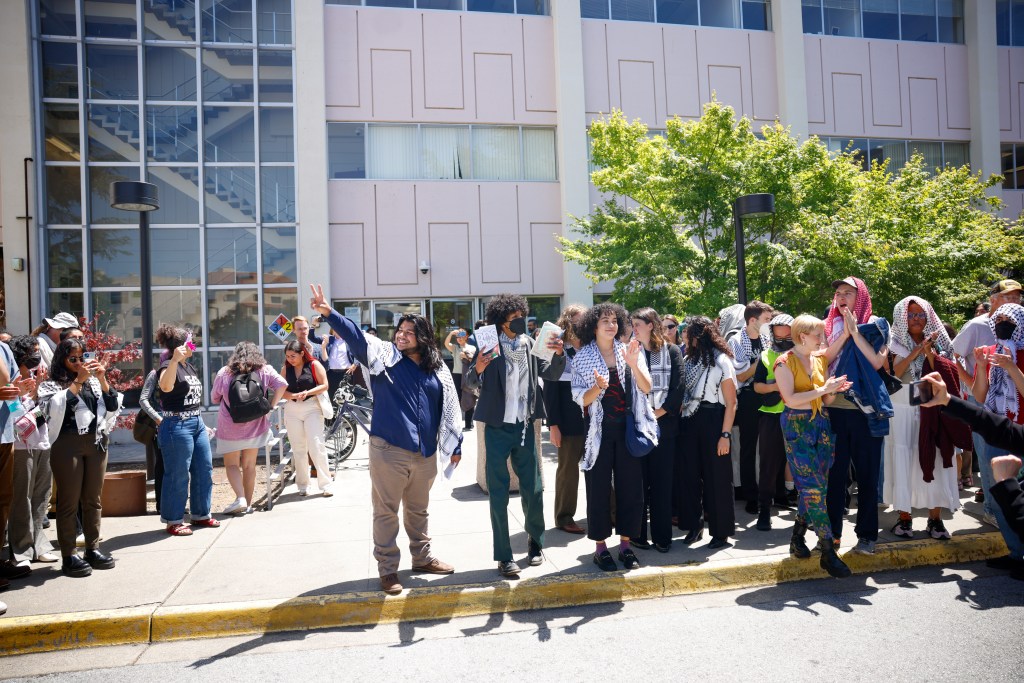

Prosecutors and defense attorneys presented closing arguments this week in the trial of five pro-Palestine activists accused of felony vandalism at Stanford University’s executive offices, with defense attorneys arguing that prosecutors failed to prove the charge.
The trial is nearing its conclusion three weeks after it began and nearly two years after 13 people were arrested for allegedly damaging the offices during a June 2024 protest urging Stanford to divest from companies linked to Israel.
Witnesses included fellow protester John Richardson, who took a plea deal, and Stanford facilities director Mitch Bousson, who testified about the extent of the damage, which the Santa Clara County District Attorney’s Office estimates at more than $300,000. The defendants did not testify.
Deputy District Attorney Rob Baker urged jurors to evaluate the alleged property damage independently of the protest’s political aims, arguing that free speech protections do not extend to criminal conduct.
“Free speech is irrelevant to this case,” Baker said. “You don’t get to use free speech to commit crimes.”
Santa Clara County deputy public defender Avi Singh, who represents German Gonzalez, countered that the activists’ actions amounted to a “peaceful sit-in” focused on safety and negotiation rather than a criminal occupation. Singh argued that prosecutors failed to prove the alleged crime or show the specific intent required for felony vandalism or conspiracy.
Responding to the prosecution’s repeated refrain that “dissent is American, vandalism is criminal,” Singh told jurors the government does not get to decide “what’s American and un-American, dissent and not dissent,” adding, “You decide whether their dissent is criminal.”
The remaining defendants — Gonzalez, Maya Burke, Taylor McCann, Hunter Taylor Black and Amy Zhai — face felony vandalism and conspiracy charges that carry potential prison sentences of up to three years, along with restitution, making the case among the most serious prosecutions tied to nationwide pro-Palestine campus protests.
The case stands in contrast to outcomes at other campus protest sites, where similar charges have largely been dropped. Most individuals arrested during a 2024 Columbia University protest had charges dismissed, felony cases against protesters at the University of Michigan were later dropped, and after arrests at a UCLA Gaza encampment, the Los Angeles city attorney declined to file criminal charges, though many students faced campus discipline.
The courtroom Thursday was filled to capacity during closing arguments, with some supporters leaving to watch the proceedings online. Baker struck a tone of rebuke and accountability, while defense attorneys focused on disputing prosecutors’ assertion that the students went to campus intending to cause destruction.
A key moment in the trial came from Richardson, a student who was arrested during the June 2024 protest and later accepted a plea deal. Richardson was called to testify by the prosecution but said he had “no regrets” about joining the protest.
Baker used Richardson’s testimony to prove the group had a deliberate plan to take over the building. While he acknowledged his humanitarian reasons were “commendable,” he argued those motives didn’t change the fact that he and the other defendants intended to break the law.
Defense attorneys portrayed Richardson differently, arguing he was pressured into testifying through subpoenas and a grand jury process he did not fully understand. Singh said Richardson’s use of the word “occupy” was not a legal admission of a crime, but a colloquial reference to a sit-in intended to prompt negotiations with the university.
All five defense teams are expected to complete closing arguments before the jury begins deliberations. As of press time, Leah Gillis, who represents Burke, was delivering her closing statement.
Stanford student and Drop the Charges organizer Mark Allen Cu previously said the case raises broader concerns about free speech and dissent on campus.
“Are Santa Clara County and Stanford University places that protect free speech and dissent, or not?” Cu said in a statement.
Cu also disputed prosecutors’ claims that the defendants caused up to $300,000 in damage.
“The pursuit of felony charges and restitution demands is not just an attempt to punish the Stanford 11,” Cu said. “It is an attempt to silence future activism in solidarity with Palestine.”


Leave a Reply