
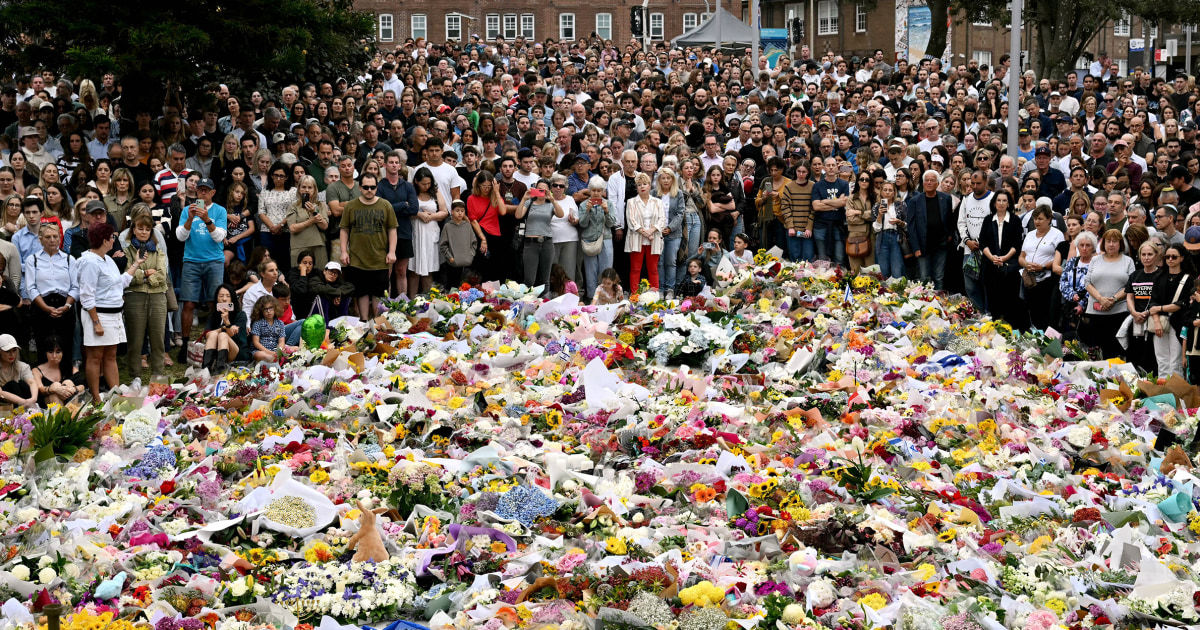
Police have said officers fatally shot the 50-year-old father at the scene, while the 24-year-old son “suffered critical injuries” and was hospitalized.
Lanyon said the suspects traveled to the Philippines last month. What that trip was for and whom the pair met with, as well as the specifics of their travel, are all under investigation, he said.
The suspects had traveled from Sydney to the Philippines on Nov. 1 and reported Davao as their final destination, the Philippines Bureau of Immigration said in a statement.
They stayed in the country till Nov. 28, it said, adding the father was an Indian national and the son was an Australian national.
ISIS-linked networks are known to operate in the Philippines and have wielded influence in the country’s south.
Davao is a city on the southern island of Mindanao, where terrorist groups have operated. In 2017, ISIS-inspired militants seized parts of the southern city of Marawi and held it in a deadly monthslong siege. But the extremists’ grip on the area has been weakened by sustained efforts by the government and military.
The younger suspect was an Australian-born citizen who first came to the attention of the Australian intelligence agency in October 2019, Prime Minister Anthony Albanese told reporters Monday.
“He was examined on the basis of being associated with others,” he said. However, “an assessment was made that there was no indication of any ongoing threat or threat of him engaging in violence.”
Home Affairs Minister Tony Burke said the older suspect arrived in Australia in 1998 on a student visa and transferred to a partner visa three years later. He has since held a resident return visa.
Neither Albanese nor Burke elaborated on the son’s associations, though Albanese said the investigation at the time lasted six months.

In a radio interview on Tuesday with ABC Australia, Albanese said the suspects were “motivated by Islamic State ideology” that “has been around for more than a decade that led to this ideology of hate, and in this case, a preparedness to engage in mass murder.”
Albanese on Monday said there was “no evidence of collusion” or that the father and son were part of a wider cell.
He also confirmed police information that a number of improvised explosive devices were found in a car. Albanese also said the younger suspect was not on a counterterrorism watch list.
Police raided an Airbnb property in Campsie, close to Bondi Beach, where the men had been staying, according to ABC Australia.
Authorities also said they raided a property in Bonnyrigg, a working-class suburb about 22 miles from Sydney’s central business district.
Residents said they were stunned to see armed police cordon off their street and raid a house as news of the shooting emerged. Neighbors said the family who lived there kept to themselves and appeared no different from others in the area.
“It’s a quiet area, very quiet,” Lemanatua Fatu, 66, who lives across the street, told the Reuters news agency. “People mind their own business, doing their own thing — until now.”

“I always see the man and the woman and the son,” she added. “They are normal people.”
The Sydney Morning Herald spoke to a woman Sunday evening who identified herself as the wife and mother of the suspects but said she was unable to identify her son based on images from the scene of the attack.
She said the two men told her they were going on a fishing trip.
“He doesn’t have a firearm,” she said of her son, the Morning Herald reported. “Anyone would wish to have a son like my son.”
The 50-year-old suspect killed by police had the legal right to possess firearms, authorities said at a news conference Monday.
“He met the eligibility criteria for a firearm’s license,” said Lanyon, the police commissioner. “He was a member of a gun club and was entitled by nature of the firearms act to have a firearms license issued.”
Lanyon added that the license permitted him to own the registered long guns used in the attack.
Discussing radicalization broadly, an expert told NBC News that family connections can be a significant potential risk factor in extremist involvement.
What family members think “matters in a way that doesn’t necessarily apply for others,” said Andrew Silke, a professor of criminology at Royal Holloway University. He said attacks by brothers were more common than by father and son.
Normally, Silke added, “the older family member is the one who introduces the younger family member to the ideology and kind of coaches them in, but there have been a few cases where the opposite has happened.”
Silke said that it often emerges in terrorism investigations that there was a pattern of radicalization over time. An attack completely out of the blue, with no evidence of engagement with more radical ideas, would be “incredibly rare,” he said.
“Normally, there are signs,” he added.





Leave a Reply