
By JOHN WAWROW
MILAN (AP) — Alina Muller instantly understood the significance her bronze medal-clinching overtime goal in a 2-1 win over Sweden meant not only to girls back home in Switzerland, but in the bigger picture of women’s hockey.
Muller has spent the past 12 years experiencing the ups and downs, fitful starts and stops her sport has endured since first splashing on the Swiss hockey scene as a 15-year-old by scoring her nation’s first bronze-medal clinching goal at the 2014 Sochi Games.
These Milan Cortina Games, however, were different for Muller and the rest of the competitors. They represent the first Olympics since the Professional Women’s Hockey League was launched in the summer of 2023.
“Just a few years ago there would have been a hundred people in the stands, and now it’s crazy to see,” said Muller, the former college star at Northeastern and now in her third season with the Boston Fleet.
“Every year, it’s getting more exciting. We’re getting more physical, more athletic, faster, faster game,” she added. “And the stadiums are filling up.”
For a sport and league banking on enjoying a post-Olympic boost, the tournament delivered on many fronts.
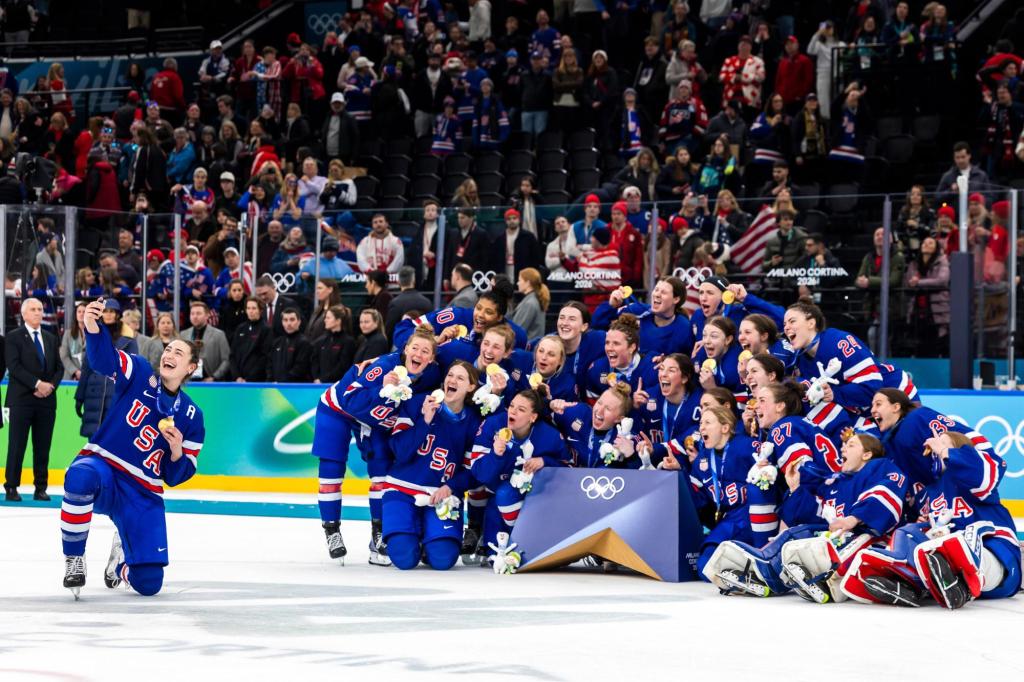
U.S. captain Hilary Knight is heading home with a gold medal in closing her Olympic career. The tournament featured two thrilling medal finals, both ending in overtime, with the Americans beating Canada 2-1. And the competitive gap the U.S. and Canada have long enjoyed appears to be closing ever so slightly.
“This is just the new normal,” Canada coach Troy Ryan said following the loss Thursday.
“Largely because of the impact of the PWHL, you saw a lot of closer games,” added Ryan, who also coaches the PWHL Toronto Sceptres. “You saw international teams that have PWHL players in it showcase better than they previously did.”
-

United States’ Megan Keller (5) scores the winning goal during the women’s ice hockey gold medal game between the United States and Canada at the 2026 Winter Olympics, in Milan, Italy, Thursday, Feb. 19, 2026. (Alexander Nemenov/Pool Photo via AP)


1 of 3
United States’ Megan Keller (5) scores the winning goal during the women’s ice hockey gold medal game between the United States and Canada at the 2026 Winter Olympics, in Milan, Italy, Thursday, Feb. 19, 2026. (Alexander Nemenov/Pool Photo via AP)
Expand
Four years after Czechia broke through by winning its first medal, a bronze, at the world championships, Switzerland and Sweden climbed the ranks by reaching the medal round as the fifth- and sixth-seeded teams.
Just as important were the lack of lopsided scores, which previously raised questions as to whether anyone can catch Canada and the U.S. The most one-sided outcome was the top-seeded Americans’ 6-0 win over host Italy in the quarterfinals.
That’s a large departure from the past when Canada routed the Italian hosts 16-0 at the 2006 Turin Games, followed by Canada’s 18-0 win over Slovakia in 2010. Four years ago in Beijing, five games were decided by seven or more goals, including Canada’s 10-3 win over Switzerland in the semifinals.
In Milan, nine games were decided by one-goal margins, including four of eight in the knockout and medal rounds.
“What the entire world enjoyed in Milan was the highest level of Olympic women’s hockey we’ve ever seen,” PWHL executive vice president of hockey operations and Hockey Hall of Famer Jayna Hefford told The Associated Press. “The speed, the skill, the physicality, it’s all been elevated, and the competitive balance is stronger than ever.”
PWHL hats were notable around Milan, and the league’s Olympic pins so in demand they were traded in to pay for at least one dinner.
And the league’s influence on international competition is only expected to grow with more roster spots opening on the horizon. After adding two franchises last year, the eight-team PWHL is preparing to expand by as many as four more for next season.
The growth is a reflection of the league’s desire to attract even more talent from Europe. And the timing coincides with a deep and talented prospect class eligible for this year’s draft. It’s a group topped by Americans Caroline Harvey, the tournament MVP, Abbey Murphy and Laila Edwards, and also includes Sweden’s Josefin Bouveng, Finland’s Elisa Holopainen and Swiss goalie Andrea Braendli.
“I think it’s a big game changer,” Swedish coach Ulf Lundberg said of the PWHL.
“I’ve been there watching a lot of games and I can see it,” added Lundberg, whose team featured seven U.S. collegiate athletes. “It’s big events for every game and it’s for real, so I think it’s very important for women’s hockey.”
There’s a payoff, too, for PWHL players. They now have a league to return to, with the PWHL schedule resuming next week, rather than spend much of the next four years playing and practicing in relative obscurity as they’ve done in the past.
“I think it’s just the reality that women’s hockey isn’t going to go silent. It’s not going to go dark,” U.S. forward and Minnesota Frost captain Kendall Coyne Schofield said, a day before the gold medal final. “You’ll be able to see every one of these players in tomorrow night’s game a week from now, which is pretty awesome and hasn’t been the case for the existence of women’s hockey and the Olympic games.”
AP Winter Olympic: https://apnews.com/hub/milan-cortina-2026-winter-olympics





Leave a Reply