
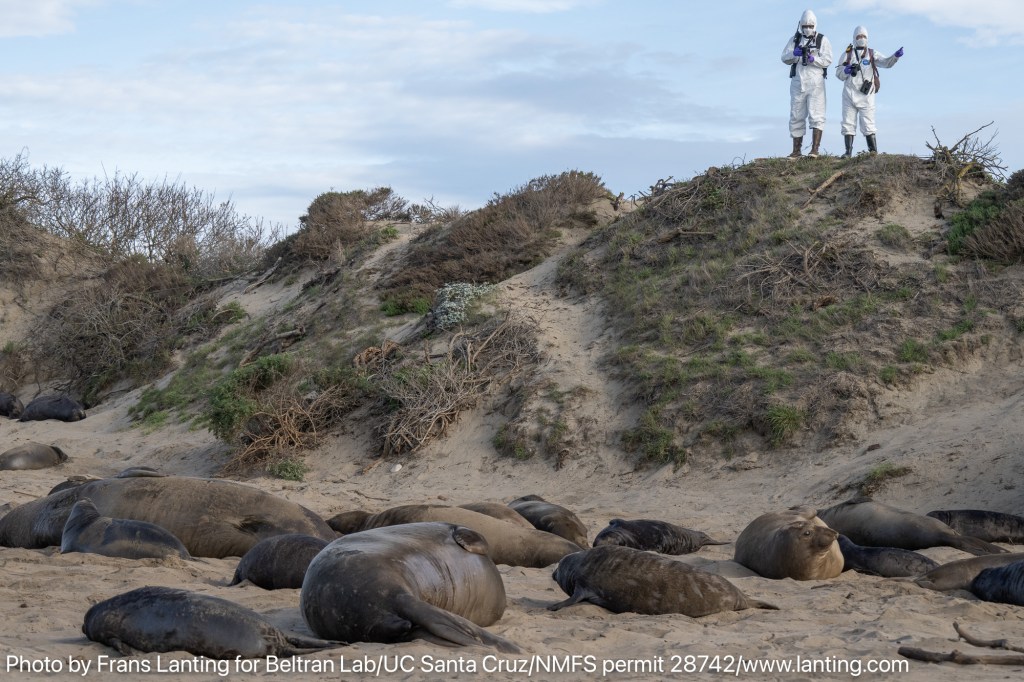
PESCADERO — Every year from late December through March, scientists from the Beltran and Costa labs at UC Santa Cruz set out for the beaches of Año Nuevo State Park. There, thousands of elephant seals gather for their annual breeding season to give birth and mate. Male bull seals battle it out over female harems, and young pups learn how to swim before returning to sea in late March. The spectacle draws visitors from across the state every year.
The massive seals, which can reach lengths of over 15 feet and weigh over 8,000 pounds, are also the subjects of a decadeslong research project by UCSC scientists. For the past 60 years, researchers have collected data on the seals, including their population dynamics, geographic distribution and feeding habits. The team spends every day during breeding season getting to know individual seals and documenting their behavior. So, when some seal pups were found dead and others began showing strange symptoms such as weakness and tremors, researchers noticed right away.
The UCSC team worked with UC Davis scientists to collect and test samples from the sick and dead pups. The results confirmed that at least seven weaned pups were infected with influenza A, subtype H5N1 — more commonly known as avian influenza or bird flu.
“Since we all care deeply about the seals, seeing this is devastating,” said Esin Ickin, a Ph.D. student in the Beltran Lab at UC Santa Cruz.

The first seven cases of avian influenza were confirmed by preliminary testing at UC Davis and confirmatory testing by the USDA National Veterinary Services Laboratory. Samples from 60 more elephant seals are currently being tested for the virus. The university has a web page that will be updated as more information becomes available.
This is the first known outbreak of bird flu in this population of northern elephant seals, and the first case of a marine mammal contracting the virus in California. But scientists from UCSC and UC Davis have been watching closely for symptoms over the past few years, ever since the virus devastated marine mammal populations in South America in 2023.
A study by a team of researchers from UC Davis, the Wildlife Conservation Society in Argentina and other partners, published in November 2024, gave insights into the outbreak in South America. Avian influenza killed over 17,000 elephant seals in Argentina, including about 97% of that year’s pups. Around the same time, hundreds of thousands of seabirds and over 30,000 sea lions in South America also died as the virus spread. The research team found genetic evidence that the virus was being transmitted between different species of marine mammals, such as elephant seals and sea lions, and occasionally between marine mammals and birds.
The current California outbreak was caught in its early stages, and it’s too early to tell whether the virus might spread to sea lions or other animals. Scientists are also unsure what kind of toll the outbreak may take on the Año Nuevo elephant seals.
The recent case study in South America is not encouraging, but there is a key difference between the Argentina outbreak and the current one in California, Ickin said. The Año Nuevo bird flu outbreak began in late February, after the breeding season had already peaked and many adult female elephant seals had already left the park. Only about 1,350 of the 5,000 seals remained on the beach by the time the virus was detected. It’s possible that the timing of the outbreak could spare California marine mammals from the same fate of their southern cousins in Argentina.

“We’re cautiously optimistic that it is going to be contained,” Ickin said.
Right now, researchers don’t have any means of intervention; all they can do is observe the situation. According to the USDA, there is no known cure for avian influenza in animals. A pared-down version of the elephant seal research team will continue to visit the colony each day to collect data for the long-term monitoring project and keep tabs on the flu outbreak. The visits are being supervised by the UCSC campus veterinarian Dr. Megan Moriarty, Ickin said, as well as public health and safety officials.
To prevent exposure, scientists wear full personal protective equipment, including body protective coveralls, splash goggles, N95 masks and gloves. UC Santa Cruz, the Center for Pandemic Insights at UC Davis, NOAA Fisheries, the California Department of Fish and Wildlife and the West Coast Marine Mammal Stranding Network are all working to oversee the outbreak and watch for symptoms in elephant seals and other marine mammals.
Año Nuevo has closed its elephant seal viewing areas, parts of its natural reserves and trails, and its popular elephant seal viewing tours for the remainder of the breeding season. The elephant seal colony is a huge draw to the park, and a beloved part of the California coast. The closures have changed the landscape of the park, said Jordan Burgess, deputy district superintendent for the Santa Cruz district of California State Parks.
“It’s a really popular tour, and it draws visitors from all over, so the park definitely looks different right now than it would on a normal day in the beginning of March,” Burgess said.

Despite the outbreak, visitors are still welcome, Burgess said. Attractions like the marine education center, horse barn movie theater and some parts of the Año Nuevo Point Trail are open.
It remains unclear whether the outbreak will affect other beaches and state parks. California State Parks is working with the team of agencies monitoring the spread of the virus. While State Parks does not yet know what will happen, Burgess said, many of the beaches near Año Nuevo have several entry points, making them difficult to close off completely. Instead, Burgess and State Parks are posting signs and working to educate visitors on the outbreak, though their response may change as the situation unfolds.
“We are working with the best available science and trying to make the most informed decision while also trying to balance recreation opportunities,” Burgess said. “Together, I think we can get through this.”
According to the U.S. Centers for Disease Control and Prevention, the current risk to public health from the avian influenza outbreak in the country is low. However, the UC Davis Institute for Pandemic Insights notes on its website, the influenza virus has a high mutation rate and has been known to cross species barriers occasionally. Current advice is for humans and pets to stay at least 150 yards away from the seals and avoid all contact with sick or dead animals, as it is possible for the virus to spread to pets and people. The public is encouraged to report sick or dead animals to the NOAA Fisheries West Coast Region Stranding Hotline at 866-767-6114.






Leave a Reply