
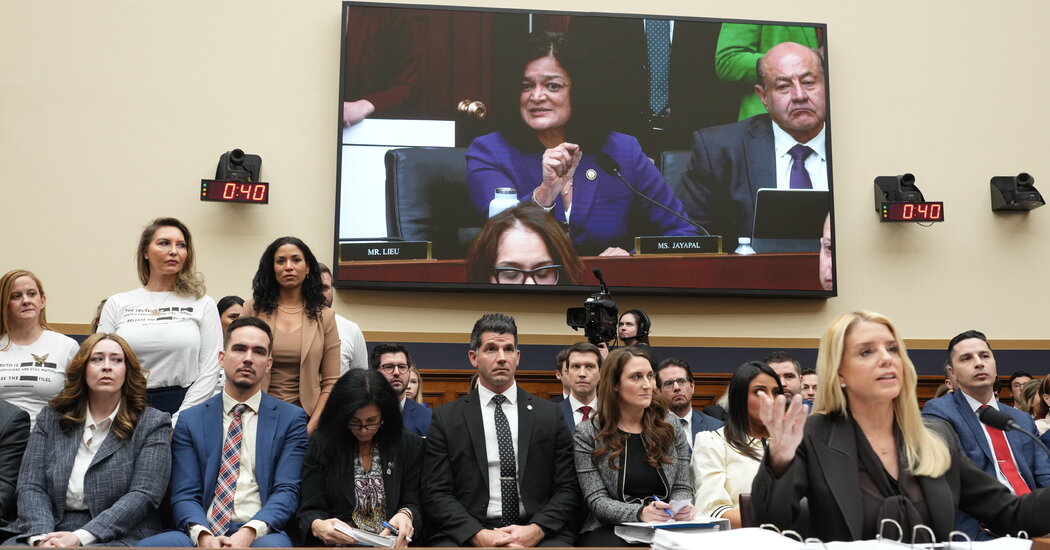
Describe the scene inside a hearing.
HIRSCHFELD DAVIS: There’s a lot going on off camera. Lawmakers usually make an effort to attend the beginning of these sessions, when they are allowed to make opening statements, and to be there when it is their turn in the queue to ask questions. But they have busy schedules and get bored when things drag on, like everyone else. So there is a lot of getting up and leaving during the proceedings. Sometimes they will go off to other meetings or to vote on the floor. Other times, they will duck into the anterooms behind the hearing room — each party has one on its side of the room — to make calls or eat a snack. Their staff typically line up behind the dais or on the sides of the room and can be seen trotting over at various points to slip the members notes or, occasionally, to point out something in their prepared questions or remarks. By the end of the hearing, attendance is usually pretty sparse.
How does this work for the reporters and photographers?
HIRSCHFELD DAVIS: I consider it very important for a reporter to be in the room, watching the body language, the exchanges or sidebars that happen away from where the cameras may be pointed, and in position to be able to get up and follow a lawmaker or witness out of the room to follow up on something.
Public hearings on Capitol Hill are accessible to the press, and reporters are allowed to have their laptops and cellphones with them. For bigger, more high-profile hearings, I will sometimes team reporters together so there is somebody in the room and someone watching on a livestream. That way, they can tag-team the writing and listening, which can be difficult to do all at once.
Pam Bondi and committee members spent a lot of time sparring. What goes into reporting that?
HIRSCHFELD DAVIS: It’s really about providing context to what is being said. It’s not about taking sides. But as subject-matter experts, it’s important for us to give readers the insight, for instance, that it is unusual for an attorney general of the United States to hurl insults at duly elected members of Congress. Likewise, we have to explain to people why she is accusing Democrats of being responsible for the crimes of undocumented immigrants, groundless as that was. And it’s equally important to break down their criticism of her for her handling of the Epstein files.
If we find ourselves just sending live updates that amount to “he said, she said,” we are really failing our readers. But if we can use some of these exchanges to help people understand what the underlying issues are, then we are doing them a service.




Leave a Reply