
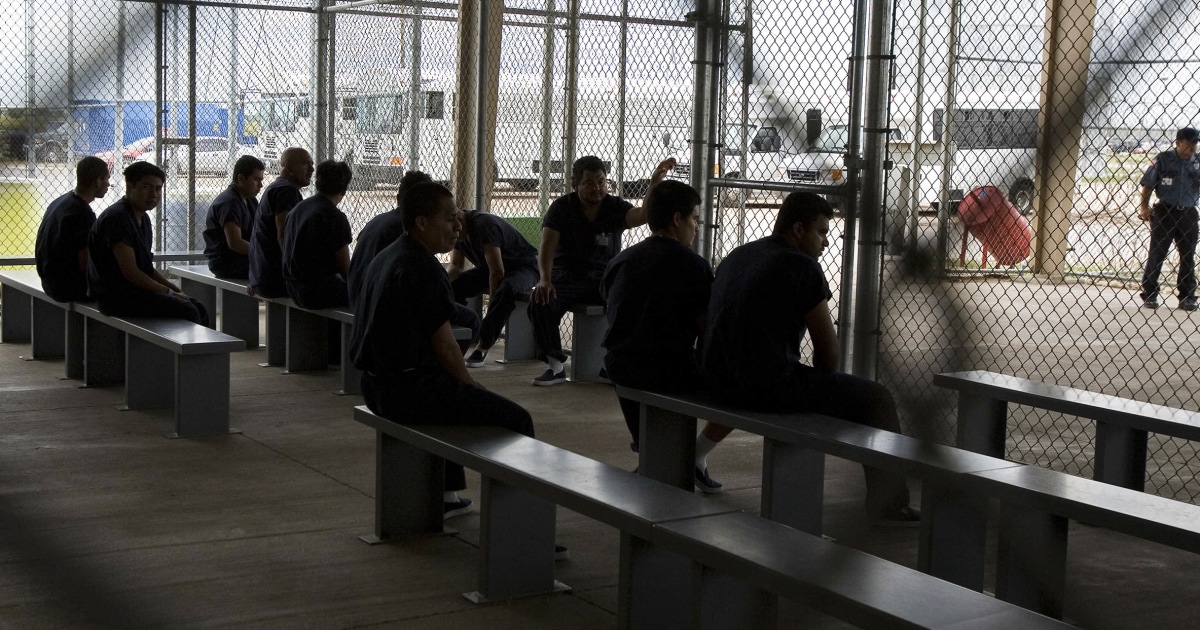
Physicians said Thursday that new research on deaths in ICE custody showed that “systemic weakness” in medical care at the agency has become more serious in the past two decades. Meanwhile, the number of people in immigration detention has soared and conditions have worsened during the Trump administration, with the death rate during part of this fiscal year reaching a 22-year high based on information starting in 2004.
Subscribe to read this story ad-free
Get unlimited access to ad-free articles and exclusive content.

The research, published Thursday in the medical journal JAMA, looked at the mortality rate of detainees in ICE custody from fiscal year 2004 through Jan. 19 this year. The fiscal year begins on Oct. 1 of each year and ends on Sept. 30 of the following year.
The authors found a total of 18 deaths from last October through Jan. 19, an annualized death rate of 88.9 people per 100,000 using the average daily population in custody for that fiscal year. Ten more people have died in ICE custody this year since then.
The researchers found that after a high of an annualized death rate of 127.7 people per 100,000 using the average daily population in custody for fiscal year 2004, the rates of deaths in ICE custody decreased until 2020, when there was a spike during the first year of the Covid pandemic. The death rate dropped sharply again after that before it climbed increasingly since fiscal year 2024.
As immigrant deaths in custody rise, ICE has scaled back the information it releases to the public about how those deaths happened from about three pages of details to summaries about four paragraphs long.
The Department of Homeland Security did not immediately respond to a request for comment about the research. In a previous statement to NBC News, DHS said the death rates were a very small percentage of the overall detained population.
“All detainees are provided with proper meals, water, medical treatment, and have opportunities to communicate with their family members and lawyers. In fact, ICE has higher detention standards than most U.S. prisons that hold actual U.S. citizens,” it said.

FORSUBSCRIBERS

Why complaints from some DHS contractors raised red flags
03:33
The report authors said the information about ICE detainee deaths it used were obtained through a Freedom of Information Act release for fiscal years 2004 through 2017, through ICE’s Detainee Death Reporting page on its website for fiscal years 2018 through 2025 and through ICE’s death reporting postings and announcements for the part of fiscal year 2026 included in the findings.
Physicians Michele Heisler and Katherine R. Peeler wrote in an editorial accompanying the research that the findings “suggest not isolated lapses but systemic weaknesses in medical care, mental health protection, and mortality review in a population wholly dependent on the state.” Heisler is the medical director at the non-profit Physicians for Human Rights and a professor of internal medicine and public health at the University of Michigan. Peeler is a medical advisor at Physicians for Human Rights and an assistant professor of pediatrics at Harvard Medical School.
They wrote that the death rate for fiscal year 2026 “was the highest in the 22-year study period, exceeding even the COVID-19 era spike.”
They said the most recent spike in deaths took place in a system with “longstanding failures” that were then compounded by Trump administration policies “that rapidly expanded detention to historically high levels, weakened oversight mechanisms, and worsened conditions of confinement.”
“These developments do not establish causation, but they make it difficult to view the recent increase in deaths as an isolated clinical phenomenon rather than a warning signal from a detention system placed under extraordinary and deliberate strain,” they wrote in the editorial.
More on immigration detention deaths
Heisler and Peeler wrote that during the second Trump administration, ICE has been detaining a “far broader population” as the southern border is largely closed and immigration authorities target people already living in the country, including “long-term U.S. residents who may have complex medical histories and untreated chronic conditions.”
“These individuals may be less likely to have undergone recent health screening and more likely to present with conditions that deteriorate rapidly without continuity of care,” they wrote.
Peeler told NBC News she was struck by how the research showed how the death rate had “skyrocketed in the last year and a half.”
“It’s very concerning that there’s this rising number of deaths,” she said, adding “and we’re only in mid-April of this year unfortunately.”
In its announcement of the most recent death in its custody, that of Alejandro Cabrera Clemente, 49, a Mexican national, ICE said it was “committed to ensuring that all those in custody reside in safe, secure and humane environments.”
“Comprehensive medical care is provided from the moment individuals arrive and throughout the entirety of their stay,” it said. “All people in ICE custody receive medical, dental and mental health intake screenings within 12 hours of arriving at each detention facility; a full health assessment within 14 days of entering ICE custody or arrival at a facility; access to medical appointments; and 24-hour emergency care.”
The JAMA report found that from fiscal year 2024 through Jan. 19, the median age of the people who died was 45 and that more than 90% were male. The detainee population overall skews male.
Heisler and Peeler wrote in the editorial that the median age of the people who died underscored “the prematurity of many deaths in custody.”
They said cardiovascular disease accounted for about one-fifth of the deaths during the time covered by the research, which they said pointed to “longstanding deficiencies in chronic disease monitoring and timely escalation of care.”
They also raised concerns that the research showed that only about 13% of deaths occurred in hospitals or medical facilities, “suggesting that some detained individuals with life-threatening illness may not have reached a higher level of care in time.”
Heisler and Peeler said the finding that nearly 49% of all deaths were listed as “undetermined or unclassified” showed an accountability issue that could obscure preventable causes of death and impede learning from the deaths to prevent similar ones.
Heisler and Peeler called on Congress to restore and fully staff Department of Homeland Security oversight offices that the second Trump administration moved to substantially cut back and close, such as the Office for Civil Rights and Civil Liberties, the Office of the Immigration Detention Ombudsman and the Office of the Citizenship and Immigration Services Ombudsman.
The result of the Trump administration’s breakdown of agency oversight was “a detention system that is simultaneously larger, more crowded, less medically supported, and less subject to external scrutiny than at any point in recent history — conditions likely to increase mortality risk,” they wrote.












Leave a Reply