
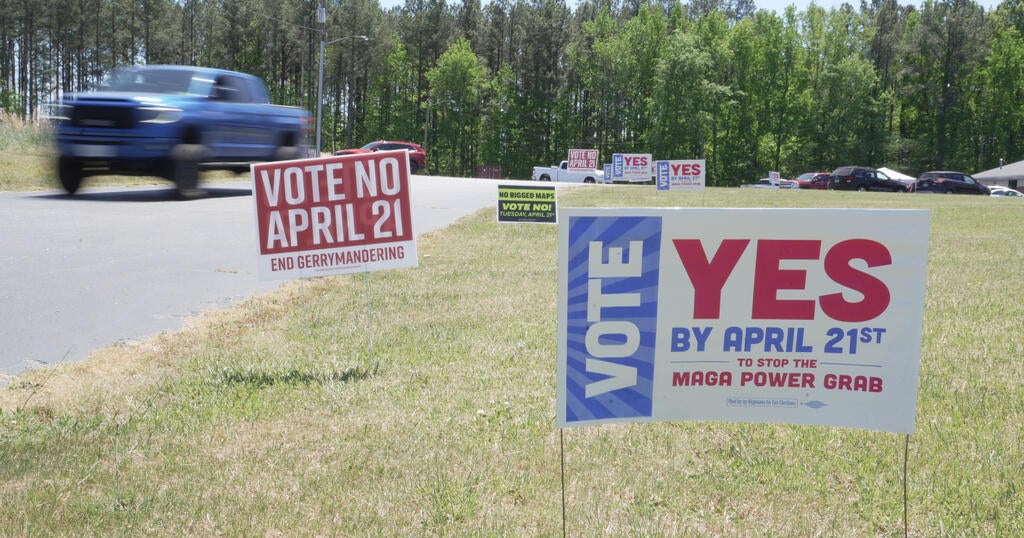
A state court judge on Wednesday blocked Virginia from moving forward with a redistricting effort that passed in a referendum a day earlier, a roadblock in Democrats’ efforts to redraw the state’s congressional maps and tilt as many as four House districts away from the GOP.
The order from Judge Jack Hurley of Tazewell County Circuit Court declares all votes for and against Tuesday’s referendum “ineffective,” and bars state officials from certifying the results or taking any actions to put the new maps passed by state lawmakers into effect.
In a brief order, Hurley found that the referendum violated several clauses of the state constitution, arguing it skirted a 90-day public notice requirement and calling the question that was presented to voters “flagrantly misleading.”
Virginia Attorney General Jay Jones, a Democrat, said he will immediately appeal the ruling.
“Virginia voters have spoken, and an activist judge should not have veto power over the People’s vote,” Jones wrote in a statement on X. “We look forward to defending the outcome of last night’s election in court.”
The Republican National Committee, one of several GOP groups that sued over the referendum, called the ruling “a major victory for Virginians.”
“Democrats attempted to force an unconstitutional scheme to tilt congressional maps in their favor, but the court recognized it for what it is — a blatant power grab,” RNC Chair Joe Gruters said in a statement.
The ballot measure, which voters approved by a 3-point margin on Tuesday, sought to amend Virginia’s constitution so that lawmakers could redraw the state’s House map, overriding a 2020 amendment that created a bipartisan commission to handle redistricting. The state’s Democratic-controlled General Assembly passed a new map earlier this year. Virginia will return to its old redistricting system after the 2030 election.
Hurley previously ruled in January that the constitutional amendment was illegal when it was passed by the state General Assembly. The state Supreme Court ruled that this week’s vote could move forward, but did not rule on the underlying legal issues.
The new maps would make 10 of Virginia’s 11 House seats Democratic-leaning, largely by dividing up the deep-blue D.C. suburbs in Northern Virginia into several districts. The state’s House delegation is currently made up of six Democrats and five Republicans.
CBS News 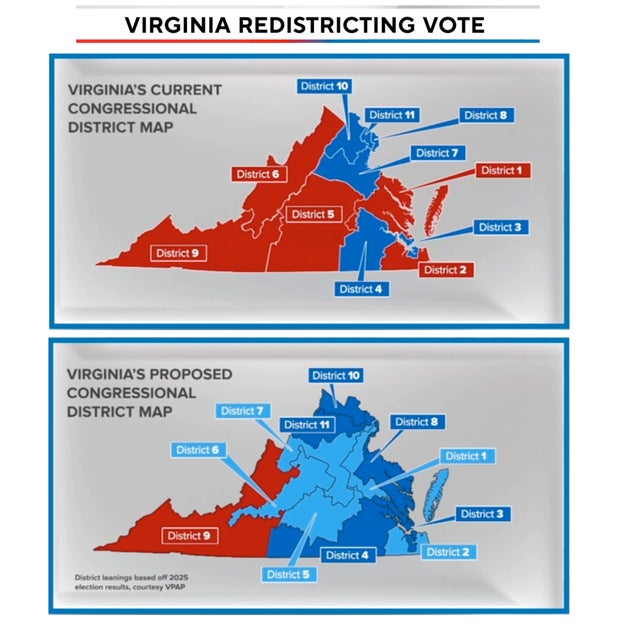
The referendum was part of a nationwide redistricting battle ahead of this year’s midterm elections.
Last year, Texas Republicans tilted five Democratic districts toward the GOP following pressure from President Trump, and California voters responded by approving a ballot measure to move five GOP-held districts toward Democrats, a campaign that was spearheaded by Gov. Gavin Newsom. Republican state lawmakers in Missouri and North Carolina also shifted one House district apiece toward their column.
All of the state-by-state redistricting efforts have drawn legal challenges, but none have succeeded so far. The U.S. Supreme Court declined to overturn Texas’ and California’s new maps.
Virginia Democrats cast this week’s referendum as a way to counter GOP states’ Trump-endorsed redistricting scramble. The effort drew support from former President Barack Obama and his Attorney General, Eric Holder, as well as Virginia Gov. Abigail Spanberger, whose 15-point win last November fueled Democrats’ optimism about the redistricting referendum.
Republicans strongly opposed the referendum, raising questions about its constitutionality and arguing it would weaken representation for GOP voters in the state’s more conservative southern and western regions. Some opponents also argue it undermines the state’s bipartisan redistricting process, which was designed to stop partisan gerrymandering.




Leave a Reply