
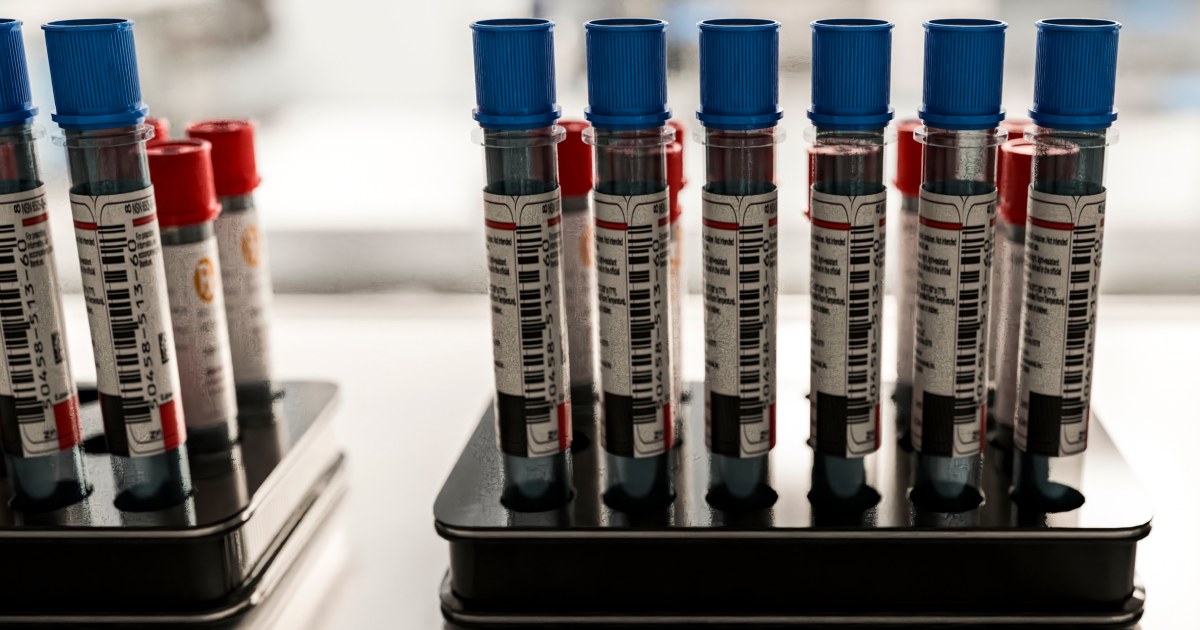
The idea is straightforward: Take a blood test now, even without symptoms, and learn if you could some day develop Alzheimer’s disease.
Subscribe to read this story ad-free
Get unlimited access to ad-free articles and exclusive content.

Whether you should get this test is a more complicated matter.
Most Alzheimer’s blood tests work by measuring levels of amyloid or tau, proteins that build up in the brain and are thought to play key roles in the disease. Both can begin gathering in the brain decades before any symptoms appear.
But it’s still an ongoing debate how well the tests can predict who will go on to develop Alzheimer’s disease, doctors say. Some people who test positive never do, fueling suspicion about how reliable the results are in the first place.
Even if the tests can accurately predict risk, they raise a bigger question: what should patients do with the information? There is no cure for Alzheimer’s disease, which affects about 7 million people in the U.S., according to the Mayo Clinic. The two drugs approved by the Food and Drug Administration — Leqembi and Kisunla — aim to slow, not cure, the disease. There’s mixed evidence for how well they work, and they come with potentially serious side effects, including brain swelling and bleeding. Diet and exercise may help reduce the risk of Alzheimer’s, but their effects are limited.
“The whole idea of doing a test to provide an early diagnosis of any disease is that if we act early, we get better results,” said Dr. Alberto Espay, a neurologist at the University of Cincinnati College of Medicine. “But there is zero evidence to demonstrate that people who are at the earliest stages [of Alzheimer’s disease] would benefit from anything we have.”
That tension is reflected in a survey published earlier this month in the journal Alzheimer’s & Dementia, which found that 85% of patients said they would take a blood test to assess their Alzheimer’s risk if their doctor recommended it.
The survey included responses from nearly 600 adults with an average age of 62 at primary care clinics in the Chicago area. About half reported having a family history of Alzheimer’s disease, though none had been diagnosed. Most had never heard of the tests before taking the survey.
The survey’s lead author, Andrea Russell, said the findings reflect the anxiety she sees in her older patients.
“A lot of people seem to want to understand what’s happening to them,” said Russell, a clinical and primary care psychologist at Northwestern University Feinberg School of Medicine. The survey also found that nearly 3 in 4 respondents said they would expect to feel distressed after a positive result, even as most said they would likely take steps to improve their brain health.
As a psychologist, Russell does not order the tests for her patients. She said she has questions about the tests’ validity.
“There’s still a lot to be ironed out. They’re still not ready for prime time,” Russell said. “There is definitely skepticism.”
The FDA has cleared two blood tests for Alzheimer’s, both in the last year, for people 55 and older. They’re approved for people who are already showing symptoms of the disease, not for those without symptoms. The tests don’t diagnose Alzheimer’s on their own and are used alongside other tests, like a PET scan. The FDA noted in one of its approvals that the main risk of the tests is inaccurate results — including false positives and false negatives — which “could lead to an inappropriate diagnosis of, and unnecessary treatment for, Alzheimer’s disease.”
Despite the current limitations, there are at least 25 commercially available blood tests worldwide, and there are more in development, according to the Alzheimer’s Association, a proponent of testing.
The approval of blood tests isn’t only important for earlier diagnosis, but for ensuring that patients have easy access to a diagnosis, according to Rebecca Edelmayer, the Alzheimer’s Association vice president of scientific engagement. The tests, she said, are simple to administer, relatively inexpensive and more convenient than PET scans or MRI.
“There is strong public sentiment in support of early Alzheimer’s diagnosis and treatment,” Edelmeyer said in an emailed statement. “People want to know if they have Alzheimer’s or another disease that causes dementia, and they want to know before it impacts their daily life.”
Dr. Ronald Petersen, a neurologist at the Mayo Clinic in Rochester, Minnesota, said the tests have improved “dramatically” in recent years, though more work is needed.
Petersen said the blood tests are generally used in three ways.
The first is prediction, estimating the likelihood that someone has amyloid in the brain, which is then typically confirmed by a PET scan. That’s how the tests have been used in clinical trials, he said, as a screening tool to identify which patients should go on to more expensive imaging.
The second is tracking treatment. In theory, doctors could use blood tests over time to see whether amyloid levels or other changes after a patient starts on an Alzheimer’s drug.
The third is diagnosis: whether a blood test alone can confirm Alzheimer’s disease by detecting amyloid or other markers of the disease in the brain.
“I think the jury is still out on that,” Petersen said. “Some people will take that and will say, ‘OK, good enough for me.’ But I think there’s been enough inconsistencies, discordances, mismatches between blood tests, spinal fluid and PET scans, in both directions, to make most people in the field still skeptical about using a blood test alone.”
A 2024 study found blood tests correctly identified whether patients with memory problems had Alzheimer’s about 90% of the time, though experts noted it was conducted in Sweden and would need to be confirmed with studies in the U.S., where the population is more diverse. Last December, the Mayo Clinic presented data on one of the FDA-approved Alzheimer’s blood tests — from Fujirebio — finding it may be overly sensitive and more likely to flag patients as positive than other methods.
Espay, of the University of Cincinnati, said another important consideration is that amyloid and another biomarker, tau, are also present in the brains of some older adults who may never go on to develop the disease.
It may not be “telling you have a disease,” he said. “Pathology is what we are all developing as we age, but very few of us will die with the disease we’ve attributed the pathology to cause.”
Petersen said he’s hopeful that the tests will one day evolve and could one day be used as a lone tool for diagnosis, although the field isn’t there yet.
Russell said patients desperately want to know whether the symptoms they’re experiencing are a normal part of aging or something more.
“It could make a meaningful difference and help people feel like they have hope and control,” Russell said.











Leave a Reply