
A few months ago, a measles outbreak seemed poised to overwhelm the northern region of South Carolina.
More than 100 infections were being reported every week, with the total eventually surpassing that of last year’s record-setting outbreak in Texas.
However, after six months and nearly 1,000 cases, the outbreak took a dramatic turn in the right direction.
Over the weekend, the South Carolina Department of Public Health said no new cases had been confirmed for 42 days, leading to an announcement on Monday that the outbreak is officially over.
Public health experts told ABC News that the combination of a strong vaccination push, people following isolation and quarantine orders and an awareness campaign helped beat back the disease.
“Measles vaccinations [were] the most effective single containment tool,” Dr. James Harber, an internal medicine physician with Spartanburg Regional Medical Center, told ABC News. “And then to identify the index cases and their exposures and enforcing quarantine, and there’s that integrated public health and private sector collaboration. Those are the keys.”

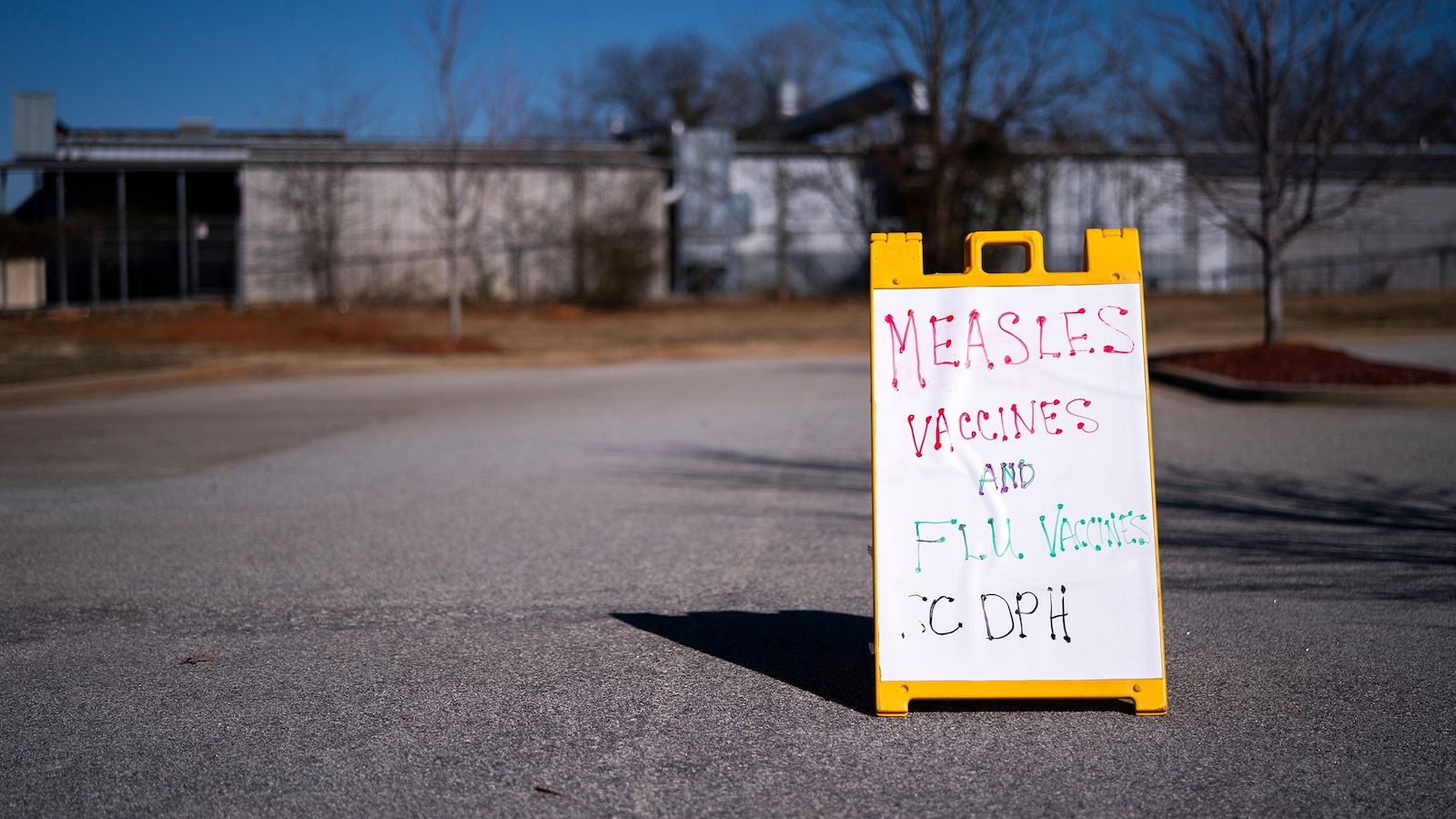
A sign outside a mobile clinic offering measles and flu vaccinations on February 6, 2026 in Spartanburg, South Carolina.
Sean Rayford/Getty Images
Vaccination push
The Centers for Disease Control and Prevention (CDC) currently recommends people receive two doses of the measles, mumps, rubella (MMR) vaccine — the first at ages 12 to 15 months and the second between 4 and 6 years old.
One dose is 93% effective, and two doses are 97% effective against measles, according to the CDC.
In Spartanburg County — the epicenter of the outbreak in northwestern South Carolina — 88.9% of students had the required immunizations needed to attend school, among the lowest in the state, according to state health department data.
This is lower than the 95% threshold needed to achieve herd immunity.
In the wider Upstate region of South Carolina, some pockets have much lower vaccination rates. State data shows that, for the 2025-2026 school year, one elementary and middle school only had 17% of students with the required immunizations.
Of the 997 cases during the outbreak, 932 were among unvaccinated individuals who were mostly under the age of 17, state data shows. Experts told ABC News that a vaccination campaign helped play a big role in reigning in cases.
“We believe vaccination is one of the primary reasons this outbreak came to an end,” Dr. Brannon Traxler, deputy director of health promotion and services and chief medical officer at the state health department, told ABC News. “Thousands of people got vaccinated. An additional 3,788 doses of MMR were administered in Spartanburg County during the six months of the outbreak compared to the previous year.”
Traxler said that 15,000 additional doses were administered in the Upstate counties over this period competed to the year prior.
She added that January and February were record months for MMR vaccination in the state.

A box containing vaccinations for measles, mumps and rubella sits on a cooler at a mobile clinic on February 6, 2026 in Spartanburg, South Carolina.
Sean Rayford/Getty Images
The health department does not track vaccine exemptions at the individual level, but Spartanburg Regional Medical Center’s Harber believes some vaccine-hesitant parents were encouraged to vaccinate their children — even those with previous exemptions on file — as the outbreak grew and their kids were exposed to the virus.
“I think the numbers … speak to the idea that that definitely happened,” he said. “Parents and/or young people who have historically requested and been granted exemptions and not been vaccinated saw what was happening within the community and then changed their minds.”
People following isolation, quarantine orders
South Carolina health authorities first confirmed the outbreak on Oct. 2, 2025, after eight cases were recorded in the Upstate region.
Most cases were recorded in Spartanburg County, with some confirmed in neighboring Anderson, Cherokee, Greenville and Pickens counties.
Only two other counties that didn’t border the epicenter saw measles cases: Lancaster County in the north central area and Sumter County in the central area.
Harber said that people generally followed health officials’ orders about quarantine and isolation, which helped keep the outbreak under control
“I think that’s probably the second most important part, the very aggressive quarantine and exposure control when index cases were identified,” he said. “They were very quickly provided with information around isolation and what they needed to do — staying away from others and to help prevent that spread.”
Harber said more than 2,000 quarantine orders were issued and almost 900 students stayed home when they tested positive across 33 schools in the Upstate region.
“That rapid identification and isolation of the suspected cases .. once they were confirmed really helped to prevent that secondary spread that is such a big problem because of how contagious [measles] really is,” he said. “So, we really had great compliance especially within families and that really helped shorten transmission window based on all the data we have.”
Awareness campaigns
Traxler said the state health department conducted wide-range outreach in Spartanburg County and surrounding areas to “educate the public about the facts regarding measles and the outbreak as well as to encourage people to consider being vaccinated to get long-term protection against the virus.”
She noted that the department communicated with schools, churches, community-based organizations, community leaders, local health care professionals and other organizations.
A box containing vaccinations for measles, mumps and rubella sits on a cooler at a mobile clinic on February 6, 2026 in Spartanburg, South Carolina.
Sean Rayford/Getty Images
Traxler added that the health department offered vaccinations at mobile health units at libraries, churches and other locations, where workers also distributed educational materials.
Ukrainian and Russian-speaking communities in South Carolina were hard hit by measles during the outbreak, and so the health department translated measles fact sheets and vaccine information into Ukrainian and Russian, as well as Spanish, Traxler said.
However, just because the outbreak is over doesn’t mean the work is done, she added.
Other states are continuing to see measles cases and the U.S. is currently at risk of losing its elimination status, which it earned in 2000. Measles would once again be considered endemic or constantly circulating.
“The outbreak is over, but our work to understand and prevent measles is not. Large outbreaks of measles, and other infectious diseases, can be prevented entirely when vaccine coverage in the population is very high,” Traxler said.







Leave a Reply