
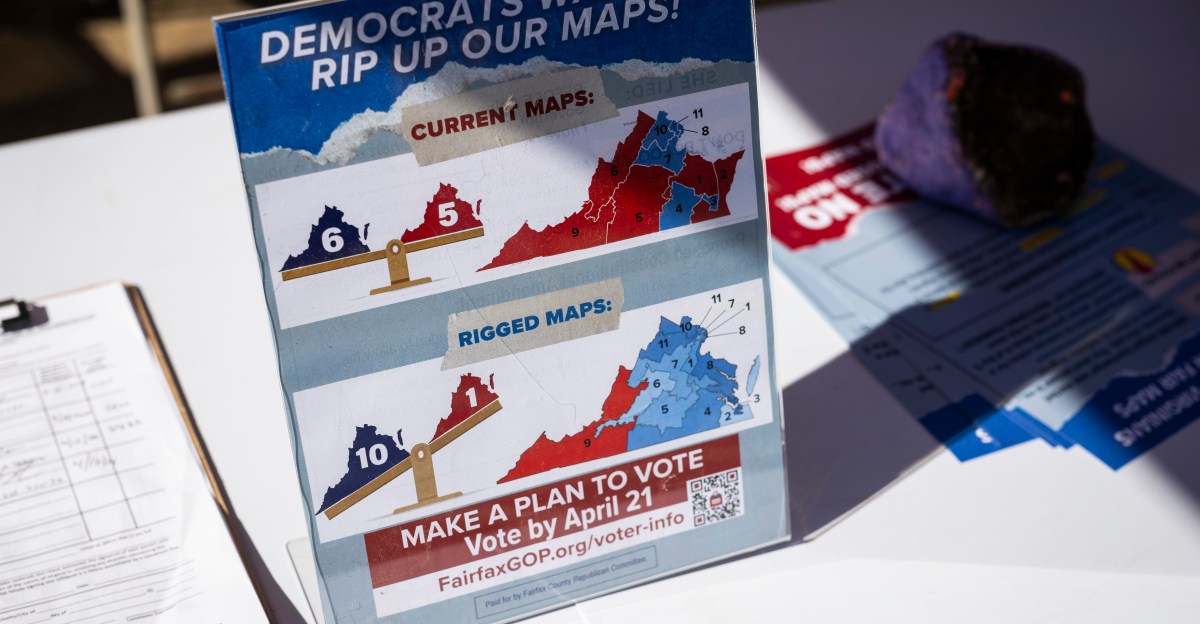
By a 4-3 vote, the Virginia Supreme Court just struck down that state’s recently enacted congressional maps, which were intended to give Democrats four additional seats in the state’s congressional election after the upcoming midterms. The state enacted these new maps to cancel out Republican gerrymanders in Texas and other red states.
Both the majority opinion and the dissent in Scott v. McDougle hyperfixate on the meaning of the word “election” in the Virginia state constitution, and neither opinion is particularly persuasive. Both sides are able to cite a raft of dictionaries, historical sources, past precedents, and other sources that support their preferred definition of this word.
Textualism, in other words, contributes very little to the dispute in Scott. Both the majority and the dissent are able to identify more than enough textual evidence to make a plausible argument.
Rather than producing two eye-glazing opinions fighting over the meaning of a word whose definition appears to shift depending on both linguistic and historical context, the justices would have produced a better opinion if they had asked a more basic question: What is the relevant provision of the Virginia Constitution actually supposed to accomplish?
The case is about whether early voting nullifies Virginia’s power to amend its constitution
Scott turns on the provision of the Virginia Constitution that governs the state’s constitutional amendments. Briefly, in order to amend the constitution, the state legislature must vote to propose an amendment. Then, “after the next general election of members of the House of Delegates” is held, the legislature must again vote to approve the same amendment.
After that amendment is approved twice, by two subsequent legislatures, it is then submitted to the voters for their approval. If a majority of the voters approve of the amendment, it becomes part of the state constitution.
In 2020, the state used this process to amend its constitution to impose anti-gerrymandering safeguards. Scott involved a more recent amendment, the one Virginia voters approved earlier this year that temporarily bypassed that 2020 amendment. That vote allowed the state to redraw its maps — counterbalancing Republican gerrymanders in other states.
The majority of the state Supreme Court, however, claims that the more recent amendment is invalid because, when the state legislature first proposed this amendment in October 2025, it did so after early voting had already begun in the state. This is a problem, they claim, because it means that “1.3 million or so Virginians” had already cast their ballots before the amendment was proposed, and thus they were denied their opportunity to express support or disapproval of the proposed amendment when they cast their vote for state lawmakers.
In essence, the majority argues that Virginia voters who opposed the amendment were disenfranchised because they were denied an opportunity to vote for lawmakers who oppose it in the 2025 state legislative elections.
But there’s a pretty glaring problem with this disenfranchisement argument: The amendment was submitted to the voters in a referendum. Virginia voters were, in fact, given an opportunity to cast an up or down vote on the redistricting amendment. And a majority of them voted to approve it.
If Virginia’s constitution called for a simpler amendments process, where two subsequent votes of the state legislature were alone sufficient to amend the constitution, then the majority’s argument would make more sense. In that case, the election held between those two legislature votes would be state voters’ only opportunity to weigh in on the amendment.
But under Virginia’s actual constitution, voters are given a direct opportunity to vote on a constitutional amendment. So it makes no sense to say that they were denied an opportunity to express their view on the amendment by the timing of a legislative vote.
A poorly reasoned decision is still law
In any event, the fact that I — or anyone else, for that matter — finds this decision unpersuasive doesn’t really matter. The Virginia Supreme Court is the highest Court in the state, and is thus the final word on any question of state constitutional law.
The result means that, most likely, those four new Democratic seats this November will go back to being Republican seats. Meanwhile, the Republican gerrymanders in Texas and other states stand.
If Democrats can identify a federal constitutional problem with the state supreme court’s decision, then they could conceivably challenge the state court’s decision in federal court. But it is unclear what that violation might be. And, even if Democrats can find a violation, federal court cases may be appealed to a Republican US Supreme Court. So the likelihood the federal judiciary will bail out Democrats here is slim to none.




Leave a Reply