
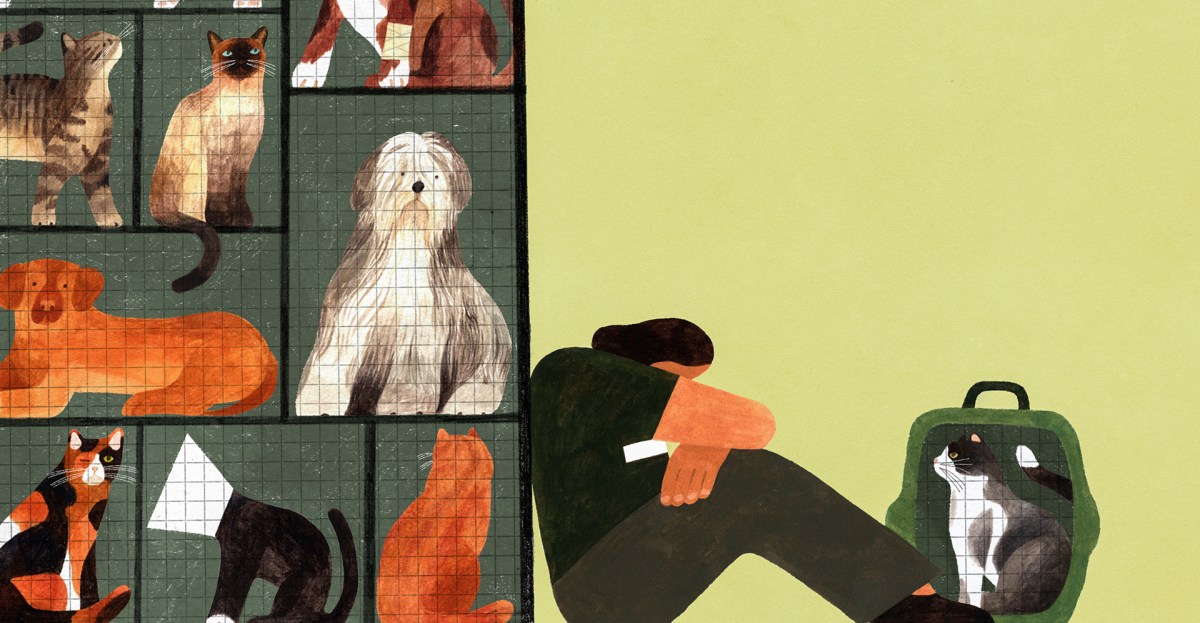
For nearly a decade, Lauren served as the animal control manager for a county in North Georgia. It was a round-the-clock, always-on kind of job, in which she and her employees responded to animal cruelty and neglect cases, dog attacks, and animal escapes.
Saving animals was, and still is, Lauren’s passion in life. But some weeks, the cruelty and the stress of the job got to be too much. It came to a head in early 2024 when she showed up to a man’s house and found 27 hound dogs outside exposed to the freezing cold.
- I’ve written a lot about the problems with pet ownership in America: animal cruelty and neglect, puppy mills, inadequate veterinary care, animal boredom, prolonged captivity, and more. But one thing I hadn’t explored was the toll that America’s pet overpopulation crisis has on its frontline human workers: animal shelter staff.
- They experience frequent trauma through their work responding to animal cruelty and neglect cases, performing euthanasia, and other countless stressors. To understand the issue, I pored through research dating back to the 1980s and spoke with many people who’ve worked in the field.
- I was floored when I heard their stories. And given how large of a role pets play in the US, I was surprised at how little attention the issue has received so far.
“It was one of the coldest nights, unseasonably, for the state of Georgia,” Lauren told me, and “these dogs are out there with no shelter.” The man was breeding the hounds to be used as hunting dogs, and her department had already told him to get them shelter, but he hadn’t complied. That left Lauren and her colleagues with two choices: let the dogs freeze to death or bring them into the county animal shelter, where they’d remain indefinitely during a cruelty investigation and court proceedings. They took the dogs.
But the shelter was already full, so she and her colleagues had to make a tough call; they euthanized dozens of animals there that day in order to make space for the 27 hounds.
“The shelter worker’s the one that’s got to stand over that body and decide, ‘Is today that animal’s day?’” Lauren said.
“And, I’m sorry, but some of that never leaves you; you carry it the rest of your life,” she said. (Lauren is a pseudonym. She requested anonymity to speak openly on sensitive issues because she’s still involved in Georgia’s animal welfare community.)
Just days later, she responded to a situation in which two dogs had attacked people and were then shot by the police — one dog died, while the other was rushed to a veterinarian’s office. Around this time, the county shelter was also dealing with a severe disease outbreak, and one of her employees got injured while trying to catch a loose animal.
“How am I supposed to mentally and emotionally deal with all of that at one time?” she told me. Lauren quit a few months later, she said, because the compassion fatigue — the deep emotional and physical exhaustion that can result from intense caregiving — had become too much to handle.
This wasn’t Lauren’s first bout of compassion fatigue. She had worked at an animal shelter in the 1990s where, two to three times a week, she’d have to go into a room and euthanize dogs for hours at a time.


Animal control and shelter workers, who often work hand-in-hand and share many of the same burdens, “get the trauma heaped on them daily that lasts most people a lifetime, and nobody inside or outside talks about it — it’s the dirty secret of [animal] sheltering,” Lauren told me.
Across the US, animal control officers and shelter staff are overworked and underpaid. Turnover is incredibly high, as many of them become burnt out from bearing the immense emotional and physical burden of the job. Collectively, these workers euthanize an average of over 1,600 dogs and cats each day, while responding to countless cruelty and neglect cases; rounding up millions of strays; routinely putting themselves in harm’s way; and dealing with indifferent, difficult, and even hostile pet owners.
They are the frontline workers of America’s long-running and ever-evolving pet overpopulation crisis, currently fueled by a decline in spay and neuter rates, the rising costs of veterinary care, and a chronic lack of government funding.

Then, there are the American consumers, many of whom prefer to buy dogs and cats from breeders, even as millions of animals in need of a good home languish in shelters, where they will be euthanized if they’re not quickly adopted. Last year in the US, almost 6 million pets went to animal shelters. Ten percent were euthanized.
“We live in a throwaway society, be it the animals or their TV,” Lauren told me. “People throw stuff away all the time, and somebody’s got to be there to clean it up.”
“You will not forget the dog’s name”
Animal sheltering, for all its challenges, has come a long way. To see how, just read this New York Times story from 1877, which describes how the city pound euthanized stray dogs by loading dozens at a time into an iron crate and lowering it into the East River for 10 minutes to drown them.
At the time, large numbers of stray and semi-domestic animals roamed city streets and were generally considered a nuisance for barking, fighting, defecating, rooting through garbage, and biting people. But, in time, the pet overpopulation problem morphed from one of too many stray animals to too many pets.
By the 1940s, the role of cats and dogs had largely shifted from “working” animals to companions, and advances in veterinary medicine, the growth of the suburbs, and the emergence of large-scale dog breeding operations led to the nation’s pet population doubling in the decade after World War II. But with a boom in the nation’s pet population inevitably came a boom in unwanted pets.
According to one estimate, animal shelters euthanized 13.5 million of these unwanted cats and dogs in 1973. That number had plummeted to 596,000 by 2025, even as the US pet population swelled. Researchers attribute much of this sea change in euthanasia rates to the rise of spay/neuter programs. In the 1970s, shelters and animal welfare groups worked with veterinarians to offer high-volume, low-cost spay/neuter clinics, and since the late 1990s, more than 30 US states have passed laws that require shelter pets to be spayed or neutered before adoption. The growth of animal rescue organizations that facilitate pet adoption has undoubtedly played a big role in reducing euthanasia numbers, too.
This represents enormous progress. But as the situation has improved for animals, so, too, has our understanding of how gut-wrenching this field’s work can be for the humans who do it.
The pandemic pet adoption spree that wasn’t
In 2020, stuck at home amid a global pandemic, people adopted pets in record numbers, leading to much emptier animal shelters. That narrative took hold in the news media, but as it turns out, it wasn’t true. Pet adoptions actually decreased in 2020, according to data from the nonprofit Shelter Animals Count. Many animal shelters were emptied, but that was because they took in fewer animals during the initial months of the pandemic, and many people volunteered to foster animals at home in order to temporarily get them out of shelters.
In the late 1980s, researchers began to interview animal shelter employees about the toll that euthanasia and other parts of the job takes on their well-being. In the decades since, we’ve come to learn that performing euthanasia predicts poorer mental and physical health, including higher levels of work stress; lower levels of job satisfaction; and higher rates of anxiety, depression, and substance abuse than the general public.
Some of the stress these employees feel is the result of what sociologist Arnold Arluke calls the “killing-caring” paradox, in which they routinely have to kill animals they’ve spent days, weeks, or months caring for and getting to know.
“You will not forget the dog’s name, you will not forget the animal’s face,” Caitlan Frazier, director of Aransas County Animal Care Services in Texas, told me. She recounted to me the guilt she felt for having to euthanize a litter of newborn kittens, because there was nobody to provide the round-the-clock care they needed (she certainly couldn’t with two kids and nine animals of her own at home).
She told me a story about a dog named Bougie whose bites put her in the hospital for four days. Despite what he put her through, Frazier said, “I still feel guilty with that dog, because I feel like, if I would have given him more time [for training], maybe he wouldn’t have been put down.”
But many shelter workers also expressed anger toward the people whose actions drive the pet and shelter overpopulation crisis: owners who acquire a pet when they’re not ready for the responsibility or who fail to spay/neuter or vaccinate their animals when it’s available, as well as those who casually breed dogs and cats and then dump the ones they can’t sell onto shelters.


“It’s draining, heartbreaking, and maddening, especially when the animal is young and healthy and you’re euthanizing for space,” Bailey Smith, who works at the Humane Society of Young County in North Texas, told me over email. “I still cry sometimes.” (I should note that every shelter worker I spoke with also considers euthanasia the greatest gift they can give to animals who are severely injured or diseased or are too aggressive to be adopted.)
Other problems also increase animal control and shelter workers’ stress: bearing frequent witness to animal cruelty and neglect, physical injuries inflicted by the very animals they’re caring for, and the always-on-call nature of the job.
Keane Menefee understands the strains of the job well. He joined the animal control department in Fort Worth, Texas, in 1997 and worked there until 2010, when he quit due to compassion fatigue. The euthanasia work took its toll, but so did the long hours and the horrors he saw in the field, including a girl who had been mauled to death by a dog. He told me stories of night terrors and attempted suicide.

The job puts “wear and tear on you on every level of your being,” Menefee told me. He now teaches courses for animal control officers, including one on compassion fatigue.
Another challenge of the job is dealing with members of the public who get angry at animal shelters and their employees about essential parts of their work, including euthanasia.
In 2008, The Oprah Winfrey Show aired an episode about puppy mills, and Menefee went on to talk about the high euthanasia rate at his shelter — a rate that was so substantial, in part, because of puppy mills churning out a large volume of dogs.
“I wasn’t ready for what was to happen,” Menefee told me. Within hours, he received over 3,000 emails, and virtually all of them were hateful. Some included death threats, with people going so far as to tell them they knew his home address and the school his children attended.
“I understand the sensitivity” to euthanasia, Menefee told me. “But this is not the animal control’s fault, this is not the shelter worker’s fault.” Many people, he said, just don’t understand how these industries and laws work to create the conditions that make euthanizing perfectly adoptable animals a necessary part of the job.
What animal shelter workers want you to know
When I asked people in the animal control and shelter community what’s most needed to bring down pet overpopulation and make their work sustainable, the answer, invariably, came down to money.
Animal control departments are run by city or county governments, and the vast majority of animal shelters are either government-run or -funded. And they work together to manage their region’s pet overpopulation challenges. One thing they all have in common is that they’re all operating on shoestring budgets (as are the privately run shelters, operated by nonprofits), so there’s never enough staff or space to meet the needs of the animals in their communities. But, ultimately, many of the people I spoke with say a lot of the money should go directly to providing pet owners with low-cost spay and neuter, which has been in shorter supply in recent years.
“Spay/neuter — it’s not sexy, it’s expensive, it’s constant, but it truly is the number one way to curb our [pet] overpopulation crisis,” Shelby Bobosky, who formerly served as executive director of the Texas Humane Legislation Network and now teaches animal law at Southern Methodist University, told me. “Overpopulation is a simple math problem.”

Bobosky also wants to see policymakers crack down on puppy mills, strengthen animal cruelty laws, mandate spay/neuter procedures, and restrict the sale of animals at pet stores.
Smith, of the Humane Society of Young County in North Texas, told me more pet-friendly housing and low-cost veterinary care are also critical. About one out of five animals surrendered to shelters are given up because their owner could no longer afford them or couldn’t find accommodating housing.
But Smith also wants to see more responsible, thoughtful pet ownership. “People need to think before bringing a pet home,” Smith told me. “Are they ready for the commitment?”
The costs can add up quickly: food, spay/neuter, vaccination, training, insurance, and veterinary care — not to mention time giving their animals plenty of daily exercise and attention. While a lot of pets are given up due to affordability issues, a lot are given up for less black-and-white reasons, like their owner simply had too many animals, or they didn’t want to deal with a (non-aggressive) behavioral issue.
Beyond more responsible acquisition and caretaking, the public can help by fostering animals at home and volunteering to walk shelter dogs.
“An animal starts mentally deteriorating in a shelter within three weeks of being there,” Frazier said. “If you don’t have that extra enrichment or those volunteers or people coming and doing things with these animals…those animals mentally deteriorate so fast that they can’t even be adopted anymore.”
As for the well-being of the animal control and shelter staff, many told me that just talking about the challenges of the job helps. “I’ve had compassion fatigue three times in the last eight years,” Frazier told me. And if it weren’t for talking with her peers and co-workers, she said, “I don’t know if I’d still be in this job.”
How you can help end pet overpopulation
- Foster: Fostering an animal at your home for a few days or weeks helps everyone. It gives the cat or dog time out of the shelter, ensures they’re not euthanized before someone’s ready to adopt them, and makes space for another animal. To get started, reach out to a rescue organization or shelter in your area.
- Volunteer: If you take a dog for a walk or play with a cat at your local shelter, it’ll probably be the highlight of their day. If that’s not your thing, animal shelters need help in other ways, too, like cleaning and helping at adoption events.
- Donate: Animal shelters and rescue organizations need your financial support. You can also give to a low-cost spay and neuter program in your area (which you can search online) or to Good Fix or Fix the Future.
- Adopt: If you’re looking to commit to a long-term furry friend, be sure to adopt instead of shop. Get started with PetFinder.
Of the numerous training courses Menefee offers, his one on euthanasia and compassion fatigue gets the most repeat attendees. In the course, he’s direct and open about the mental health struggles he’s endured while working in animal welfare because “it’s not said enough in this industry.” He wants people to know they’re not alone, that they’re not weak, that they can handle the job, but also that there are warning signs to watch out for and things people can do to protect themselves.
But as hard as the job is, many people I spoke with also told me how much meaning it gives their life and about the powerful bonds they have formed with others in the trenches.
“One of the things I love about this industry is just how close-knit the people who work in it are,” Menefee said. “When these individuals get together, they see that we’re all facing the same challenges and they start telling their stories and they…get some comfort in knowing ‘I’m not alone and I’m not the only one.’”
Our relationship with dogs, cats, and other animals kept as pets is often portrayed as joyful and uncomplicated: They love us unconditionally, and, in return, we promise to provide the best care we can for them. There’s some truth to that, but spend just a moment looking under the surface of this story, and you’ll find a darker side to it: millions of people making millions of choices, many of which put unlucky animals through hell and put the people tasked with caring for them into impossible situations.
We need a more honest and nuanced story to explain our relationship with pets, and we can start by listening to the ones America’s animal shelter workers have to tell.






Leave a Reply