
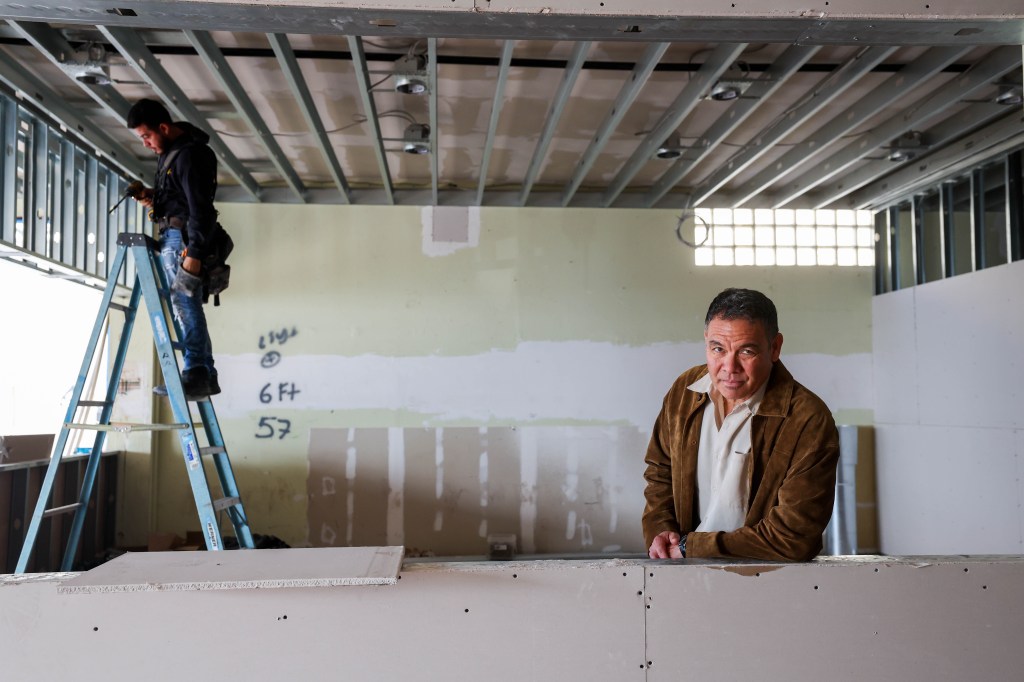

Sean McCauley was raised on a farm, where his family had an almond orchard and a chicken and egg business in Brentwood. Growing up, he understood the challenges of the agricultural world, but it also inspired him to become an entrepreneur because he “didn’t want to be poor.”
“We grew up poor. My dad was an entrepreneur and a farmer. What people don’t realize is that farmers are entrepreneurs, and they are risk takers,” said McCauley. “And it’s a very hard life. It’s a very modest life.”
Describing himself as a blue-collar entrepreneur, McCauley said he has a passion for service-related industries, calling them “recession-proof.”
“During COVID-19, people saw that those are valued and worthwhile jobs that people have to do, and that kind of galvanized service-related industry will never go away, especially with new AI stuff coming into play,” said McCauley.
Over the years, he has built businesses in commercial real estate, consulting, and venture capital, and has coached budding entrepreneurs.
We speak with McCauley, who talks about revitalizing downtown districts. His responses have been edited for brevity and clarity.
Q: You have acquired and revived a lot of places, especially in Antioch and Brentwood. How did you get into helping businesses downtown?
A: What we’re seeing in the far East (Contra Costa) County is a migration from downtown districts such as Pittsburg, Antioch, Brentwood, turning a downtown district from a business district, traditionally, maybe a retail district, in some aspects of what I call social districts … entertainment, food, drinking, nightlife. Traditional downtowns have really suffered, and these large shopping malls, like The Veranda, Santana Row … Streets of Brentwood … have really done a disservice to downtown districts.
What we’ve seen over the last 15 to 20 years is this cycle of revitalizing these downtown districts. We were at the forefront of that back in 2008, when the crisis happened, and I was able to pick up multiple properties well below cost to build. Nobody wanted these buildings. We made a conscious effort to revitalize these downtown districts into more social districts, so we were getting restaurants, bars, and nightlife entertainment into these locations on a low basis. The key for me was to get in on a low basis so we can pass those savings on to our tenants.
We get entrepreneurs into these downtown districts on a low basis. Sometimes you don’t get the A players. So we said, we have to coach these guys to understand the business, our financials, and the human capital aspect of their businesses. And as they scale, because chances are they’re going to be pretty successful, because they have a low basis in their rent and know what they’re doing. We have a very good mix of A players, B players, and C players. We consistently want to make sure we help those C players turn into B players, and B players turn into A players, and that’s kind of how it all came about.
Q: What are the obstacles to revitalizing downtown businesses? What are the challenges you faced when you first started?
A: I think back in the early 2000s, or let’s just say, 2008, 2009, and 2010, it was getting cooperation with the cities. It was important that they understood we were bringing a substantial investment to turn these places around. Unfortunately, city staff, city councils, and mayors change every two to four years. Our biggest challenge was just making sure that they understood that we needed really good partners to help us pull off what we’re trying to do.
Brentwood was our first challenge. Back in 2009 or 2010, I had picked up four or five large properties in the downtown district. People thought I was crazy, buying a 16,000-square-foot vacant building in the middle of a recession, borderline depression. Entrepreneurs have to have … some balls, you know. If you don’t take measured risks, the rewards won’t be there. And oftentimes, a lot of people who are in a bureaucracy or a municipality don’t see that vision, so it’s a lot harder to get those guys on board with what you’re trying to do.
The other challenge was just changing the paradigm of what people felt about downtown districts. Everything was migrating towards these brand-new, really sexy outdoor shopping malls, like The Veranda, Santana Row, and The Streets of Brentwood. And so, this brand-new, shiny, sexy object was superseding what people really wanted: spending their time in a downtown district. Our main goal was to bring really, really good restaurants, entertainment, bars, and nightlife to these quaint areas. They were historical, they were artisan. And that was a gamble that paid off … people loved it. They wanted to be part of this small, artisan restaurant.
The other challenges, I think, are getting the message out. Nowadays, it is all driven by digital marketing and social media, and entrepreneurs and cities really have to do a good job at it.
Q: How important are small, locally owned businesses for any downtown district to succeed?
A: It’s a known fact that people like to patronize small businesses. … The hard American entrepreneur, they love the fact that they would much rather visit a small mom-and-pop-owned shop than a large, big box retailer. And the key is to get the right mix right. Being a landlord isn’t passive income; it is a community enhancer. It’s a constant effort. And if you don’t have the right mix of people in a downtown district or a building, others suffer. You have to have the right genetics. When we build a building or a community, we need to make sure they synergize. Our main goal is to enhance a community, so everybody’s successful.
Q: How do you vet the business proposals that come to you, to see if they are beneficial for the local economy?
A: We actively look at artisan food and different things that aren’t the norm to stick into our communities. And when you have that cultural diversity, and you see an operator who’s very coachable and has a relatively high level of business acumen, we normally want to talk to them further. For us, it’s not necessarily the big chains or franchises. What are the things that people want, and what are the experiences that people are looking for nowadays? We saw that people would rather not have tangible things, they would rather have an experience. And so if we can deliver an experience to people, that’s where the money is. We check demographics. I have a whole army of people at my corporate office who just check these and underwrite things for me. We’re very responsible that way, but we are constantly looking for that new experience people haven’t had.
Q: What are the lessons you have learned in business, helping entrepreneurs over the past 30 years?
A: I think the best thing I can say about that is that effort takes the place of talent all the time. You have tons of talented people out there, but effort beats them every time. You don’t have to be the smartest or the most talented, but if you put in the effort, you can accomplish 10 times more than anyone else.
Five interesting things about Sean McCauley
McCauley has acquired, built, or rehabilitated over 57 companies and has consulted over 50 businesses. He still operates businesses in the pest control, agriculture, hospitality, property management, and automotive industry.
In far East Contra Costa County, McCauley has established or remodeled about 28 restaurants, such as Humphrey’s at the Antioch marina, which has been renamed Smith’s Landing and Guadalajara Taqueria, among others.
He is proud of his three daughters, who have an “entrepreneurial drive.” They currently run the family-owned McCauley Estate
Vineyards, a wedding and event center.
McCauley is the author of “DNA of the Young Entrepreneur.”
He is a triathlete who enjoys running.
Profile
Name: Sean McCauley
Age: 55
Residence: Brentwood, California
Position: Founder and managing principal of Sean McCauley Investments, entrepreneur, and real estate investor.
Education: Entrepreneurial background with real-world business training.

Leave a Reply