
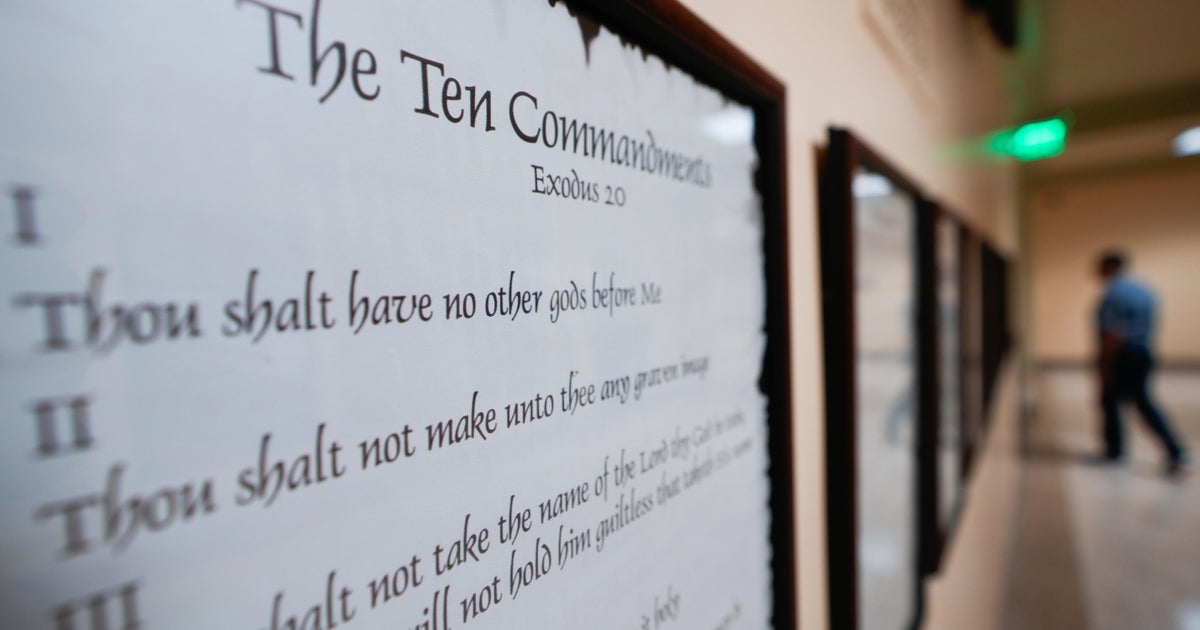
The Texas law requiring public schools to display the Ten Commandments in each classroom has been upheld by the Fifth Circuit Court of Appeals, according to an opinion released by the court on Tuesday.
In June 2025, the Texas Legislature enacted Senate Bill 10, which requires public elementary and secondary schools to display in each classroom a “durable poster or framed copy of the Ten Commandments.” The poster or copy must measure “at least 16 inches wide and 20 inches tall,” use an easily readable typeface, and be “display[ed] in a conspicuous place.”
A lawsuit filed in early December 2025 claimed that the law violates the First Amendment. The American Civil Liberties Union and religious freedom organizations filed the lawsuit in the U.S. District Court in San Antonio on behalf of 18 families with children in public school across the state. Sixteen school districts were named as defendants, including seven from North Texas.
Court says Ten Commandments displays are not “engines of coercive indoctrination”
The court found the law to be legally compliant with the First Amendment, meaning it does not improperly establish or endorse a religion nor does it prevent individuals from practicing their faith.
In its opinion, the court said in part:
“S.B. 10 … does not tell churches or synagogues or mosques what to believe or how to worship or whom to employ as priests, rabbis, or imams. It punishes no one who rejects the Ten Commandments, no matter the reason. It levies no taxes to support any clergy. It does not co-opt churches to perform civic functions. These are the kinds of things ‘establishments of religion’ did at the founding. S.B. 10 does none of them.”
The plaintiff’s lawsuit argued they didn’t “want their children to be forced to observe and venerate a state-mandated version of the Ten Commandments each school day, in violation of their religious freedom,” according to a news release from the ACLU.
The court disagreed, saying that SB 10 requires no religious exercise or observance.
“Students are neither catechized on the Commandments nor taught to adopt them,” the court document reads. “Nor are teachers commanded to proselytize students who ask about the displays or contradict students who disagree with them. Most importantly, the ‘coercion’ characteristic of religious establishments was government pressure to engage in religious worship. That’s why establishments prescribed liturgies and punished those who skipped them. S.B. 10 is far from that. It puts a poster on a classroom wall. Yes, Plaintiffs have sincere religious disagreements with its content. But that does not transform the poster into a summons to prayer.”
The court also said that exposing children to religious language is not enough to make the displays “engines of coercive indoctrination.”
“S.B. 10 authorizes no religious instruction and gives teachers no license to contradict children’s religious beliefs (or their parents’). No child is made to recite the Commandments, believe them, or affirm their divine origin.”
The ACLU released a statement on Tuesday saying it is disappointed in the court’s ruling.
“We are extremely disappointed in today’s decision,” the statement reads. “The Court’s ruling goes against fundamental First Amendment principles and binding U.S. Supreme Court authority. The First Amendment safeguards the separation of church and state, and the freedom of families to choose how, when and if to provide their children with religious instruction. This decision tramples those rights.”
The Senate author of the bill, Sen. Phil King, R-Weatherford, called the court’s ruling a great day for the state.
“As I have said all along, few documents in the history of Western civilization and in American history have had a larger impact on our moral and legal code, and our culture, than the Ten Commandments,” King said in a statement. “Returning this historical document to public school classrooms will provide moral clarity and allow students to better understand the foundation for much of American history and law. This is a great day for Texas!”
The case could ultimately end up back in front of the Supreme Court.








Leave a Reply