
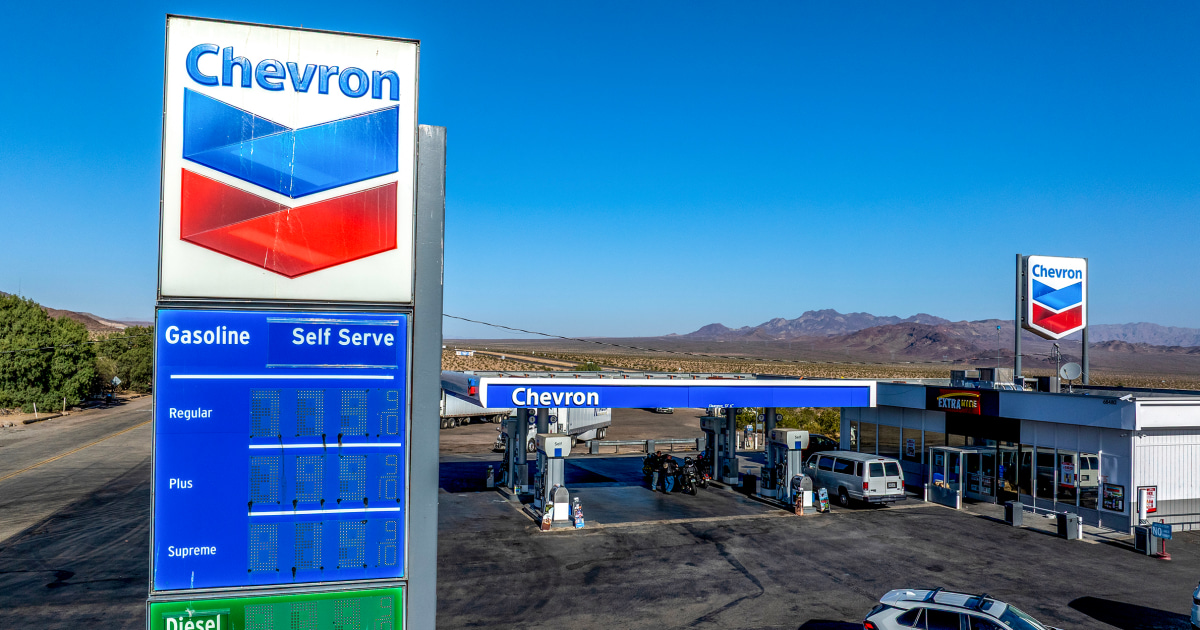
The national average price of gas pushed higher Monday to $4.46 per gallon, as oil futures rose again after three days of declines, increasing the direct cost to consumers of the war with Iran.
Subscribe to read this story ad-free
Get unlimited access to ad-free articles and exclusive content.

U.S. crude oil rose over 4% to more than $105 per barrel in midday trading, while international Brent crude oil rose 5% to more than $114 per barrel. Wholesale gas prices also jumped 4%.
Since the Iran war began in late February, the national average price of unleaded gas has risen 49%.
The renewed rise in oil prices came despite President Donald Trump announcing a plan Sunday dubbed “Project Freedom,” under which the United States will “guide” commercial vessels through the Strait of Hormuz. More than 20% of the world’s oil supplies typically transit the strait every day, but the war has halted that traffic.
Trump’s announcement appeared to fall short of naval escorts, which shipping companies and insurers say are what would be required for them to send their ships through the waterway again.
As of Monday morning, the shipping industry had not received details or guidance regarding “Project Freedom,” said Jakob Larsen, chief safety and security officer with the Baltic and International Maritime Council (BIMCO), which counts more than 2,000 shipping companies among its members.
As the war drags on, U.S. consumers are now spending around $1 billion more per day in higher fuel costs than they were before the start of the war, according to longtime oil industry analyst Andy Lipow. $550 million of that comes from gas prices alone, but it also the reflects a sharp rise in the price of jet fuel, diesel and other energy products
Wary insurers and owners
Larsen, of BIMCO, told NBC News it was unclear Monday whether Trump’s Project Freedom plan plan was intended to be in place for the long run, or whether it would be a limited operation to get some of the trapped ships out.
“The overall security situation for the shipping industry is currently unchanged, and our advice is for all shipowners to continue carrying out thorough risk assessments,” he added.
Global shipping giant Hapag-Lloyd also told NBC News in an email Monday that its risk assessment of the situation in the strait remained unchanged, and the strait remained closed for transit of its vessels.
There were also new questions this weekend about a U.S. government program launched last month with the goal of helping insurers write policies to cover ships near the strait.
On Saturday, Berkshire Hathaway, one of the world’s largest insurers, said that it had yet to write a single insurance policy under the program because it was still too dangerous.
In order for Berkshire to issue one of these policies, the U.S. Navy would have to escort the ships out said Ajit Jain, vice chairman of insurance operations. “But nothing’s happened as yet,” he said.
The president also offered few indications over the weekend that the war would end soon, posting on social media that he doubted Iran’s latest offer for negotiations to end the war would be acceptable.
Trump also warned that Iran has “not yet paid a big enough price for what they have done to Humanity, and the World, over the last 47 years.”
Soaring gas prices
Meanwhile, jet fuel has risen about 65% since the war started, according to data from the Argus U.S. Jet Fuel Index.
“To mitigate some of the supply disruption out of the Middle East, the world has tapped Strategic Petroleum Reserve releases as well as commercial inventories,” Lipow wrote in a note on Monday.
“In the USA, Gasoline inventories are down 14% and diesel inventories are down 17% since the beginning of February,” he wrote. Lipow warned that the oil market is taking notice of that and it’s translating into higher prices.
“This is bad news for the consumer as $4.50 gasoline is around the corner,” he wrote. “If the Strait remains closed another month, we will be at $5.00 per gallon.”
Prices in Ohio, Indiana, Illinois and Michigan have risen the most since the war with Iran began, according to data compiled by NBC News. While Georgia, Hawaii, Delaware and Minnesota have seen the smallest increases, the price jumps in those states have still amounted to more than $1.10 per gallon.
In Mono, Calif., prices rose to $7 per gallon. The state of California also ranked as the most expensive on Monday, with prices averaging $6.11.
“Retail prices for regular grade gasoline in California are consistently higher than in any other state in the continental United States, often exceeding the national average by more than a dollar per gallon,” according to EIA. That’s because of “state taxes and fees, environmental requirements, special fuel requirements, and isolated petroleum markets.”
The state with the least expensive gas Monday was Georgia, at $3.86 per gallon.
“We are cognizant that this short term blip up in prices is affecting the American people,” Treasury Secretary Schott Bessent said in a Fox News Channel interview on Monday morning. “But I am also confident on the other side of this, prices are going to come down very quickly.”
Bessent added that “corporate earnings are good, employment is good…and this temporary aberration will be over in a matter of weeks or a month.”










Leave a Reply