
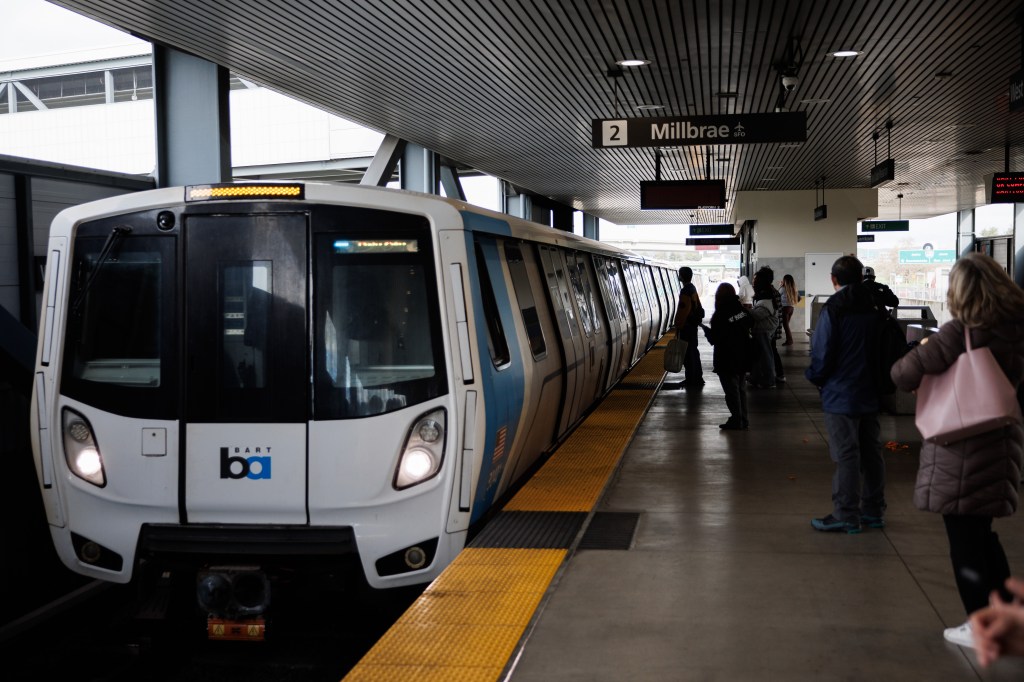

A bailout deal Gov. Gavin Newsom signed Thursday for Bay Area transit agencies enables BART’s reckless spending and could endanger already-tenuous federal funding for extending the rail system through San Jose.
Under legislation unveiled Feb. 13 and slammed through the Legislature mostly along party lines in just six days, the state would loan $590 million to BART, AC Transit, Caltrain and San Francisco MUNI.
The Legislature passed the bill on Thursday morning, just hours before Newsom, flanked by gushing Bay Area transit officials, signed it at BART’s Daly City maintenance yard.
The loan money would help the four transit agencies cover the cost of operations until they can begin collecting revenue from a new Bay Area sales tax measure planned for the November ballot.
The loans would not require new state money. Rather the money would come from an existing pot of state funds earmarked for Bay Area transit capital projects. The transit agencies would have 12 years to repay it.
The biggest share of the capital money tapped for the loans had been allocated to help a fifth transit agency, the South Bay’s Valley Transportation Authority, build its planned San Jose BART extension.
Which helps explain why one, but only one, Bay Area legislator did not vote for the deal. “They’re essentially mortgaging our capital projects to make payroll,” said state Sen. Dave Cortese, D-San Jose, on Wednesday, the night before the Legislature approved the bill. “It’s just not sustainable.”
He’s right. The notion of BART, AC Transit, Caltrain and MUNI taking on long-term debt to pay for current operating expenses is fiscally irresponsible. And the sin is compounded because the scheme would divert, and potentially put at risk, money for a key capital project.
We can’t keep putting Band-Aids on the region’s transportation financing problems. The plea for the loans to cover ongoing operating expenses stems from a failure to right-size operations to meet post-pandemic demand.
That’s especially true of BART, which is threatening voters with shuttered stations if the sales tax measure doesn’t pass in November. Never mind that BART is carrying less than half as many passengers as it was before the pandemic while providing more train service. It’s nuts.
Meanwhile, it’s hard to feel much sympathy for VTA, which has refused to pare back the cost of the BART extension as the price tag has more than doubled since 2020 to $12.8 billion.
VTA will now need to bank on the other four transit agencies repaying their loans. The South Bay agency needs the replenished capital fund as part of its matching money to leverage federal dollars for the extension.
To be sure, the terms of the loans Newsom approved supposedly provide security to ensure VTA is made whole. Under the legislation, if the four transit agencies to the north fail to make their loan payments, the money would be repaid out of those transit agencies’ future state operating money.
But, of course, that makes little sense. The transit agencies supposedly need money now because they don’t have enough funds for operations. Diverting future operations funding would only create a new hole.
It’s time to stop digging. Agencies like BART need to face the reality that its ridership demand is still less than half of what it was pre-pandemic — and adjust service accordingly.
And VTA needs to stop kidding itself: With or without the state capital funds, the chances for needed federal support for the BART extension are tenuous, in this presidential administration or any other. It’s time to find ways to trim the cost of the extension project.
As for the governor, whose administration dictated the terms of the loan deal, give him credit for grabbing the limelight Thursday as he signed the legislation while local leaders genuflected. And give him credit for structuring a deal that ensured the Bay Area, not the state, would bear the risk.
Daniel Borenstein is editorial page editor. Reach him at dborenstein@bayareanewsgroup.com.


Leave a Reply