
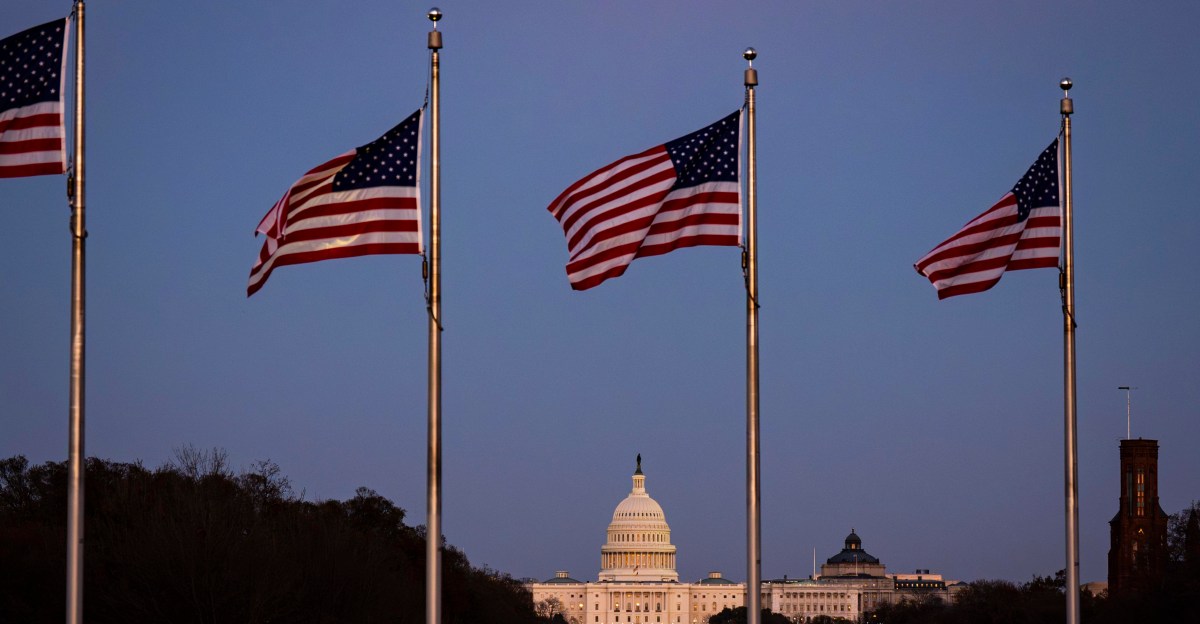
How would you grade America’s first 250 years?
That’s the question I posed to historian and professor Heather Cox Richardson on this week’s episode of America, Actually — and a question I pose to myself.
All grades are subjective, and the rubric of whether America earns a passing grade is one of position and perspective, but the best I could come up with was a B-/C+.
The enduring model of multiracial democracy, however fragile it currently is, deserves some credit. So does the long list of American inventions and academic institutions, and the cultural impact of American music, film, and sports. With some demerits for the permanent underclass capitalism requires, injustices here and abroad, and preferring the wrong type of football, a passing grade seemed fair enough.
In our interview, Richardson said that she sees the country as entering a period of enormous change, particularly as President Donald Trump continues to reshape our government to serve his maximalist desires. And since we’re focused on America post-Trump, and our road to that point in these coming elections, I asked how responsive a democracy Richardson feels we truly have — and pushed on the question of the electorate’s commitment to preserving it, considering the results of the 2024 election.
Read on for an excerpt of our conversation, lightly edited for length and clarity. There’s much more in the full show — we write a new founding document for America’s next 250 years, listing out the values that will earn the country an A+ for the next grading period — so listen to America, Actually wherever you get your podcasts or watch it on Vox’s YouTube channel.
As I was preparing for this, I was reading about how you’ve argued that the country has basically reinvented itself every 80 to 90 years from the founding to the Civil War to the New Deal.
I wondered how you thought about those reinventions. What forces shaped them, and are we in a reinvention period right now?
I’m not sure I’ve ever used the words reinvention, because the way I think about it is that a country has to deal with new challenges all the time, and because we had set out at our foundation a series of principles that at the time were quite limited by who they covered, but were expansive in terms of what they could cover, we have managed through our history to address new challenges — like westward expansion, like industrialization, like globalization, like the advent of nuclear weapons — and to expand American democracy to more closely adhere to those foundational documents.
So are we in a moment like this now? Absolutely.
What forces shape these kinds of shifts in the country? If we think about those moments where we face new challenges, how do we muster up that kind of creativity and what are the seeds that we should be looking for right now?
There’s a whole lot embedded in that question. And one of the places that I want to start is that the seeds for reinvention, I think, come from the arts. They come from music, they come from art, they come from new languages and new clothing styles and sculpture, and all sorts of new ways to envision the world through our imaginations.
And we could talk about the late 19th century, for example, and how extraordinarily creative that time was, and so forth. Those ideas, I think, come from there, but that’s not enough. I think when you see reinvention, you see Americans reaching back for their stories, for their traditional history and the places that they can see other Americans having exercised their agency to make our best traditions come into law, or at least come into practice.
It’s an especially poignant time for us to be talking about this because on April 12, Hungarian voters put a supermajority of opposition figures to Viktor Orbán into power in their parliament, and they will, of course, have a different prime minister.
And one of the things that they appear to have done is to have reached back to Hungarian history and said, listen. We might disagree with each other about immigration and about finances and so on, but we can agree that we care deeply about our country and we must start there with people who are trying to build our country rather than tear it down.
And that really hit a chord for me because that is precisely what the Republicans did when they formed in the 1850s. It’s precisely what the populists and the Democrats did in the 1890s when they organized against the robber barons and then included the progressive Republicans. It’s certainly what we saw in the 1920s and the 1930s, what we saw in the 1950s, and I think what we’re seeing in the United States again today.
I wanted to ask about today. The premise of this show is to try to take Trump out of the center and to see the country beyond the lens of him, but baked into that is a question of whether he is an aberrant piece in American politics or reflective of a system and we’re going to have to live with Trumpism for longer than even the individual person.
Trump is very clearly the outcome of at least 40 years of right-wing rhetoric that has been adopted by the Republican Party, that laid the groundwork for a man to come in and essentially get rid of the dog whistles and call to the sexists and racist who had ended up sliding into the Republican Party after 1965 and the Voting Rights Act, to basically create sort of a libertarian, small-government elite in the Republican Party that depended on the votes of those racist and sexists to stay in power.
What he did was he sort of flipped the script. He nodded to the establishment Republicans who wanted the tax cuts, but he empowered the racist and the sexists and the America-Firsters and so on. And so he is very much a product of that.
But he is also something different because by empowering them, what he did is he turned a democracy not just to an autocracy, but to a personalist autocracy. It’s sort of, in a way, a step beyond fascism that we can talk about — the idea that wants all the power, but he also wants the power not for his party and not for even his cronies, but for himself.
Now there’s a bigger question, as I say, embedded in what you said, and that is, is the United States of America’s system so deeply flawed to begin with that we were waiting for a Trump?
And to that, I would say no. I say that many of us dropped the ball after the 1960s and the 1970s, and the idea that we had finally managed to create a new kind of American government that was premised on reality rather than on the previous images of American life.
By that I mean that it was a government that recognized the worth of individuals. It didn’t necessarily protect individuals the way the principles of that government suggested they should, but it recognized their worth in a way that the government before 1965 and before the Great Society under LBJ had not done. And so for a lot of people, they thought, oh, we’re on this trajectory toward a liberal democracy that is in fact going to recognize the worth of disabled Americans and elderly Americans and so on.
And as a result, we stopped focusing on the importance of liberal democracy. But what that did is it enabled the radical right to step in and give people a sense of a national narrative that made their agency feel deeply important to them — that they were the ones protecting America in a way that people like me weren’t.
Because the immigrants are taking your job, because folks are coming in and represent a kind of imminent threat.
That’s right. And you know, one of the things that always jumps out to me is Lauren Boebert, the representative from Colorado, on the morning of January 6, 2021, [tweeting] to people, “This is 1776” — the idea that they were the ones who were truly protecting America.
One of the things that I think Trump has done for us since his re-taking the oath of office in January 2025 was to make it clear that our democracy and the guardrails of our democracy that so many people believed couldn’t be challenged, Trump just tore ‘em up.
And with that, a lot of people who sort of assume the guardrails were there are stepping into the fray and saying, okay, I didn’t think I was going to have to get involved in politics, but clearly I do, and here I am.
That kind of engagement in protecting American democracy is the sort of thing that we’ve seen in the past — in the 1850s, 1890s, and so on — to reclaim that democracy and crucially, make it adjust to new conditions that are currently challenging it.




Leave a Reply