
DOHA, Qatar — Among senior U.S. officials, the wealthy Gulf nation of the United Arab Emirates is known by an affectionate nickname: Little Sparta.
Subscribe to read this story ad-free
Get unlimited access to ad-free articles and exclusive content.

The moniker, often attributed to former U.S. Defense Secretary James Mattis, reflects the American admiration for the UAE’s investment in its military and its willingness to act decisively, compared to its slower-moving Gulf neighbors.
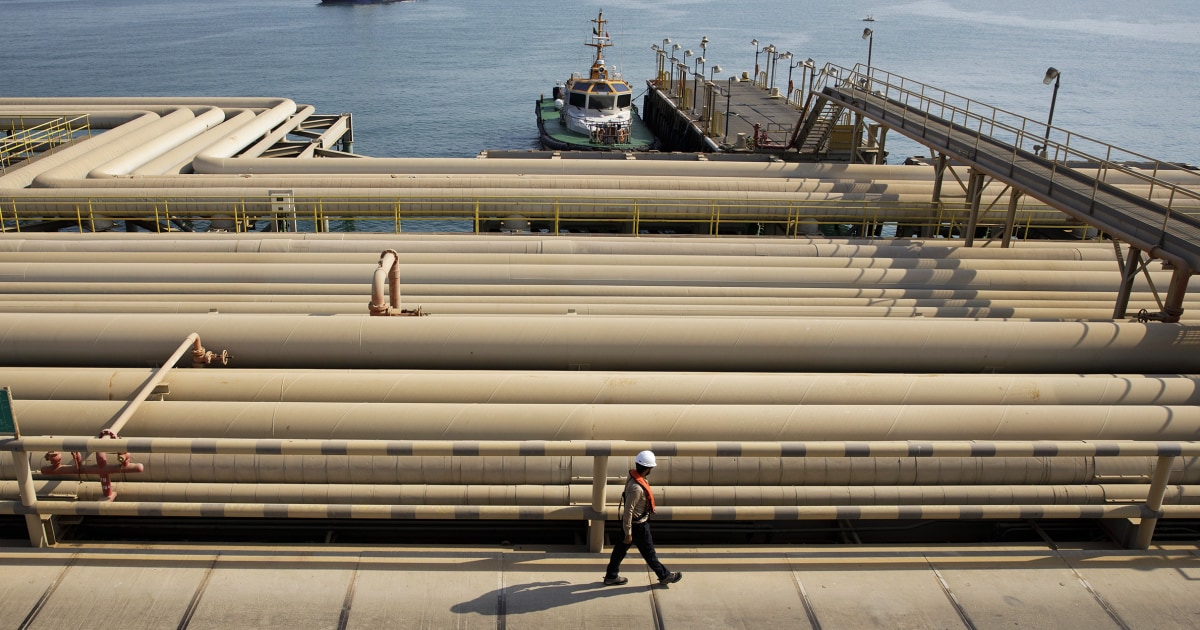
This week, “Little Sparta” lived up to its reputation for pivoting fast and going it alone, as it announced that on May 1 it will leave OPEC, the league of oil-exporting states that since 1960 plays a major role in setting global oil prices.
By exiting the cartel, UAE will be able to set its own levels of oil production and no longer be bound by the collective decision-making of OPEC, which has long been accused by critics of placing artificial limits on production in order to boost oil prices.
The decision comes amid mounting Emirati frustration with the Gulf states’ response to attacks by Iran and tensions between the UAE and its larger neighbor, Saudi Arabia, that are playing out on diplomatic fronts and battlefields across the region.
“You are seeing a more independent and more assertive UAE policy in the region. This is the new UAE that everyone has to settle with,” Abdulkhaleq Abdulla, an Emirati political scientist, told NBC News in a phone interview on Wednesday.
Even the timing of its OPEC announcement seemed to reflect the country’s impatience with its neighbors. The news flashed to oil traders worldwide on Tuesday just after 4:20 p.m. Abu Dhabi time (8:20 a.m. ET). At that moment, Saudi Arabia’s de facto leader Crown Prince Mohammed bin Salman was hosting a summit of Gulf states in the coastal city of Jeddah in an effort to project regional unity. While other countries were represented by their king or crown prince, the UAE sent only its foreign minister to the meeting.

A day earlier, a senior Emirati official publicly lashed out at the Gulf Cooperation Council — composed of Bahrain, Kuwait, Oman, Qatar, Saudi Arabia and the UAE — for its “weak” response to Iranian drone and missile strikes.

FORSUBSCRIBERS

UAE quits OPEC: What this means for global oil prices
01:23
“The GCC’s stance was the weakest historically, considering the nature of the attack and the threat it posed to everyone,” Anwar Gargash, an Emirati diplomatic adviser, said at a conference in Dubai on Monday. He accused neighboring states of attempting “a containment policy” toward Iran through trade ties and energy partnerships. “These policies have failed miserably, and we are now facing a major reassessment,” he added.
Saudi officials did not immediately respond to a request for comment on the criticism.
At the heart of the UAE’s new direction is an increasingly stark policy divergence with Saudi Arabia, the largest of the GCC states. The kingdom’s size and its role as the guardian of the two holiest sites in Islam have traditionally made it a regional leader. Salman, 40, has been unafraid to use his country’s financial and military heft to try to shape the region.
But the UAE’s president, 65-year-old Mohammed bin Zayed, has made clear he is unwilling to defer to his younger Saudi counterpart.

Both men are authoritarian royals often referred to by their initials: MBS and MBZ, respectively. Both are U.S. allies who are pushing through widespread reforms of their nations’ societies and economies. But they have taken markedly different paths in their foreign policies.
“The UAE and Saudi Arabia have had a history of growing competition economically, and they now have different visions for regional security and regional relationships,” said Sanam Vakil, director of the Middle East and North Africa program at Chatham House, a London-based think tank.
Those differences have been sharply felt in Yemen, Saudi Arabia’s impoverished southern neighbor wracked by a complex civil war since 2014.
The Saudis and Emiratis mounted a joint air campaign against Yemen’s Iranian-backed Houthi rebels in 2015, but the two sides later backed different factions, and, in December 2025, Saudi Arabia bombed a shipment of Emirati weapons saying they were being sent to a separatist group. The UAE denied the accusation and responded by announcing it was withdrawing its troops from Yemen.
“The most profound difference between the UAE and Saudi Arabia is over Yemen,” said Abdulla, the Emirati political scientist.

The Saudis and Emiratis have also backed opposing sides in the bloody war in Sudan. Salman has given political support to the Sudanese army, while the UAE has given weapons to the army’s rivals, the paramilitary group known as the Rapid Support Forces (RSF), according to a U.N. investigative panel and human rights. The UAE denies backing the RSF, whose fighters massacred thousands of civilians in the city of el-Fasher last year.
Another area of conflict has emerged over Israel. The UAE established diplomatic relations with Israel as part of the U.S.-brokered 2020 Abraham Accords, one of the signature foreign policy achievements of the first Trump administration. Since then, the two countries have established increasingly deep ties in trade, energy and security.
Despite coaxing by President Trump and former President Joe Biden, Salman has so far resisted normalizing Saudi Arabia’s relations with Israel. In a November 2024 speech, the crown prince accused Israel of carrying out a genocide in Gaza, going much farther than Zayed’s occasional criticisms, while government-controlled Saudi media outlets have attacked the UAE’s ties to Israel. Israel has previously rejected a report from U.N. experts that alleged it carried out a genocide in Gaza, where more than 75,000 people have been killed, according to figures from Gaza’s Ministry of Health.
When the Iran war broke out on Feb. 28, it looked like MBZ and MBS might put aside their differences as their neighboring nations came under blistering attack from their shared Iranian foe. The two men spoke by phone on the first day of the war and again two weeks later, according to a list of calls provided by both governments.
But the unity appears short-lived. The same list shows they have not spoken in the six weeks since.




Leave a Reply