
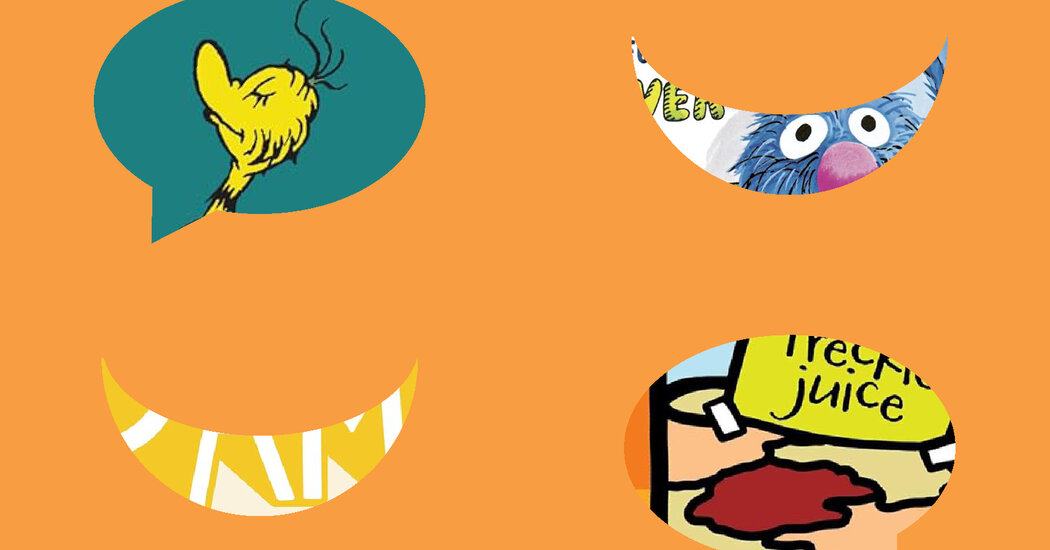
To a kid, funny books feel like contraband. Somehow, adults you’ve never met have felt the things you’ve been turning over in your head but have never quite had the vocabulary to express. They get you.
A good comedy writer knows that writing funny stories for children is no joke. There’s a strong temptation to write down to young readers, to impart some sort of lesson. But that kind of thinking tramples comedy. The best humor writers have figured out how to shed their scaly grown-up skin and access that raw part of themselves that’s experiencing the absurdity of life for the very first time.
I remember when, as a kid, I got my hands on the good stuff, by Judy Blume, Shel Silverstein, Gary Larson — truth-tellers and joyful provocateurs. There’s something a little punk rock about all of them.
Here are a handful of books that have helped shape my sense of humor — and continue to make me laugh.
The Monster at the End of This Book
by Jon Stone; illustrated by Mike Smollin
Talk about breaking the fourth wall. The beloved Muppet Grover talks directly to the reader. “If you do not turn any pages, we will never get to the end of this book. And that is good, because there is a Monster at the end of this book. So please do not turn the page,” he pleads, which of course has the opposite effect, transforming the book into a kind of portal. The buildup to the reveal is exhilarating, and the ending is surprisingly tender.
The Sneetches and Other Stories
by Dr. Seuss
You can have your “Cat in the Hat,” “Green Eggs and Ham” and “How the Grinch Stole Christmas.” The Seuss book that spoke to me was “The Sneetches and Other Stories,” an offbeat collection of four tales that also speak to our times. When Elon Musk made people pay for verification status on Twitter, turning verification into something that was looked down upon by many, I thought of the Sneetches, whose starred bellies are first coveted, then disdained. Only the con man Sylvester McMonkey McBean, who invents a machine to add and subtract stars from the Sneetches’ bellies, makes out in the end, leaving town with piles of money.
Ramona Quimby, Age 8
by Beverly Cleary
I grew up in the mid-1970s, when the edition of Cleary’s “Ramona Quimby, Age 8” had a feral-looking young girl on the cover — head perched atop a pencil-thin turtleneck, a deer-in-the-headlights expression on her face. I wanted to know this girl. It turned out the book was a gateway into the neighborhood where Ramona, her sister Beezus, Henry Huggins and so many other memorable characters lived. The stories were fresh and vibrant, even though they took place in a bygone time. It didn’t matter — these characters felt like friends.
Freckle Juice
by Judy Blume
How is it that Blume’s books still strike a nerve, decades after their first publication? She tapped into universal truths and held up a mirror to ordinary kids’ lives. In “Freckle Juice,” Andrew Marcus — a second grader envious of a classmate’s freckles — is tricked into buying a recipe for a noxious freckle-making potion: mustard, vinegar and so much more, concocted by the scheming Sharon, who is hellbent on humiliating him. Children can be cruel, and Blume remembers that. But their misguided efforts to fit in can be rich comic fodder.
A Light in the Attic
by Shel Silverstein
The photo of the author’s face on the back of the book terrified me. I can’t help wondering if that was a purposeful provocation. Silverstein had a way of doing that — getting his readers out of their comfort zones, unsettling them with his weird black-and-white pen-and-ink drawings and audacious humor. The fact that he delivered the goods with crisp, accessible poetry is something like a miracle. “A Light in the Attic” features 135 darkly humorous poems with characters like Backward Bill, Sour Face Ann, the Meehoo and a girl named Abigail who dies because her parents refuse to buy her a pony. Silverstein was never afraid to poke his readers to get an uncomfortable laugh.
The Far Side Gallery
by Gary Larson
In the late 1980s, newspaper cartoonists were like rock stars. Their work was clipped and shared in schoolyards and corporate offices. The comic strip artists Berke Breathed (“Bloom County”) and Bill Watterson (“Calvin and Hobbes”) were heroes to me. But nobody could pack a bigger punch into a small frame than the single-panel cartoonist Gary Larson. The “Far Side” books were slam-dunk holiday purchases — given to parents from kids, and to kids from parents. The absurdity and simplicity of the humor worked in conjunction with the minimalist style, which helped an untalented artist like me see a pathway to reaching my own rock-star dream of becoming a cartoonist.
The Book With No Pictures
by B.J. Novak
I remember meeting Novak at a rooftop publishing party in New York City, where he told me about a children’s book he was working on called “The Book With No Pictures.” “Sounds interesting,” I said, “but there will actually be pictures, right?” “No,” he said. “There will not.” I thought to myself, That’ll never work. The joke’s on me, as the book spent 192 weeks on the New York Times best-seller list (for children’s picture books, of course). It’s delightfully hilarious, and reading it out loud is a reliable way to fully wind up a roomful of 5-year-olds.
I Want My Hat Back
by Jon Klassen
The look on the bear’s face on the cover draws you in. Perhaps he’s having his picture taken but feels a bit uncomfortable. Maybe he wasn’t expecting to be photographed — and now here he is, on the cover of a children’s picture book. Klassen’s work is like this: a little off-kilter and always wholly original. “I Want My Hat Back” follows the bear’s quest to retrieve his red, pointy hat, and its arguably dark ending leaves the reader with a feeling of comic dissonance. It took courage to publish a story like this one, and my hat is off to the author.



Leave a Reply