
Following the bombing of Pearl Harbor on Dec. 7, 1941, Executive Order 9066 was issued — the culmination of fomenting anti-Asian sentiment — and President Franklin D. Roosevelt ordered the removal of people of Japanese descent from the West Coast.
This led to the incarceration of more than 120,000 people of Japanese descent across 10 “relocation centers” or “internment camps” in remote areas in California, Arizona, Colorado, Utah, Wyoming, Idaho and Arkansas. The law was based on fears of espionage after the attack, which were generally unfounded. Over 60 years after its enactment, local historians in Los Gatos and Saratoga revisited that history, especially in light of President Donald Trump’s immigration and deportation policies that threaten to destabilize the Bay Area’s diverse communities.
For those who know about incarceration, the language and attitudes wielded against undocumented immigrants feels starkly similar to those directed at Japanese people during World War II.
Los Gatos Anti-Racism Coalition president Jeff Suzuki and vice chair Nigel Chandler recorded the contributions of Japanese people in the west Santa Clara Valley and the impact of their incarceration in their local narrative series, which was released in November and December. Chandler said the project began as an extension of the work the coalition’s education team was doing to meet with Los Gatos High School teachers to make local primary source material more accessible in history classrooms.
“One of my primary goals is to communicate that we cannot simply cut ourselves off from that history; it is as real as something that happened last week,” Suzuki said in an email interview. “There are people alive who still remember what happened to them and their families, and that matters. Once we grasp that basic fact, we can better understand ourselves and the society we’ve inherited from previous generations.”

At the same time, Suzuki and Chandler became fascinated by Gordon Yamate’s own family’s story of incarceration. Yamate, chair of the Los Gatos Diversity, Equity and Inclusion Commission, recounted that his mother, Kikuye Inouye, was incarcerated for three years at Heart Mountain, Wyoming. Like two-thirds of those incarcerated, Inouye was a U.S. citizen by birth.
Yamate said he feels this history deserves more attention given the current political climate and how relevant it is to the town’s history.
“There is this tremendous resurgence of racism that troubles me no end because the tactics of breaking up families, which happened in camps… instances of repatriation, you’re seeing that here today, ” Yamate said.
Saratoga City Councilmember Belal Aftab said he hosts the Saratoga History Podcast to share stories about the city in a new medium. The topic of incarceration appears in the podcast’s second episode on Hakone Gardens.
While interviewing Ann Waltonsmith, former chair of the Hakone Foundation, and Connie Young Yu, whose parents were some of the last private owners of the gardens, for the episode, Aftab learned the haunting story of Hakone gardener James Sasaki and his family, who dug a pit in the ground that would eventually become Hakone Gardens’ parking lot to burn any items that reflected their Japanese heritage, which included kimonos, wooden kendo swords and Japanese books and toys.
“That, to me, was really heartbreaking and that feels reminiscent a bit of what we’re seeing today,” Aftab said. “Whether it’s insane (Immigration and Customs Enforcement) on the basis of whether or not you speak English with an accent, it’s people being afraid to embrace their minority identity.”
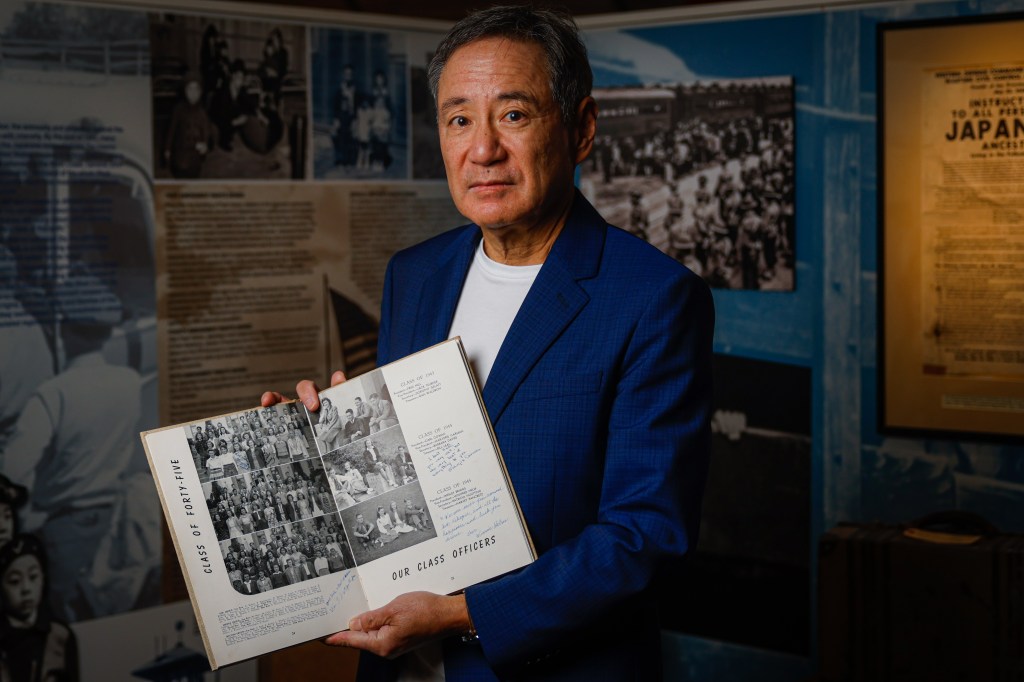
Yamate said his family rarely talked about their time in camp, but the stigmatization they faced had longstanding effects. He recalled that his mother was incarcerated when she was a freshman at Los Gatos High School. Her classmates had given her a signed copy of their yearbook, but she ultimately graduated with valedictorian honors while at Heart Mountain. She didn’t return to the friends she had made in Los Gatos High School when she was released.
“I think she didn’t go back to them because being in camp for no logical reason, it’s shame,” Yamate said. “I think she had to deal with that shame and she was (treated) less of a person, that puts a real stigma on you.”
-

Gordon Yamate, the DEI commissioner of Los Gatos, holds his mother’s yearbook from Los Gatos High School that was signed by her classmates at the Japanese American Museum of San Jose in San Jose, Calif., on Friday, Dec. 19, 2025. Yamate’s mother his mother was incarcerated with two of her siblings and her parents in the Japanese internment camp at Heart Mountain, WY. (Shae Hammond/Bay Area News Group)


1 of 6
Gordon Yamate, the DEI commissioner of Los Gatos, holds his mother’s yearbook from Los Gatos High School that was signed by her classmates at the Japanese American Museum of San Jose in San Jose, Calif., on Friday, Dec. 19, 2025. Yamate’s mother his mother was incarcerated with two of her siblings and her parents in the Japanese internment camp at Heart Mountain, WY. (Shae Hammond/Bay Area News Group)
Expand
Even later in life, he saw the effects of her incarceration. As he reflected over his mother’s poor cooking skills, Yamate deduced that his mother had to eat bland, starchy, poorly prepared foods in the mess hall when she would have been learning how to prepare food for a family.
In their local narrative series, Suzuki and Chandler reminded readers that racism didn’t go away; it just changed. They discovered that the bureaucratic mechanisms used by the Bureau of Indian Affairs to manage Native American reservations were inherited by the War Relocation Authority, which organized the incarceration of Japanese people, with much of the authority’s staff coming from the BIA.
“Minus the massacres, we would see an eerily similar system, the so-called ‘Japanese Internment,’ used to manage the displaced Japanese American population decades later,” Suzuki and Chandler wrote. “In this way, the Indian reservation system established the bureaucratic mechanisms that would later be borrowed by the War Relocation Authority in the 1940s.”
San Jose State University Asian American studies professor Yvonne Kwan echoed this, saying the racist stereotype of seeing Asian Americans as a “yellow peril” threatening to replace white Americans transformed into the model minority myth to separate Asian Americans from other racial minorities and prevent them from organizing together.
“That’s why I think a lot of Asian American activists, Japanese American activists, (are) looking to what’s happening right now with ICE raids, police brutality,” Kwan said. “It is all part and parcel of a similar system of militarized control, which is what happened to Japanese Americans in the incarceration. It was militarized control of people and also instilling fear within these communities.”
The parallels between the attitudes toward Japanese incarceration and present-day immigration enforcement are not lost on Yamate; he called them unequivocally “racist behaviors,” but noted that people didn’t seem to have a problem with it anymore.
“I still get pushback here in town: ‘Why do we need the DEI commission? Why do you need to bring up these things in history? Because people don’t think that way anymore,’” Yamate said. “I have to disagree with that. It may not be as blatant as the president, but I’m not seeing these people pushing back on what’s going on. They’re not speaking out about that and saying this is wrong.”
Ultimately, people outside targeted groups are impacted by policies founded on hate. Suzuki noted that the “Big Beautiful Bill” cut funding for several social services in Santa Clara County, like funds for the county hospital system, food assistance, mental health and public safety, which thousands of people in Los Gatos and Saratoga rely on.
“As Los Gatos residents have observed the most flagrant exercises of force, it has also become clear that the administration’s policies have been catastrophic for countless people in the United States,” Suzuki said in an email. “And some of these impacts have made their way to Los Gatos.”
Kwan called on the need for an intergenerational and multigenerational movement that values everyone’s shared humanity.
“What I want to say is really a call to action for people to get involved and to learn from one another and have those uncomfortable conversations and see, are there things that we each as individuals, but also as collectives, can do together to resist this draconian, violent administration,” Kwan said.


Leave a Reply