
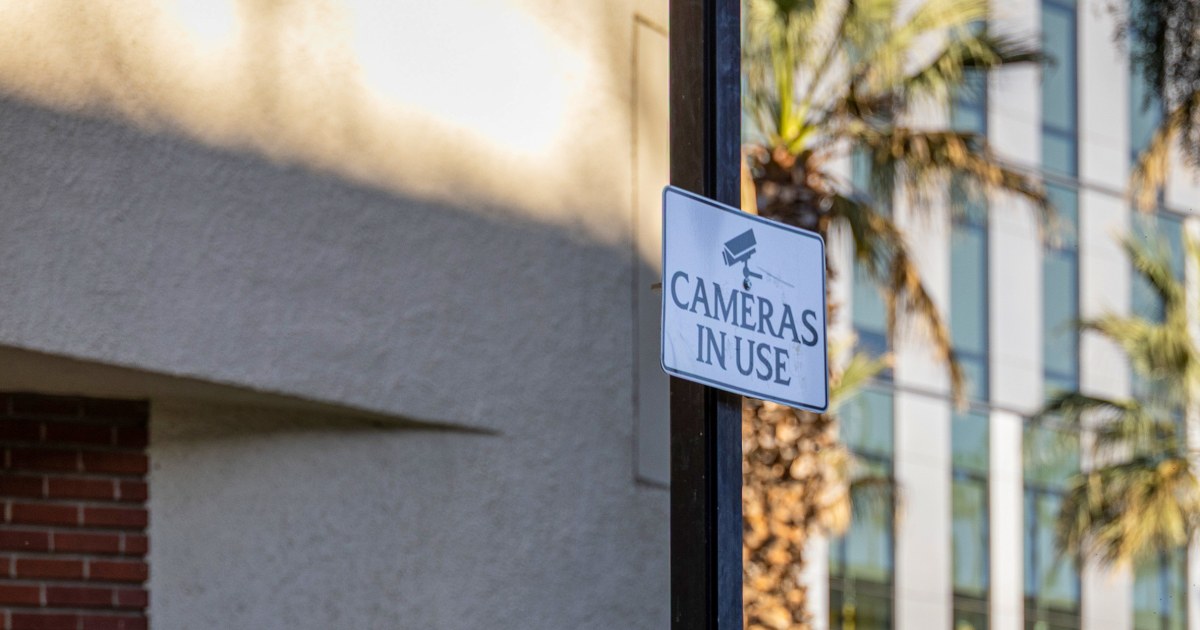
Three drivers in San Jose, California, filed a class action suit against the city and police department over the deployment of nearly 500 cameras operated by Flock Safety, a controversial surveillance tech company that uses AI and dedicated cameras to catalogue vehicles’ movements.
Subscribe to read this story ad-free
Get unlimited access to ad-free articles and exclusive content.

Organized by the Institute for Justice, a libertarian nonprofit law firm, the suit argues that the city’s use of the technology constitutes an unreasonable law enforcement search, in violation of the Fourth Amendment to the Constitution. Pictures collected from the cameras are added to giant searchable databases that use AI to help law enforcement easily identify when and where particular vehicles have traveled.
Flock offers a wide range of surveillance technologies to law enforcement agencies, governments, private companies and homeowners associations, but it is best known for its nationwide fleet of Automatic Licence Plate Cameras (ALPRs), which are mounted by prominent roads to record which vehicles go by and when.
Unlike other ALPR companies, Flock offers its customers the chance to share access locally, statewide or across the country. Its databases can be accessed without warrants by officials at participating law enforcement departments. San Jose shares its Flock data with hundreds of other law enforcement agencies in California, but not nationwide.
According to a transparency website operated by Flock, the San Jose Police Department has 474 cameras. As of Wednesday, it had detected almost 2.8 million vehicles within the previous 30 days, and officers had searched the San Jose database 4,099 times. Thousands of government employees across the state access California’s databases, according to the lawsuit, and audit logs obtained through a Freedom of Information Act Request showed that the Flock San Jose data was searched 2.5 million times in the last six months of 2025, the suit found, or around 13,500 per day.
The city of San Jose has acknowledged some criticism of the cameras and location data. Last month, the City Council voted to shorten the data retention period of location information that Flock can hold from one year to one month.
A Flock spokesperson said in an email that the suit raises “important questions” but noted that courts have repeatedly found that “using Flock devices is constitutional.”

A spokesperson for the San Jose Police Department declined to comment. A city spokesperson did not immediately respond to a request for comment.
Flock has been the subject of several lawsuits alleging the technology violates the Fourth Amendment, and it has yet to be found culpable. One of those lawsuits was brought last year by the Institute for Justice on behalf of two residents of Norfolk, Virginia.The court found in favor of Norfolk, but the case revealed some information about how Flock operates, including that it took hundreds of photos of plaintiffs’ vehicles over several months.
The Institute for Justice’s Michael Soyfer, the lead attorney on the case, told NBC News he simply disagreed with that court’s decision and has appealed and that he hopes the Northern District of California is more sympathetic.
“What we’ve demonstrated in these cases is that these cameras have the capability to generate data on virtually every route people take when they leave their house. Are they following you door to door? No. Are they generating a few data points on just about every route you take in your car? Yeah, they’re clearly capable of that, and with that information police and the government can piece together a lot about you, because they usually know where you live, and they can usually make reasonable inferences,” he said.
“They can find other information to figure out where you went, especially if that process is repeated over weeks and weeks and weeks.”
Soyfer said Flock cameras are often near sensitive facilities, heightening the privacy concern that people could be tracked on those streets.
“We’ve seen these cameras in San Jose on the same blocks as hospice care facilities, immigration lawyers offices, hospitals, all sorts of places where you wouldn’t want to be monitored and surveilled by the government,” he said.
The suit asks the court to compel the city of San Jose and the police department to delete all Flock images within 24 hours except when there are warrants.
“If the court doesn’t go for that, our second-line request is for a warrant requirement to access data,” Soyfer said. “But our belief is that it’s the collection of data that’s really the injury to people’s privacy, and not necessarily access. It’s the maintenance of this very widely available database.”
Flock has become increasingly controversial, with communities across the country persuading their local governments to cancel their contracts, though the number is still dwarfed by how many cities renew their agreements with Flock every year.
Tony Tan, a software engineer and one of the plaintiffs in the case, said a Flock ALPR is mounted on the intersection of the street he uses to leave or return home, making travel without being tracked impossible.

“In the past year or so, with the second Trump administration, I’ve been involved in some local activism. I’m, for example, volunteering as a legal observer, responding to reports of potential ICE activity,” he told NBC News.
“And I’m worried that as I go to these calls, every time my license was being captured. What if that data gets into the wrong hands in the future? Even though everything I do I believe is lawful, maybe that could change. Maybe someone wants to retaliate against me anyway,” he said.










Leave a Reply