
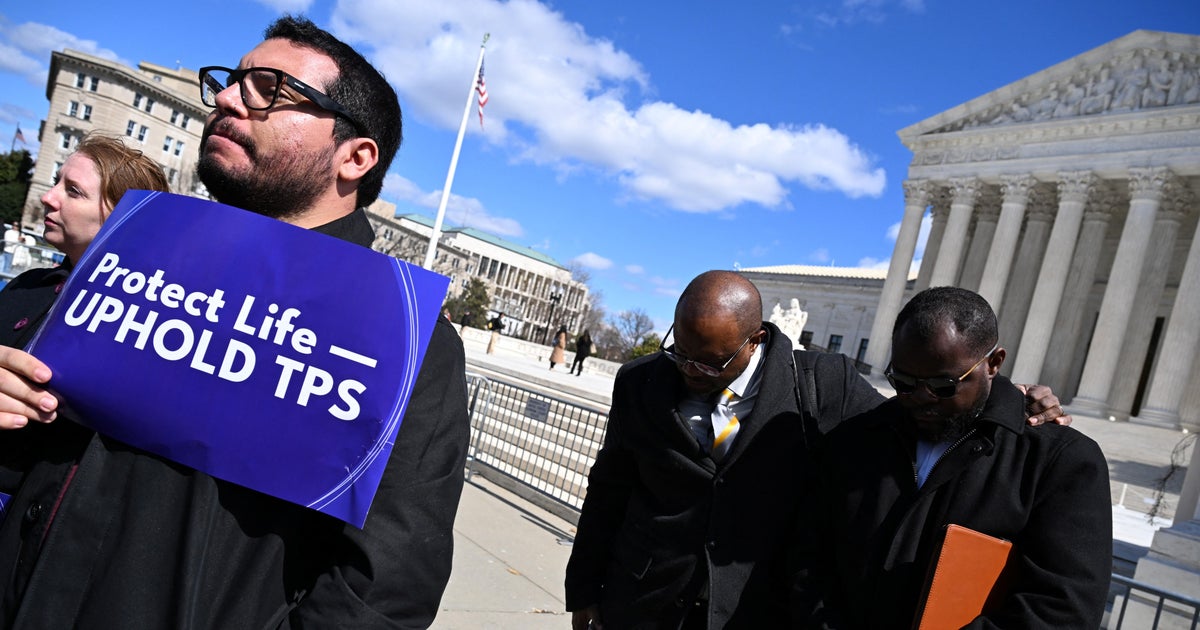
Washington — Dahlia Doe felt as though her world was shaken.
A Syrian national who came to the U.S. more than a decade ago for college, Dahlia, a pseudonym, has received legal protections through Temporary Protected Status, a program that provides relief from deportation to people from certain countries beset by conflict, natural disasters or other extraordinary circumstances.
But in September, the Department of Homeland Security moved to end TPS for more than 6,000 Syrians, giving those authorized to live and work in the United States 60 days to leave the country or risk arrest and deportation.
“I knew that TPS was being targeted. I knew that the Trump administration was going after TPS country after country. But giving us only 60 days was an even further shock and heartbreak for me,” Dahlia told CBS News. “It shows how little our lives matter.”
Dahlia, who is in her 20s, received TPS in 2021. She works as a research director and lives in the Bronx, New York, caring for her father, who has Parkinson’s disease. Her parents are lawful permanent residents and her sister is a U.S. citizen.
A Syrian citizen and passport holder, Dahlia was born in another Middle Eastern country and has never lived in Syria. But if the Trump administration is allowed to move forward with ending TPS for Syrian nationals — an issue that the Supreme Court will weigh Wednesday — Dahlia fears she is at risk of being removed to a country where she has never lived and where she has no immediate family. She and six other Syrian nationals filed a lawsuit last year seeking to stop the Trump administration from stripping away their deportation protections.
“My life would turn into a constant state of fear and uncertainty. Everything I’ve built, my entire adulthood, would vanish right in front of my eyes,” she said. “It’s not just a legal change. It’s not just a policy. It’s disrupting entire lives overnight for people like me who have been here a decade or more.”
The end of TPS for Syria and Haiti
Syria is one of 13 countries for which the Trump administration has moved to roll back temporary protections. The Supreme Court is set to consider Wednesday the Department of Homeland Security’s effort to terminate TPS both for Syria and Haiti, in a pair of cases known as Mullin v. Doe and Trump v. Miot.
The Justice Department and those defending the administration have argued that TPS is supposed to provide temporary relief from deportation. They said the decision to scrap the program for Syrians and Haitians was rooted in protecting national security and public safety.
The Supreme Court last year allowed DHS to revoke protections for hundreds of thousands of migrants from Venezuela, putting them at risk of removal. Other nations targeted by the Trump administration include Afghanistan, South Sudan, Yemen and Nicaragua.
Congress enacted the TPS program in 1990. It gives the homeland security secretary the power to provide temporary, country-specific relief to foreign nationals who cannot safely return to their home countries because of war, natural disaster or other “extraordinary and temporary conditions.”
Relief is limited to up to 18 months, but the secretary can provide extensions of TPS designations, and Congress did not limit how many times the protections can be re-upped. Congress also restricted who can receive TPS, deeming ineligible foreign nationals who have been convicted of a felony or more than one misdemeanor; engaged in drug trafficking; belong to a terrorist group; or whose presence in the U.S. would endanger national security or foreign policy.
The Obama administration first designated Syria for TPS in 2012, citing “extraordinary and temporary conditions” stemming from former Syrian President Bashar al-Assad’s crackdown on anti-government protests.
Haiti, meanwhile, was designated for TPS for the first time by the Obama administration in 2010 because of a devastating earthquake, which affected roughly one-third of Haiti’s population of 9 million people. The Biden administration extended TPS for Haiti several times because of economic, health and political crises in the wake of the assassination of its president in 2021.
But soon after Mr. Trump took office, then-Secretary of Homeland Security Kristi Noem moved to end the programs for more than 6,000 Syrian immigrants and 350,000 Haitians. In both cases, Noem found that after consulting with other agencies and reviewing conditions in the two countries, they no longer met the criteria for TPS.
Syria’s designation was set to end last November and Haiti’s in February. Immigrants from both countries had roughly 60 days from Noem’s announcement to when their deportation protections would expire. But the administration’s terminations were challenged by TPS beneficiaries from Syria, led by Dahlia, and Haiti in two separate lawsuits, and judges agreed to postpone the effective dates.
In the case involving Syria, U.S. District Judge Katherine Polk Failla found in part that the termination was motivated by “undue political influence.” She cited statements from Mr. Trump about the legality of the TPS program and an executive order directing DHS to rescind policies that he said contributed to illegal immigration.
Failla said during a November hearing that Noem “endeavored to terminate TPS status whenever presented with an opportunity to do so, resulting in termination decisions that are ground not in law and not in fact, but that are in political considerations simply not relevant under the TPS statute.”
In the case brought by Haitians protected by the program, U.S. District Judge Ana Reyes found there was sufficient evidence that Noem’s decision to terminate TPS for Haiti was motivated in part by “anti-Black and anti-Haitian” animus. Reyes cited derogatory statements about Haiti from Mr. Trump, including his comment calling Haiti a “s**thole country,” and his amplification of a conspiracy theory that Haitian immigrants in Springfield, Ohio, were eating residents’ pets.
The Trump administration sought review from the Supreme Court after appeals courts declined to pause the rulings in favor of the Haitian and Syrian immigrants. The high court said in March it would consider the government’s efforts to roll back the protections for Syrians and Haitians, but it left TPS for the two countries in place while it considers the case.
The dispute before the Supreme Court
Before weighing whether the secretary of homeland security acted unlawfully, the Supreme Court must first decide whether courts can even review the claim that the secretary violated federal law when she moved to end TPS for Syria and Haiti.
The Trump administration has interpreted the TPS statute broadly to bar judicial review of the ultimate decision to designate, terminate or extend the relief program, as well as the steps and analysis taken by the secretary in the lead-up to a determination.
“Congress forbade federal courts to second-guess TPS determinations, no matter whether courts would cavil with the final outcome, the Secretary’s decisional process, the substantive reasoning, or something else,” Solicitor General D. John Sauer wrote in a Supreme Court brief. “Any contrary approach would reduce Congress’s robust judicial-review bar to a minor speedbump while installing district courts as the ultimate foreign-policy superintendents of temporary status.”
Sauer argued that Congress imposed several procedural checks on the secretary’s TPS decisions, such as by limiting designations to 18 months and requiring them to be reviewed at regular intervals.
He accused the lower courts of “substituting their own views for those of the Executive as to procedures, country conditions, and foreign-policy objectives.”
Sauer also called the suggestion that the Trump administration’s move to end TPS for Haiti rested on racial animus a “legal and factual nonstarter.” He rejected claims that Noem failed to consult with the appropriate agencies, namely the State Department, before concluding that Haiti and Syria were safe for immigrants to return to.
That consultation requirement, he said, “does not invite district courts to sit in judgment of when agencies have communicated enough. All the statute requires is that DHS solicit and receive other agencies’ views; Congress left the Executive Branch to resolve how that process happens and how much detail other agencies provide.”
Documents produced in court cases involving TPS show that when DHS reached out to the State Department about the protections and country conditions, a State Department official stated there are “no foreign policy concerns” with ending the programs for Haiti and Syria. The official also noted that the Trump administration lifted sanctions on Syria last year following the collapse of the Assad regime in late 2024.
The challengers, though, argued that the email exchange was not adequate consultation, violating the TPS statute’s requirement for discussion between the DHS and State Department on the conditions in countries whose nationals are shielded from deportation.
They noted that the State Department has issued Level 4 travel advisories for both Syria and Haiti warning Americans against traveling there because of kidnapping, terrorist activity and unrest. The plaintiffs’ lawyers said those advisories highlight the inconsistencies with Noem’s TPS decisions.
“In the statute, it says that these decisions need to be made based on country conditions and after consulting with appropriate agencies, which is here the Department of State,” Lupe Aguirre, a lawyer with the International Refugee Assistance Project, which is representing the Syrian nationals, told CBS News. “They simply did not do that here or in Haiti or in the numerous other countries that have systematically terminated TPS status for.”
Lawyers for both the Haitian and Syrian immigrants warned that if the Supreme Court finds that courts have no role to play, it would insulate the secretary’s actions regarding TPS from scrutiny and lead to an expansion of his power.
“Congress could not possibly have envisioned writing a statute where the government could very unabashedly violate the law, the mandates that they themselves created, and not have to account for it,” Aguirre said. “It’s extremely important that the judiciary exercise its duty to check the Trump administration’s efforts to wield unfettered power and strip away the status of over 1 million people that have been here lawfully and cannot return to unsafe countries.”
The plaintiffs take a more narrow view of the TPS law and argue that it bars judicial review only of the secretary’s determination as to the safety of a country, and whether the protections should therefore be ended or extended. Courts, however, can scrutinize the process taken to reach that conclusion and whether the secretary applied the criteria laid out in the law, they said.
Pointing to public statements from the secretary and Mr. Trump, lawyers for the challenges said they show that Noem moved to end TPS to help the president achieve his goal of rolling back the deportation programs, regardless of whether a country was safe to return to.
“The Trump administration came into office with the plan to try to de-document — that is, strip away the lawful status of as many immigrants as possible,” Aguirre said. “TPS was on the chopping block, and as we have seen with every systematic termination, that has come to bear.”
The efforts to end TPS for more than 1 million immigrants are just one aspect of Mr. Trump’s second-term immigration agenda, a centerpiece of which is mass deportations. The president has invoked a wartime law known as the Alien Enemies Act to summarily deport Venezuelans his administration alleges are gang members and attempted to suspend access to the asylum system for migrants crossing the U.S.-Mexico border.
Mr. Trump also signed an executive order seeking to end birthright citizenship for babies born to undocumented immigrants or people in the U.S. temporarily, though the Supreme Court appears poised to invalidate the directive.





Leave a Reply