
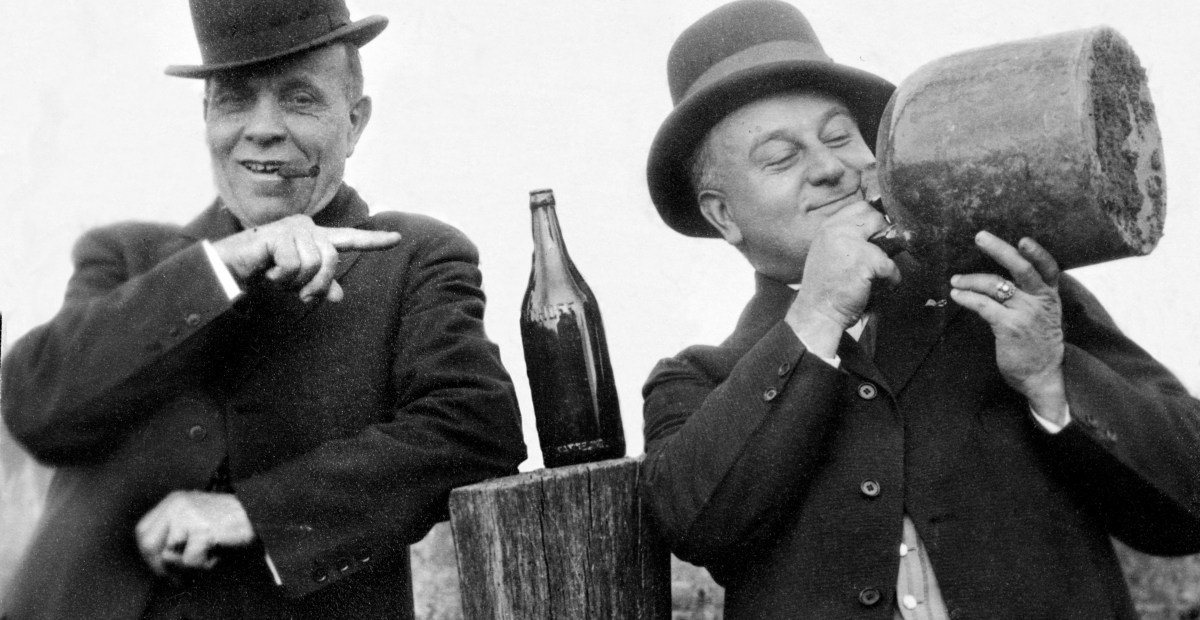
On Friday, a federal appeals court struck down a nearly 160-year-old federal law prohibiting people from distilling liquor in their own home.
That’s a fairly momentous event in its own right — any claim that a law that’s been on the books since Reconstruction is unconstitutional should be greeted with a heaping spoonful of skepticism. But the United States Court of Appeals for the Fifth Circuit’s decision in McNutt v. US Department of Justice is particularly significant because it is all but certain to be heard by the Supreme Court, and this case may tempt the Court’s Republican majority to impose restrictions on federal power that have not existed since the early stages of the New Deal.
Although the justices normally get to choose which cases they wish to hear, the Court almost always agrees to hear a case “when a lower court has invalidated a federal statute.”
McNutt potentially raises a question that the Supreme Court resolved in the Franklin D. Roosevelt administration, but that many right-leaning lawyers and legal scholars have wanted to reopen for many decades. These Roosevelt-era decisions permit Congress to regulate the American workplace, such as by banning child labor or establishing a minimum wage. They also allow many federal regulations of private businesses to exist, including nationwide bans on whites-only lunch counters and other forms of discrimination.
The Constitution gives Congress sweeping authority over the national economy. But, for a period of several decades beginning in the late 19th century, the Supreme Court strictly limited the federal government’s power to regulate commercial activity that occurs entirely within one state. In Hammer v. Dagenhart (1918), for example, the Court struck down a federal law that sought to ban child labor, on the theory that most child workers’ jobs do not require them to cross state lines.
The Court abandoned this strict divide between national and local economic activity during the New Deal era — Hammer was overruled in 1941. But many prominent conservative legal thinkers, including Justices Clarence Thomas and Neil Gorsuch, have called for a return to the more limited approach to federal power that drove the Hammer decision.
McNutt tees up a potential Supreme Court showdown over Congress’s ability to regulate economic activity that occurs within a single state because the new case challenges a ban on alcohol distilling within the home. Most people’s houses do not cross state lines.
That said, there is a wrinkle in the McNutt case that may make it more difficult for justices who want to relitigate the New Deal to do so in this case. For reasons that aren’t entirely clear, the Justice Department, which is defending the ban in court, decided not to make its strongest legal argument on appeal — the argument that the ban on home distilling fits within Congress’s broad authority to regulate the national economy. So, if there are five justices who want to overrule some of the Roosevelt-era decisions establishing that Congress’s power over the economy is very broad, they will have to do so despite the fact that the DOJ seems to want to avoid this issue.
But that doesn’t change the fact that the best legal argument for the law at issue in McNutt is that Congress has the power to regulate local distilling under the New Deal decisions. So, if the Supreme Court wants to declare the law unconstitutional, it will be difficult for the justices to ignore that fact.
McNutt is a hugely important case because it involves Congress’s two most consequential powers: the power to regulate the national economy, and the power to tax. Post-New Deal decisions defining these powers are the reason why a wide range of federal laws, including the minimum wage, the federal law guaranteeing that every American can obtain health insurance, and most federal laws barring discrimination, are able to exist. So the stakes are simply enormous every single time the Supreme Court decides to play with these federal powers.
Congress’s power to regulate production, briefly explained
The Constitution contains a laundry list of powers that Congress is allowed to exercise, such as the power to raise armies and the power to establish post offices. A federal law is unconstitutional if it does not fit within one of the powers specifically given to Congress by the Constitution.
That said, many of these powers are extremely broad. Congress’s lawful authority includes the power to tax, the power to spend these tax dollars to “provide for the common Defence and general Welfare of the United States,” and the power to “regulate Commerce…among the several States.” The Constitution also includes a somewhat vague provision permitting Congress to “make all Laws which shall be necessary and proper for carrying into Execution” laws enacted pursuant to its other powers.
When the Constitution was drafted way back in 1787, its provision allowing Congress to regulate commerce “among the several States” was understood to draw a line between the entire nation’s economy and purely local commerce. In the pre-industrial United States, a farmer located in, say, Iowa, might grow his crops on Iowa land, then transport them to a nearby Iowa town where they were purchased exclusively by other Iowans. Because none of this farmer’s behavior impacted more than one state, it was generally understood to be beyond Congress’s power to regulate.
But all of that changed after the construction of the railroads. In the post-industrial United States, this same farmer’s crops would be shipped to Chicago via the railways, where it would mix with similar grain grown by farmers throughout the Midwest. Then it might be shipped to consumers in many other states, or even overseas.
For about four decades in the late 19th and early 20th century, the Supreme Court tried to maintain a rigid divide between economic activities that were local in character, and those that impacted the entire nation’s economy. Hammer, for example, claimed that the production of goods for sale in an interstate or international market was beyond the reach of Congress, because factory workers typically do not cross state lines while they are producing those goods.
But this distinction proved unworkable. Even if Congress couldn’t regulate factory work directly, for example, its power to regulate the transit of goods across more than one state should allow it to ban any goods that are produced by child workers from traveling across state lines. So the Court largely stopped trying to draw a distinction between commerce that impacts the national economy and commerce that does not during the Roosevelt administration.
In Wickard v. Filburn (1942), the Supreme Court held that Congress’s power to regulate the production of goods includes the power to regulate all goods that are produced in the United States, even if some of those goods are never sold to anyone. Wickard rested on a modern understanding that all economic activity is connected, and that goods are often fungible. If a farmer grows wheat that only they and their family consume, the Court reasoned, that still increases the overall supply of wheat, which makes the overall price of wheat throughout the United States cheaper.
More recently, in Gonzales v. Raich (2005), the Court applied this logic to marijuana. Congress, Raich held, could ban all marijuana production throughout the United States, including marijuana growth by individual producers who consume their own supply, because otherwise local growers would undercut the federal government’s goal of eliminating the nationwide market for marijuana altogether.
Wickard, in other words, established that Congress’s power to regulate the national marketplace for wheat includes the power to regulate all wheat produced in the United States, and Raich reached a similar conclusion regarding marijuana. So it should follow that, in the McNutt case, Congress’s power to regulate distilled liquors includes the power to regulate all distilled liquors, including those that are produced inside the home.
The Justice Department inexplicably did not rely on Wickard and Raich in its brief defending the ban on home distilling
Despite all of this legal history, the Justice Department cites neither Wickard nor Raich in its Fifth Circuit brief in the McNutt case. So, rather than analyzing whether the ban on home distilling is constitutional under those two cases, the Fifth Circuit’s opinion includes a short footnote indicating that the government “forfeited” any claim that Congress may ban home distilling under its broad power to regulate commerce.
Notably, the Justice Department filed its brief in October 2024, when President Joe Biden was in office. So the DOJ’s decision not to raise its strongest legal argument cannot be blamed on the fact that the Trump Justice Department is staffed with many lawyers who share Thomas and Gorsuch’s belief that huge swaths of federal laws regulating private businesses are unconstitutional.
Instead, the Justice Department made a less intuitive argument that Congress may ban home distilling to prevent local distillers from undermining Congress’s ability to tax alcohol.
In fairness, this argument is less silly than it sounds at first blush. As the DOJ argued in its brief, the ban on home distilling was originally enacted in 1868 “shortly after a congressional committee detailed rampant evasion of the spirits tax, including by home distillers.” The law was intended to force liquor producers to create their products openly, in distilleries that could be easily identified by the government and thus taxed.
Recall that the Constitution does not simply permit Congress to levy taxes; it also permits it to “make all Laws which shall be necessary and proper for carrying into Execution” those tax laws. In Felsenheld v. United States (1902), the Supreme Court indicated that this power to make laws incidental to taxation is quite broad — writing that “in the rules and regulations for the manufacture and handling of goods which are subjected to an internal revenue tax, Congress may prescribe any rule or regulation which is not, in itself, unreasonable.”
Still, Felsenheld is a very old case. And it is far from clear that a majority of the current Court, which often appears eager to shrink the government’s power to regulate private businesses, would deem an outright ban on home distilling to be a “reasonable” way to ensure that federal liquor taxes are collected — even though this ban has been around for more than a century and a half.
The Fifth Circuit, for what it is worth, did include a single sentence in its opinion explaining how a law that’s been around for nearly 160 years could suddenly become unconstitutional. It claimed that “the economics and practicality of at-home distilling today are much different than they were in the nineteenth century, and so is the government’s ability to investigate such activity.” So maybe the fact that the government has more ability to track down home distillers in 2026 than it did in 1868 could allow the Supreme Court to write a narrow opinion striking this law down because the law is no longer needed to serve its original purpose.
But that argument only works if you ignore Wickard and Raich, which permit the government to regulate all alcohol production anywhere in the United States, including within the home.
So how is this case likely to play out?
Again, it’s overwhelmingly likely that the Supreme Court will hear McNutt. The Court almost always reviews federal appeals court decisions that declare a federal statute unconstitutional.
To the extent that the Biden Justice Department wanted to avoid a showdown over whether Wickard and Raich should remain good law by simply ignoring those cases in its Fifth Circuit brief, this strategy is unlikely to work for very long. If the Supreme Court strikes down the home distilling ban on the narrow grounds that it’s not necessary to ensure that liquor is taxed, the federal government could revive the ban at any time by claiming that it’s lawful under Wickard and Raich — and then the courts would have no choice but to consider that argument.
Once McNutt reaches the Supreme Court, moreover, it’s likely that many of the justices will be eager to reconsider Wickard and Raich. Both decisions are very unpopular in Republican legal circles. And two justices, Thomas and Gorsuch, are so hostile to the post-New Deal understanding of federal power that they’ve endorsed the same legal framework that the Court once used to strike down child labor laws.
The question is just how far this Court will go if it does reconsider those two decisions. Again, the New Deal-era insight that Congress may regulate the entire chain of commerce, from the production of goods to their eventual sale to a local consumer, forms the basis for countless federal laws. It is the reason why Congress may regulate the workplace, bar restaurants from refusing to sell to Black customers, or require businesses to construct wheelchair ramps or other accommodations which ensure they are accessible to everyone.
Wickard and similar cases all stand for the proposition that it is so hard for the courts to draw a principled line separating the national economy from local commerce that any attempt to do so will make a hash of the entire project, and require the courts to strike down federal laws for completely arbitrary reasons. If a majority of the justices decide to reconsider those cases, we can only hope that they find some way to limit the scope of their decision.




Leave a Reply