
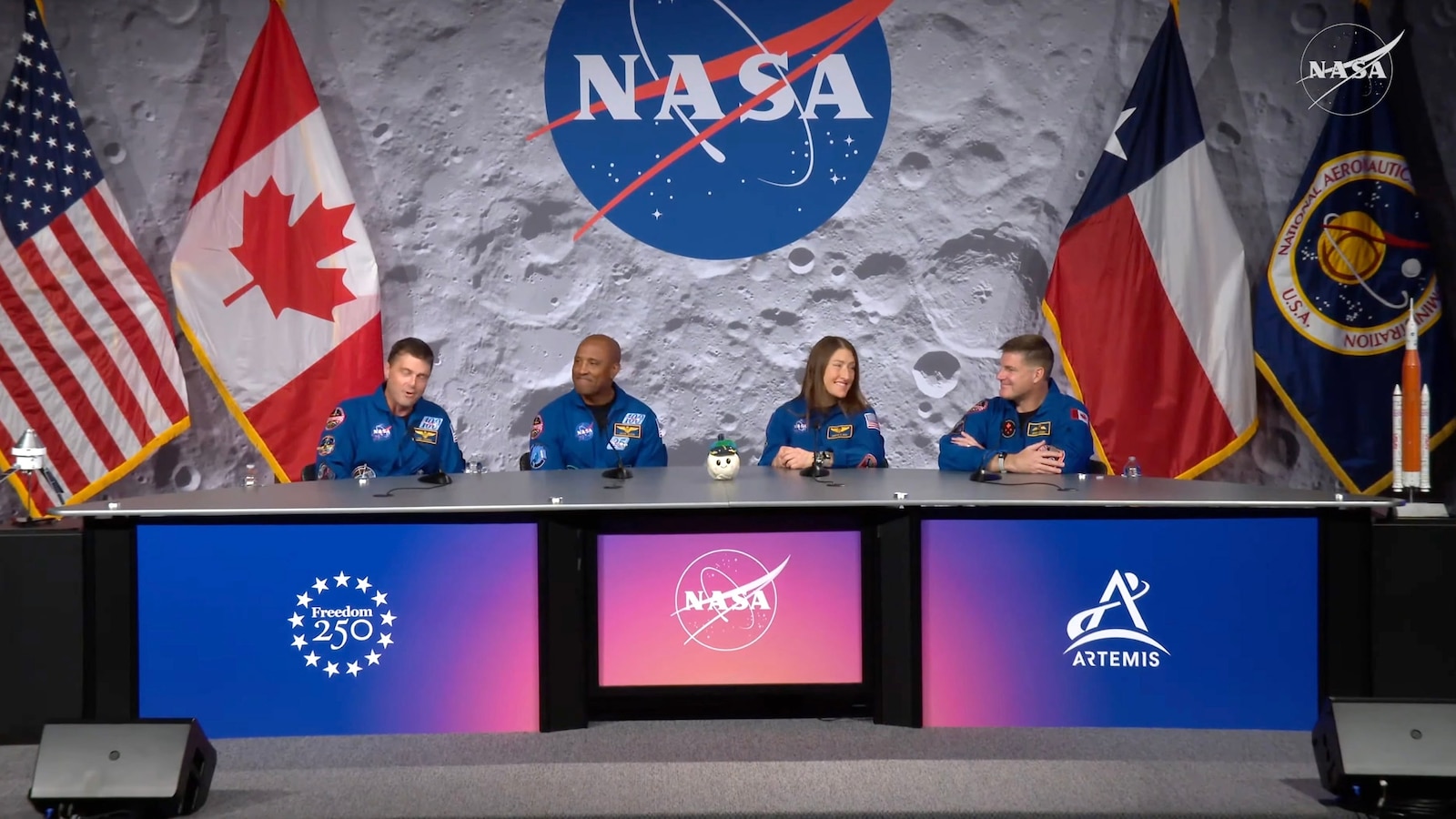
Less than a week after returning from their historic 10-day, 694,481-mile journey to the moon and back, the Artemis II crew answered questions on Thursday about their successful mission.
During a news conference at NASA’s Johnson Space Center in Houston, home of the Mission Control Center, the three NASA astronauts and one Canadian Space Agency astronaut spoke fondly of their time aboard the Orion spacecraft, Integrity, and recalled how they came together as a crew during the first mission to the moon in more than 50 years.
Reid Wiseman, who served as the Artemis II commander, said, “What an amazing journey that was. First and foremost, Victor, Christina, Jeremy, just thank you. This was an unbelievable adventure, and it was made possible by this crew and the support of each other throughout the whole thing.”

NASA’s Artemis II mission astronaut, commander Reid Wiseman, speaks at a press conference on April 16, 2026.
NASA
He added, “We are bonded forever. I mean, that’s the closest four humans can be and not be a family.”
“I am here to tell the world: we launched as friends, and we came back as best friends,” he added.
When asked by ABC13 reporter Nick Natario whether the gravity of what they’ve accomplished has hit them and how it may have changed them, the crew said they were focused on completing the mission.

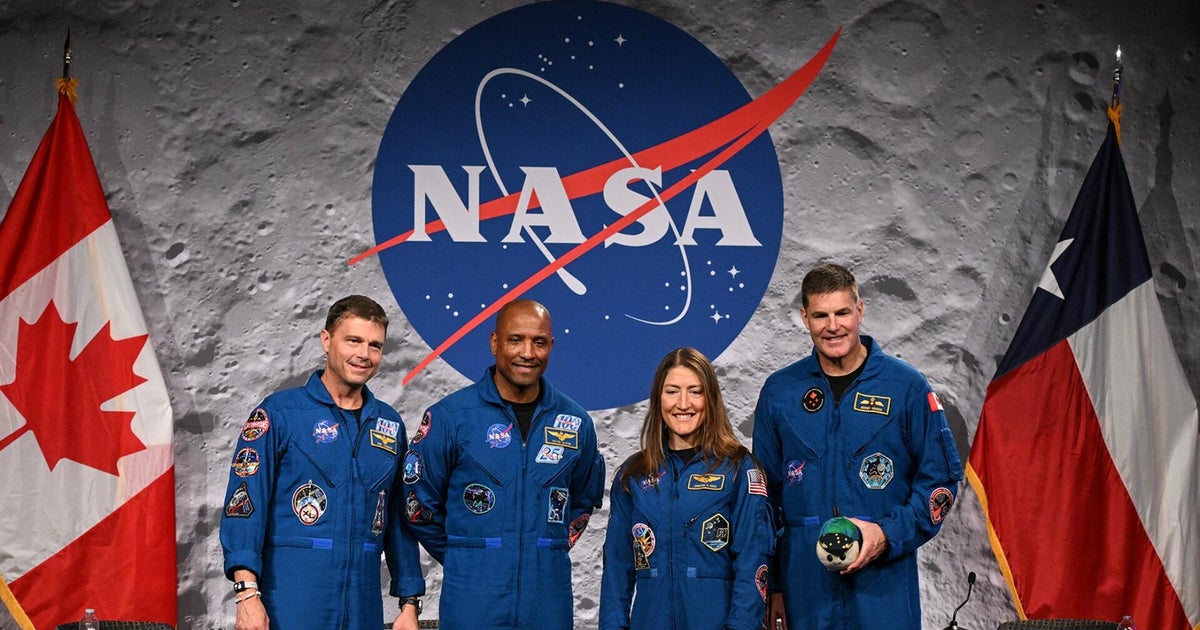
NASA’s Artemis II mission astronauts commander Reid Wiseman, pilot Victor Glover, mission specialist Christina Koch, and Canadian Space Agency’s Jeremy Hansen appear at a press conference on April 16, 2026.
NASA
Victor Glover, the pilot for the mission, added, “We did what we said we were going to do, and now we’ve got to step out and just face that reality.”
Christina Koch, one of the flight’s mission specialists, said, “When my husband looked me in the eye on that video call and said, ‘No, really, you’ve made a difference.’ It brought tears to my eyes, and I said, that’s all we ever wanted.”
She added, “When we come before you now, we’ve done this together. We took your hearts with us and your hearts lifted our hearts.”

NASA’s Artemis II mission astronaut mission specialist Christina Koch speaks at a press conference on April 16, 2026.
NASA
Jeremy Hansen, the first Canadian to travel into deep space, said, “I found it really refreshing to find out how people have followed the mission and been creative with the mission and there’s lots of funny stuff online. And that really resonates with me a lot, and it just reinforces something I already knew, but humans are just great people in general. We don’t always do great things. We’re not always in our integrity, but our default is to be good and to be good to one another.”
When asked if the experience of traveling to deep space created a “sense of universal connectedness,” Wiseman said, “I turned to Victor, and I said, I don’t think humanity has evolved to the point of being able to comprehend what we’re looking at right now, because it was other worldly and it was amazing.”
In terms of their sleep about Orion, Koch said that “space sleep is the best sleep ever,” and now that she’s back on Earth, she said, unlike after her International Space Station mission, this time, “every time I’ve been waking up or in the first few days, I thought I was floating. I truly thought I was floating and I had to convince myself I wasn’t.”

NASA’s Artemis II mission astronaut Canadian Space Agency’s Jeremy Hansen speaks at a press conference on April 16, 2026.
NASA
Wiseman complimented the Orion spacecraft and the Space Launch System and said it’s ready for the Artemis III mission, scheduled for 2027.
“My own personal opinion, they could put the Artemis III Orion on the Space Launch System tomorrow and launch it, and the crew would be in great shape,” said Wiseman. “This vehicle really handled very well.”
When asked what they brought with them on the trip, Wiseman said he took some notes from friends, some great quotes and a bracelet that his daughter had made for him a few years prior.
The crew was asked what advice they would give to younger people “who are looking skywards.”
Wiseman said one thing that he thinks society has lost is the pursuit of challenging goals.
“You have to go do really hard, really challenging things and you have to go move the needle,” said Wiseman. “We have to get our hands out there and engaged. Our hands and our minds have got to be engaged.”

NASA’s Artemis II mission astronaut pilot Victor Glover speaks at a press conference on April 16, 2026.
NASA
Glover encouraged young people to “really get comfortable asking questions and then listening to their peers, but also their mentors. I think that’s been a game-changer for all of us.”
Koch added that people should “find your fulfillment,” “do what scares you,” and “support those around you.”
Hansen said people should “just follow the example that people saw here, don’t do it alone, and share what you’re trying to accomplish with others, because you need the support of others to do big things, and so share your goals. Be brave enough to share them.”
With the next Artemis mission scheduled for as early as next year, the crew discussed their contributions to what comes next for NASA and its pursuit of a moon base.

The Artemis II crewed lunar mission lifts off from Pad 39B at Kennedy Space Center in Cape Canaveral, Florida, on April 1, 2026.
Jim Watson/AFP via Getty Images
“We were very much lifted up by the notion that we would get to contribute to astronauts doing this all over again, much sooner than we thought that we were going to be focused on the moon base, on surface operations,” said Koch. “And I would say, if nothing else, we are feeling even more excited and just ready to take that on as an agency.”
Wiseman added that if we had a first flight lander on board that thing, I know at least three of my crewmates would have been in it, trying to land on the moon.”
“We have to be willing to accept a little more risk than we were willing to accept in the past, and to just trust that we will figure it out in real time. We’re not going to be able to pound everything flat before we go. We’re going to have to trust each other and crews and Mission Control to work through real problems,” Hansen added.










Leave a Reply