
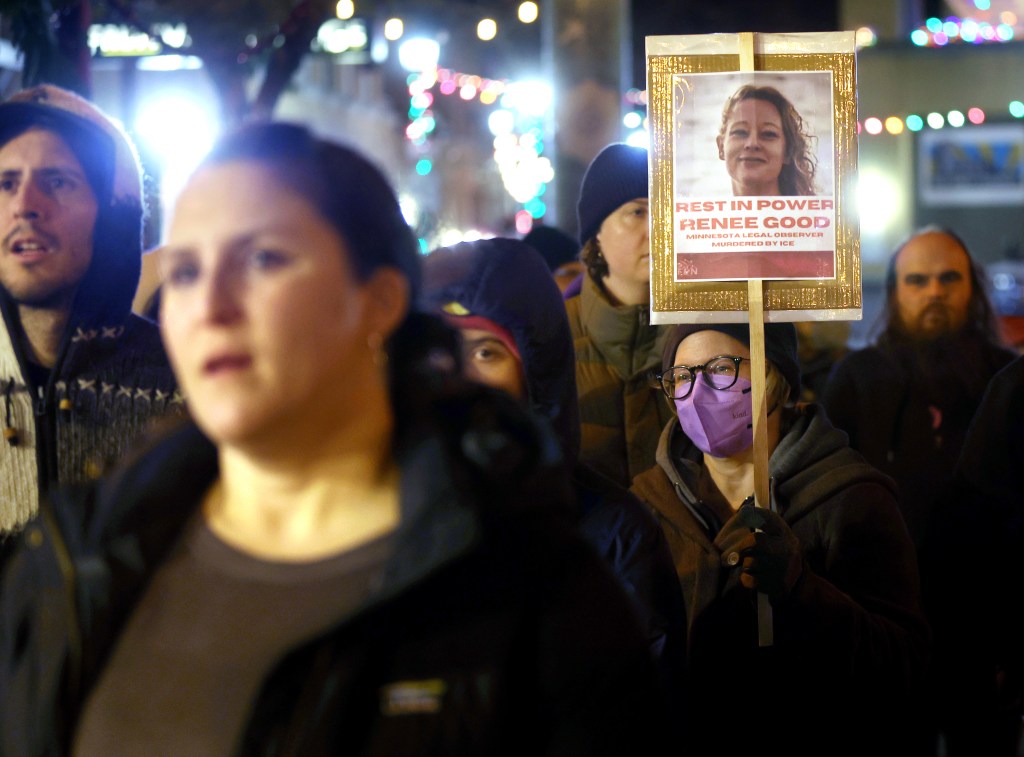
The entire encounter — a law enforcement officer standing briefly in front of a vehicle, then to its side while firing multiple fatal shots at its driver — lasted less than 30 seconds. Video captured it all, down to the motorist going limp and the vehicle crashing down the street.
It could describe the killing of Renee Good, a 37-year-old woman, Wednesday by an Immigration and Customs Enforcement agent in Minneapolis — an act that has already divided the nation, with critics denouncing it as an unlawful killing and President Donald Trump and his administration framing the encounter as “terrorism” by a woman who “weaponized her vehicle” against law enforcement.

RELATED: After ICE killing in Minnesota, Bay Area observers fear the same could happen here
Yet to policing experts and civil-rights attorneys across the Bay Area and California, the scene bears eerie similarities to a series of local police shootings involving moving vehicles — including one that sent a Contra Costa County sheriff’s deputy to prison. Others, while not resulting in criminal charges, still produced major civil settlements, such as BART’s $6.75 million payout after video showed a woman was driving away when she was shot.
“The Minnesota case is even more clear-cut” than the 2018 Contra Costa County police killing, said Adante Pointer, an Oakland-based civil rights attorney. “That woman should be alive today, and that officer should be swiftly facing criminal charges.”
On Thursday, a dispute emerged between Minnesota public safety leaders and the White House after state officials said they were unable to access evidence from the shooting and were told the FBI and U.S. Justice Department would not work with them, the Associated Press reported.
Federal agents, including ICE officers, are generally subject to federal law and federal investigations, even when their actions occur inside a state. While states can pursue charges in some circumstances, federal jurisdiction and immunity doctrines often limit state authority — meaning cases are typically reviewed by the FBI and U.S. Justice Department rather than local prosecutors.
The footage from Minneapolis is disturbing, said Cathy Riggs, a retired Los Angeles police officer of more than 30 years who now consults on police use-of-force cases. While no law explicitly prohibits officers from firing at moving vehicles, the practice is widely discouraged.
The odds of hitting a moving target are low, experts say, and when a driver is struck, the vehicle itself can become a deadly, uncontrolled force before it comes to a stop.
“The fact that (the ICE agent) shot instead of getting out of the way, I don’t understand that,” Riggs said. “It seems like a huge escalation of force as to what’s warranted.”
“You don’t shoot at a moving vehicle — you avoid it,” said Robert Clark, a former Los Angeles County sheriff’s deputy who has testified as a use-of-force expert. “You’re not going to stop two tons of steel coming at you with a 185-grain bullet.”
California’s standards governing deadly force are even stricter than in much of the nation. Since 2019, state law has required that lethal force be “necessary,” a higher bar than the federal standard, which generally permits force when it is “objectively reasonable.”
Even by that looser federal measure, several Bay Area civil rights attorneys said the Minnesota shooting appeared indefensible.
“It’s clearly an unlawful shooting and an illegal shooting and tantamount to murder in my point of view,” said John Burris, an Oakland-based attorney who has represented plaintiffs in numerous excessive-force cases. “This was just outrageously wrong conduct — a violation of just about every police standard that I’m aware of.”
Burris and others pointed to the 2018 killing of Laudemer Arboleda, who was fatally shot by Contra Costa County sheriff’s Deputy Andrew Hall as Arboleda attempted to flee a traffic stop in Danville. Though Hall initially stood in front of the vehicle, his position changed during the encounter, and at least two of the 10 shots he fired entered the car through the passenger side.
A jury later convicted Hall of assault with a firearm after deadlocking on a manslaughter charge, marking the first on-duty shooting conviction of a law-enforcement officer in Contra Costa County history. He was sentenced to six years in prison.
His case proved to be an outlier, with criminal charges rarely filed in such shootings. More often, they lead to hefty lawsuit settlements, such as a $7 million payout in 2023 by the California Highway Patrol in the killing of Erik Salgado. In 2022, a jury awarded $21 million to the family of 16-year-old Elena “Ebbie” Mondragon, who was a passenger in a vehicle that came under fire from Fremont police.
Police encounters involving moving vehicles are “very dynamic,” with officers forced to make split-second decisions in roadways while considering a vehicle’s position and the safety of other motorists and bystanders, said Tony Turnbull, who retired from the Sacramento County Sheriff’s Office in 2020 after more than 30 years investigating cases in which police shot people.
“When you talk about best practices, you would be having to talk about a very sterile environment,” Turnbull said. “I know people want answers. Sometimes you just have to sit back and let the investigation play out.”
Pointer, the Oakland attorney, criticized the notion that the Minnesota woman’s vehicle had been “weaponized,” calling it “a political term to make a legal justification for, what looks to me, like an unlawful and inexcusable use of deadly force.”
Past initial assessments of such killings have proven to be wrong. He cited the 2024 shooting of Jasmine Gao, 32, who was shot while driving away from officers in the parking lot of BART’s Union City station.
BART Police Chief Kevin Franklin initially said Gao “is alleged to have assaulted a police officer,” but body-camera footage contradicted that account. BART ultimately paid Gao $6.75 million in a settlement while acknowledging she had not harmed any officers. The officer who shot her was later fired.

Since then, and in the wake of a 2019 state transparency law, California police agencies have increasingly turned to public relations firms to produce slick, persuasive videos explaining police shootings. While agencies and the firms they hire defend the practice as adding necessary context, critics say the highly edited videos omit key details and cast officers’ actions in an overly sympathetic light.
The latest shooting comes in a markedly different climate from the last police killing in Minnesota to galvanize the nation. In 2020, the murder of George Floyd by a Minneapolis police officer sparked nationwide protests and ultimately led to the officer’s conviction.
But police-reform advocates say the momentum for change after Floyd’s death has stalled — and in some cases reversed — as transparency by law-enforcement agencies across the Bay Area and the nation has steadily eroded.
Police departments across the region have restricted access to radio traffic, while in Oakland, city leaders recently withheld body-camera footage of a former NFL player who died in police custody, arguing that a state law requiring its release did not apply.
“There was a lot of progress that was made after George Floyd got killed that’s been undone,” said Melissa Nold, a Vallejo-based civil rights attorney. “People need to be very, very mindful that we’re reverting back.”
Jakob Rodgers is a senior breaking news reporter. Call, text or send him an encrypted message via Signal at 510-390-2351, or email him at jrodgers@bayareanewsgroup.com.


Leave a Reply