
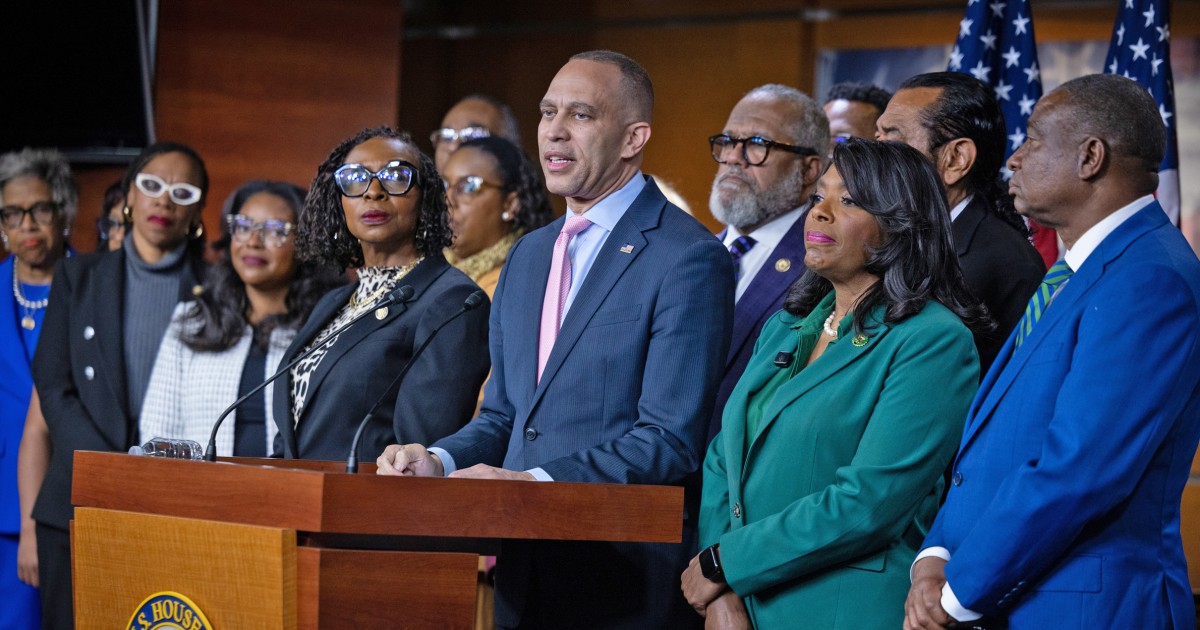
WASHINGTON — The Congressional Black Caucus, a power center in the Democratic Party for decades, saw its membership rise this Congress to an all-time high of 58 House members.
Subscribe to read this story ad-free
Get unlimited access to ad-free articles and exclusive content.

Now, thanks to a Supreme Court redistricting ruling that’s expected to dramatically diminish Black representation on Capitol Hill, the CBC is fighting a five-alarm fire that could devastate its membership.
CBC Chair Yvette Clarke, D-N.Y., said as many as 19 of the caucus’ members could be affected by the redistricting wars in a worst-case scenario, though she noted it’s still fluid given that states are still drawing new maps in the wake of the Supreme Court ruling.
“It’s devastating. People have sacrificed so much to make this a more perfect union. And here we are, in 2026, seeing this massive regression in all the gains that have been made. It’s painful,” Clarke told NBC News on Tuesday.
Members of the CBC have already held informal planning sessions to start mapping out a game plan to fight back on multiple fronts — both in the courts and on the campaign trail. While that plan is still coming together, much of the strategy is likely to focus on turning out Black voters in November, in part on a message of passing voting rights legislation if Democrats can win back the House. It’s less clear where they can have legal success, though the CBC is coordinating with activists and legal groups to challenge state redistricting efforts.
“We’re not hopeless, and we’re not helpless in this moment,” Clarke said. “And I think that, as the young people say, these folks may have played themselves, because the backlash is coming, and while [Republicans] may have momentary gains, the status quo will not hold.”
Clarke also said she has been in touch with the CBC members who may be affected by redistricting, while House Minority Leader Hakeem Jeffries, D-N.Y., said he’ll convene an emergency meeting of House Democrats on Thursday to detail the party’s plans to “forcefully push back against the Republican redistricting scheme.”
Jeffries is poised to become the first Black speaker if Democrats win back the House — a prospect now made harder.
The ruling is immediately being felt by a handful of Congressional Black Caucus members in deep-red, GOP-controlled Southern states. The Supreme Court decision centered on Louisiana, where Republicans are racing to redraw the map to scrap one or both of the state’s two Democratic, Black-majority districts.
“It’s Jim Crow 2.0,” said longtime Rep. Bennie Thompson, who as the only Democrat in the Mississippi delegation is being targeted by Republicans. The court decision “potentially takes us back 60 years.”
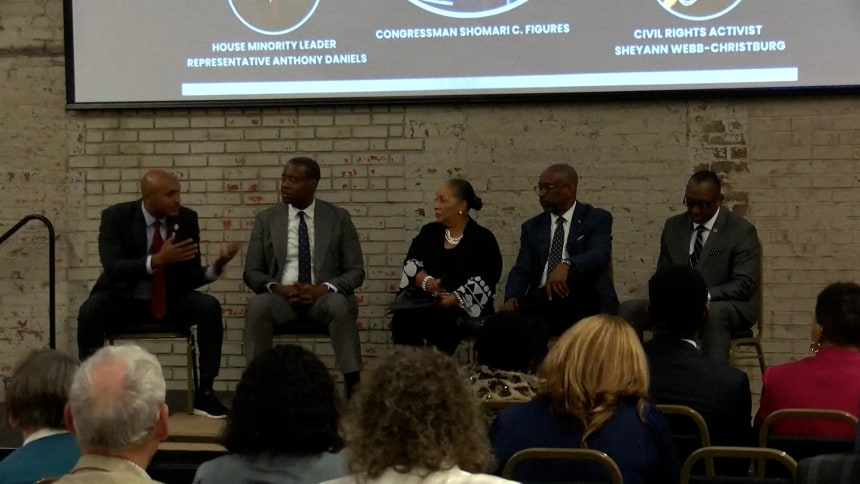
On Monday, the Supreme Court sent a case challenging Alabama’s new GOP-drawn map back to a lower court, clearing the way for state Republicans to eliminate the district held by freshman Rep. Shomari Figures, a Democratic CBC member from Mobile.
Other redistricting efforts by GOP-controlled legislatures have targeted Reps. Don Davis of North Carolina, Emmanuel Cleaver of Missouri and Al Green and Marc Veasey, both of Texas. In addition to Thompson, longtime Black lawmakers from states like Georgia and South Carolina also are at risk of having their districts redrawn to be more Republican-friendly in the next cycle.
“It is a new form of Jim Crow that this Supreme Court has given license to policymakers to say it’s OK for a white member of Congress to have a 65% white voting population in their district, but it’s not OK for an African American elected official to have a 55% or 60% district,” Derrick Thompson, president of the NAACP, said in a phone interview Tuesday.
“We are witnessing Southern legislators across the former Confederacy approach this racialized gerrymandering process in a way in which we thought we had gotten beyond,” he said.
‘It’s going to set our country back’
Section 2 of the Voting Rights Act of 1965 prohibits voting practices that discriminate on the basis of race. It was enacted during the Civil Rights era because many states, especially in the South, were still finding roundabout ways to prevent Black people from voting through election rules, gerrymandered districts and other practices.
But the recent Supreme Court ruling sharply narrowed how Section 2 can be used in redistricting cases, paving the way for states to scrap majority-minority districts. Democrats say that both disenfranchise minority voters and wipe out many of the Black members who represent them.
Republicans, however, argued that the Callais decision in Louisiana came in response to Democratic overreaching.
“We had a 5-1 map in Louisiana, and it was Democrats who took that map to court because they wanted to try to draw more Democratic seats, and ultimately the 4-2 map that was ruled unconstitutional,” House Majority Leader Steve Scalise, R-La., said Tuesday. “They did that in Virginia, too. Democrats have a history of going too far.”
CBC members from the South who could be targeted include veteran Rep. James Clyburn, D-S.C., who was the most powerful Black lawmaker on the Hill when he was majority leader, and Bennie Thompson, who is in line to return as Homeland Security Committee chairman if Democrats take back the House this fall.
“It’s heartbreaking. I mean, it’s going to set our country back,” Rep. Andre Carson, D-Ind., a CBC member who would most likely have been targeted had Indiana not rejected redistricting efforts, told NBC News. “It’s unfortunate given the deep legacy of the South and the fact that these are CBC seats, and these are my colleagues and family.”
Clyburn said the Supreme Court ruling is just one setback Black lawmakers have experienced since President Donald Trump returned to office.
“You’ve got a president that’s taken Black folks out of everything,” Clyburn told NBC News, pointing to the administration’s campaign against diversity, equity and inclusion initiatives. “So I don’t want us to just look at this voting case in isolation. No, this is a comprehensive attempt on the part of this administration to redeem Jim Crow. … He’s trying to turn the clock back.”
Last year in Missouri, state Republicans drew a new map that carved up Cleaver’s deep-blue district based in Kansas City and made it favorable for Republicans to win. The state Supreme Court ruled Tuesday that the map is allowed to go into effect for the midterm elections.
“They destroyed it,” Cleaver, a former CBC chairman who has been in Congress since 2005, said of his district.
Cleaver, a former mayor of Kansas City, lamented that his district was divided along Troost Avenue, which he described as historically a racial dividing line between Blacks and whites in the city.
“When I was mayor, I and other business leaders and politicians decided we were going to try to erase that and the stigma associated with it, and they came right back and established it,” Cleaver said in an interview. “It’s not healthy for our community; it’s not democratic. But what are we going to do, sit back and take it? I don’t think that’s in the Democratic DNA.”
Republicans losing Black members, too
Black representation isn’t dwindling on just the Democratic side of the aisle. All four Black GOP House members are either retiring or running for higher office, possibly leaving the Republican Conference with zero Black members next year.
Rep. Byron Donalds, a close Trump ally, is running for governor of Florida, while Rep. John James is running for governor of Michigan. Rep. Wesley Hunt lost his primary race for the Senate in Texas. And Rep. Burgess Owens of Utah is retiring.
That has attracted sharp criticism from former House Speaker Kevin McCarthy, R-Calif., who had focused on recruiting more Black, Hispanic and female candidates when he was leading Republicans from 2019 to 2023.
“They had more freshmen in the last class named ‘Mike’ than women. I recruited and elected the most women. We had four Black Republicans — they won’t have one next cycle,” McCarthy, who has been critical of his successor, Speaker Mike Johnson, R-La., told NBC News. “You’ve got to broaden it. You’ve got to go on offense.”
For Democrats, the series of blows from the courts has left the party scrambling to come up with a response less than six months before the November midterms. In some cases, Democrats have begun pointing fingers at one another.
“Black political representation has been under direct assault across the South. And I haven’t heard a mumbling word from @BernieSanders,” Vincent Evans, the CBC’s executive director, said on X this week, calling out the liberal icon and two-time presidential candidate.
“I checked both his X accounts — silent. I checked his Instagram — nothing. I checked his Senate website — crickets,” Evans continued. “At this point I’m starting to get worried. Has anybody checked on Senator Sanders? Because Black political power is under attack and somehow we can’t seem to run him down.”
Sanders’ office didn’t respond to a request for comment.
The Black Caucus has already taken some losses this year. Longtime Rep. David Scott, D-Ga., the first Black chairman of the Agriculture Committee, died last month at 80. And Rep. Sheila Cherfilus-McCormick, D-Fla., resigned last month ahead of a vote to expel her. Reps. Bonnie Watson Coleman, D-N.J., Danny Davis, D-Ill., and Dwight Evans, D-Pa., are among the CBC members who are retiring.
With the conservative Supreme Court ruling in Republicans’ favor in the redistricting battle, Thompson of the NAACP said it’s up to voters to respond and push back.
“I can say for all citizens of this country, we need to unite. This is not a Black problem. This is a problem of our democracy,” he said. “We have to overwhelm the system with votes so it is a clear message that this should not be accepted. And this is not about one community; it’s about all of our communities. We have to stand together and overwhelm the ballot box in November.”









Leave a Reply