
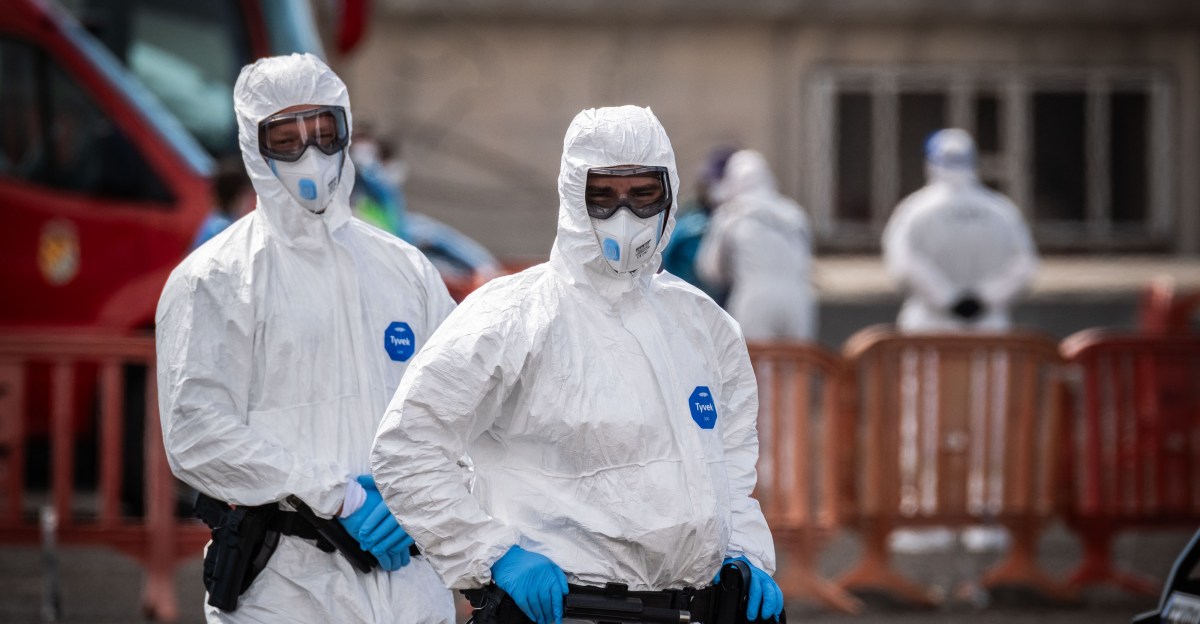
Eighteen Americans are now back in the United States after being stuck on a cruise ship that was stricken with an outbreak of hantavirus. That cruise seems a strong contender for among the worst in history — the passengers became stuck early last month, when a handful became sick.
Since then, three passengers have died from hantavirus, which is typically spread by rodents. While it is possible that the virus was spread from human to human on the ship, the World Health Organization stresses that the worldwide risk level from hantavirus is low.
That hasn’t stopped people from worrying, but Laurel Bristow, an infectious disease researcher at the Emory Rollins School of Public Health and host of the weekly radio show and podcast Health Wanted, says this viral outbreak is very far from warranting a pandemic-level freakout.
Bristow spoke with Today, Explained co-host Noel King about the outbreak and what we know about this specific strain of hantavirus, as well as the US response so far.
Below is an excerpt of their conversation, edited for length and clarity. There’s much more in the full podcast, so listen to Today, Explained wherever you get podcasts, including Apple Podcasts, Pandora, and Spotify.
The passengers that were on board the cruise ship that got hit by hantavirus got off the ship. What happened next?
All of the Americans who were on the cruise ship are now in a containment facility in Nebraska that is run by the University of Nebraska. It’s the only government-funded facility that can handle people who have been exposed to potentially novel or pathogenic viruses that have emerged. And so they are there to get monitoring and assessment from a care team and then hopefully they won’t stay there for too long.
They’re going to make a decision in conjunction with their care team about where they’re going to spend the 42-day quarantine that is being recommended. But they are not being forced to stay in that facility, though I think there’s a possibility that some might choose to.
Forty-two days of confinement is a long time and it suggests that what we’re dealing with here is something serious. What is hantavirus?
Hantavirus is actually a family of about 40 different kinds of viruses, and they’re primarily spread by coming into contact with the infected feces, urine, or saliva of rodents who are carriers.
Just to be clear, not all rodents are carriers of hantavirus. You know, people I’ve seen have been really scared, saying New York is full of rats. Not every kind of rodent carries hantavirus in the US. It’s primarily deer mice. And they’re usually found in the southwest of the Americas. That’s where we see our hantavirus cases.
What’s unique about this is that the Andes species of hantavirus is the only one that we have seen be able to transmit person to person. And because it happened to get into an environment that is conducive for the spread of infectious disease the way the close quarters of cruise ships are, that’s why we’re seeing such a kind of profound spread in a way that we haven’t really seen before.
Is it a very deadly disease?
It can be. It depends on what kind of hantavirus it is, but the case fatality tends to be up to 40 percent. I think Andes virus is 38 percent currently, and that’s because it can cause pulmonary syndrome, which causes severe pneumonia that can cause people to die, and it also can cause renal failure.
How did the Andes version of hantavirus get on this cruise ship? What do we know?
We are not sure. That investigation is ongoing, but I think the most likely working theory at this point is that one or two people who got on the cruise ship were infected with hantavirus on land in Argentina before they got on the ship, and then on the ship there was some degree of person-to-person transmission.
The first case was a 70-year-old man who passed away on the ship and nothing seemed out of the ordinary. And then of course, two weeks later, his wife got off the ship, or his partner got off the ship, and then she became ill and died. And on the same day that she got off, someone else became extremely ill and had to be medevaced.
Around that time, there started to be the suspicion that something was going on that was not just a fluke.
How does a person get this? What are the symptoms? And how are they passed?
One of the problems with the hantavirus outbreak is that the symptoms overlap a lot with influenza, so it’s not going to be the first thing that you suspect.
In these cases, you really have to think about what your actual exposure risk is with something like this and then person-to-person spread. We don’t know a ton about that yet. I think this outbreak in particular is going to teach us a lot. There have been outbreaks in Argentina before that were limited person-to-person spread, [but] I can’t really say for sure.
It does appear that this spreads similar to an influenza, but less so. It seems like you do need fairly close contact or to be in a room that has no ventilation with someone who is sick for a significant period of time.
Oh, that’s interesting. So what happened on the cruise ship is actually helping our understanding of how this thing spreads, unfortunately.
If you want to find a silver lining for it, it’s that this is going to allow us to learn a lot more about how this particular type of hantavirus spreads, which will help us in the future.
When we see and hear that the people have been let off the ship and that they’re in a containment facility in Nebraska, that feels good. I mean, we don’t like that anybody’s sick, but good that they’re all in one place.
But there are real outstanding fears here. What happens if one of them leaves the Nebraska facility too early? Or what happens if somebody somewhere drops the ball? How much of a concern is that really?
I am honestly really not concerned about there being significant onward spread of this disease. It’s a small number of people. They are acutely aware of the severity of the situation. They have been stuck on this boat probably reading headlines about them, and stories and posts about people saying, “Keep them on the boat forever.” I think that is a pretty good deterrent for them to not do anything too crazy to be the villain or the potential cause of an outbreak — which again, I don’t think will happen just from the way this virus functions.
They are being taken care of by professionals. They’re going to be monitored by professionals, and people don’t like to think about it, but this sort of stuff is not as uncommon as you think. I worked for the San Francisco Department of Public Health when there was an Ebola outbreak in West Africa and we monitored people who had been there caring for patients when they came home and they got to quarantine in their homes and we called them to check on their symptoms and make sure everything was good until they were out of that incubation period.
This is something that does happen behind the scenes. You’re just getting a lot more information about it because it is such a strange situation for hantavirus to be on a cruise ship.
That’s somewhat comforting. In the realm of less than comforting, President Trump was asked late last week if Americans should be worried and he said, “I hope not. We’re gonna do the best we can.”
It was not what we’ve come to expect from presidents when there is one of these situations. How would you rate the public health response coming from the administration to this point?
I would like there to be more regular updates. We’re getting to that point now where the CDC is starting to put out more regular updates about what is happening. I think that the people who are actually working on it are some wonderful, well-qualified people. The Epidemic Intelligence Service is a wonderful program that is very good at tracking outbreaks.
I think it’s unfortunate it took us this long to be involved. Because [the US has] left the [World Health Organization], that has really limited our ability to get information quickly and to be involved as quickly as we should have been, which is really unfortunate.
I just want to be very clear, my concern about this hantavirus outbreak becoming pandemic-level or even spreading, really, to anyone outside of the cruise line is incredibly low. But I am worried about our capacity to respond to an illness or a pathogen that transmits more readily if one should present itself in the future.
It seems pretty clear if you look online that there is a lot of misinformation spreading about hantavirus. Some of it is kind of in a jokey way. Some of it is people claiming, and I’ve seen a lot of this, people claiming to be public health experts or doctors and saying, “It’s time to panic. It’s time to freak out.”
As people are consuming news about this, how should they best make sure that what they’re getting is accurate?
Science communication requires a lot of nuance. If people are communicating things without any nuance, that is a pretty good sign that that is not someone that you should be investing a lot in because there are so many unknowns in this situation.
There are things that we know for certain, there are things that we don’t know, there are things we are waiting on. I think for someone to present something as black and white is a really good sign that they are not being cautious about where the information is at this point.
Also, anyone who appeals to emotion, who tries to get you to panic, is probably not a trustworthy source because anyone who works in infectious disease outbreak, anyone who works in research knows that there is no point to panicking. It’s not going to change a situation. What you need is to arm yourself with information to make the best choices for yourself and for your family, and to feel comfortable.
I think this appeal to emotion that’s happening with a lot of people is a good way to get engagement, especially because people are so heightened after having experienced Covid. But I think it’s really important to think about if someone is presenting information to you that is going to inform you or if it is just causing an emotional reaction in you.




Leave a Reply