
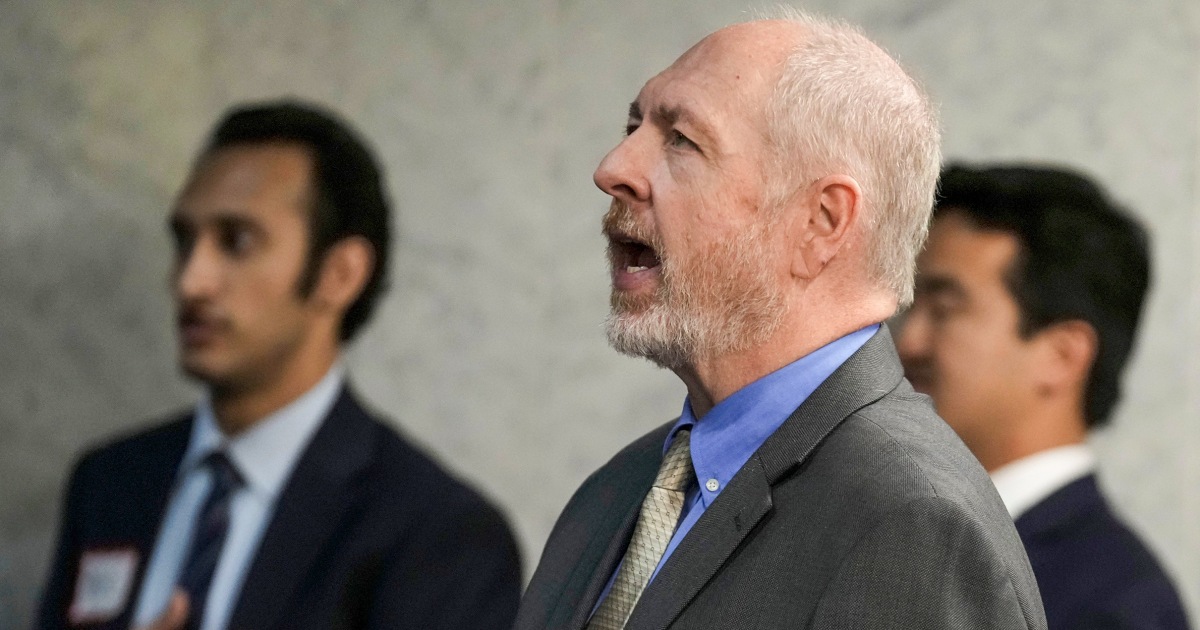
After a group of Indiana Republican legislators rejected their party’s redistricting plan last year, they faced public ridicule from President Donald Trump and millions of dollars in negative attack ads, with several ultimately losing their jobs Tuesday.
Subscribe to read this story ad-free
Get unlimited access to ad-free articles and exclusive content.

But three of those state senators told NBC News on Wednesday that they have no second thoughts about the vote that put them in the spotlight and led to their defeats at the hands of Trump-backed challengers.
“I have zero regrets,” state Sen. Greg Walker, a 20-year veteran of the chamber, said after he lost to state Rep. Michelle Davis.
“No,” state Sen. Jim Buck, who at 80 has served in the Legislature for more than three decades, said when he was asked whether he regretted his vote against the redrawn congressional map. “My district told me overwhelmingly to vote no, and that’s what I did.”
“I don’t regret it,” added state Sen. Linda Rogers. “I followed the wishes of my district.”

Walker, Buck and Rogers were among the seven state Senate Republicans on the ballot Tuesday who faced primary opponents endorsed by Trump after they opposed a congressional map proposal designed to give their party an additional two seats. The lawmakers said voters in their districts overwhelmingly saw the unusual mid-decade redistricting effort as unfair.
It was a rare rebuke of Trump, who had aggressively lobbied them to pass it as part of his broader campaign to enact new district lines around the country to boost the GOP in the midterm elections.
Five of the seven lost their primaries Tuesday, while another, Greg Goode, advanced to the general election. The other, Spencer Deery, led Trump-backed Paula Copenhaver by just three votes in a race that remained too close to call Wednesday.
In a text message to NBC News, Deery struck a similar note as his colleagues on his redistricting vote.
“I will never regret listening to constituents and doing the right thing,” he said.
Trump’s decision to get involved supercharged Indiana’s typically under-the-radar legislative primaries. According to the ad-tracking firm AdImpact, around $12 million was spent on ads in the seven races in which Trump-backed candidates were running against incumbent senators.
Facing an avalanche of negative ads from outside groups allied with Trump felt futile at times, the lawmakers said.
As he picked up his now-defunct yard signs from his district following his loss to Tipton County Commission member Tracey Powell, Buck noted that roughly $1.3 million was spent on ads opposing him in his primary. By comparison, his campaign didn’t even hit $150,000 in ad spending, according to AdImpact.
“No matter how hard you try, perception becomes reality,” Buck said. “You tell a lie enough times, and it becomes the truth.”
Buck said the influx of money was the biggest change over his 18 years in the state Senate.
“Dark money has really become an issue to deal with, but it’s the people are starting to lose their voice, and that worries me,” he said. “It’s a rich man’s playground, and I just feel sorry for that. I know that I couldn’t run again on my own like I did years ago.”
Rogers, who was defeated by Brian Schmutzler, said the attack ads were relentless.
“I’m very fortunate that I was able to raise significant dollars, but it doesn’t compete with the millions that poured in and when they played the same negative TV ads three, four times in an hour,” she said.

Buck, Rogers and Walker said they worried their primary defeats would send a signal to other legislators around the country that they wouldn’t be able to stand up to Trump if they felt it was in the best interest of their state.
“This is what our founders feared the most — that Washington would all of a sudden feel like they have the right to dictate what the states do,” Buck said.
Rogers said, “One person should not be making all the decisions.”
Meanwhile, the mid-decade redistricting battle these lawmakers pushed back against has continued apace nationwide. Eight states have enacted new congressional maps over the past year. And a major U.S. Supreme Court ruling last week could pave the way for others to join them soon.
Walker said such efforts were a key problem in modern politics, at both the state and national levels.
“That’s how Congress functions or dysfunctions today. It’s the threat of primaries,” he said. “And you can’t do that unless you have hyper-partisan gerrymandering districts. You can’t accomplish that mission of threat and coercion to bow to whatever the top dog says unless you create the structure for it.”







Leave a Reply