
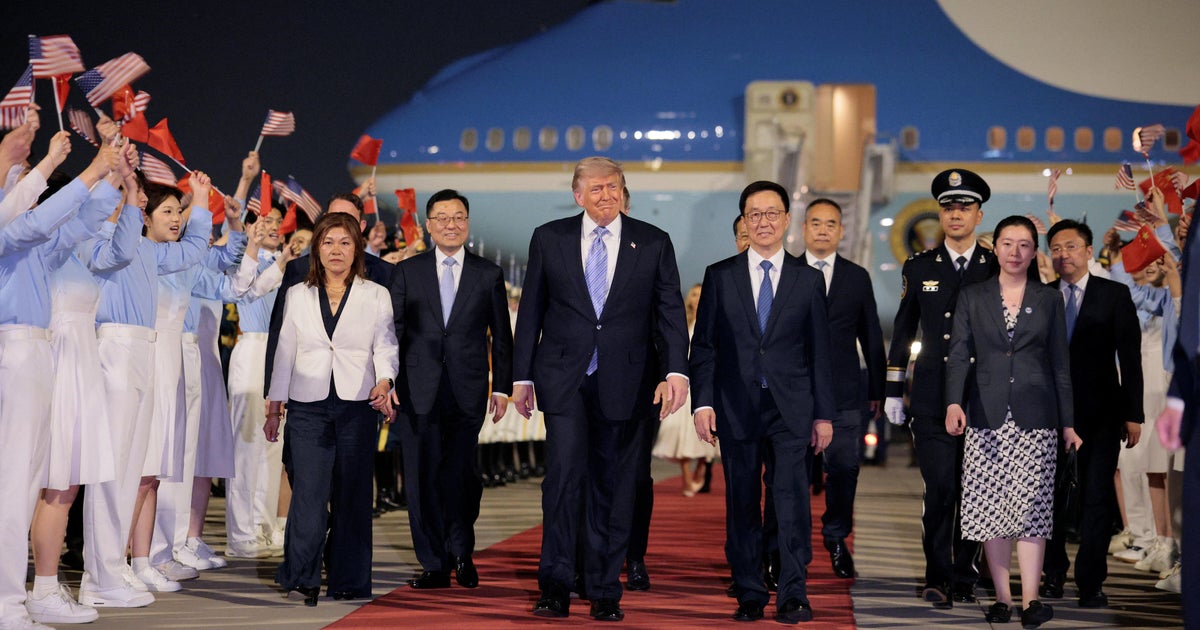
President Donald Trump is set for a high-stakes summit in Beijing on Wednesday as the U.S. signals it would welcome a diplomatic role for Beijing in ongoing talks to wind down the war in Iran.
Top U.S. officials, including Secretary of State Marco Rubio and Secretary of the Treasury Scott Bessent, who are a part of presidential delegation to China, have said China should encourage Iran to reach a settlement. Bessent called for the Chinese to “step up.”
China, which is Iran’s largest oil consumer, wields considerable diplomatic leverage over Tehran, experts told ABC News. That dynamic could overshadow talks on sharp bilateral issues between the U.S. and its chief global rival, like artificial intelligence technology, trade and the security of Taiwan as Trump prioritizes a settlement in the Middle East conflict.

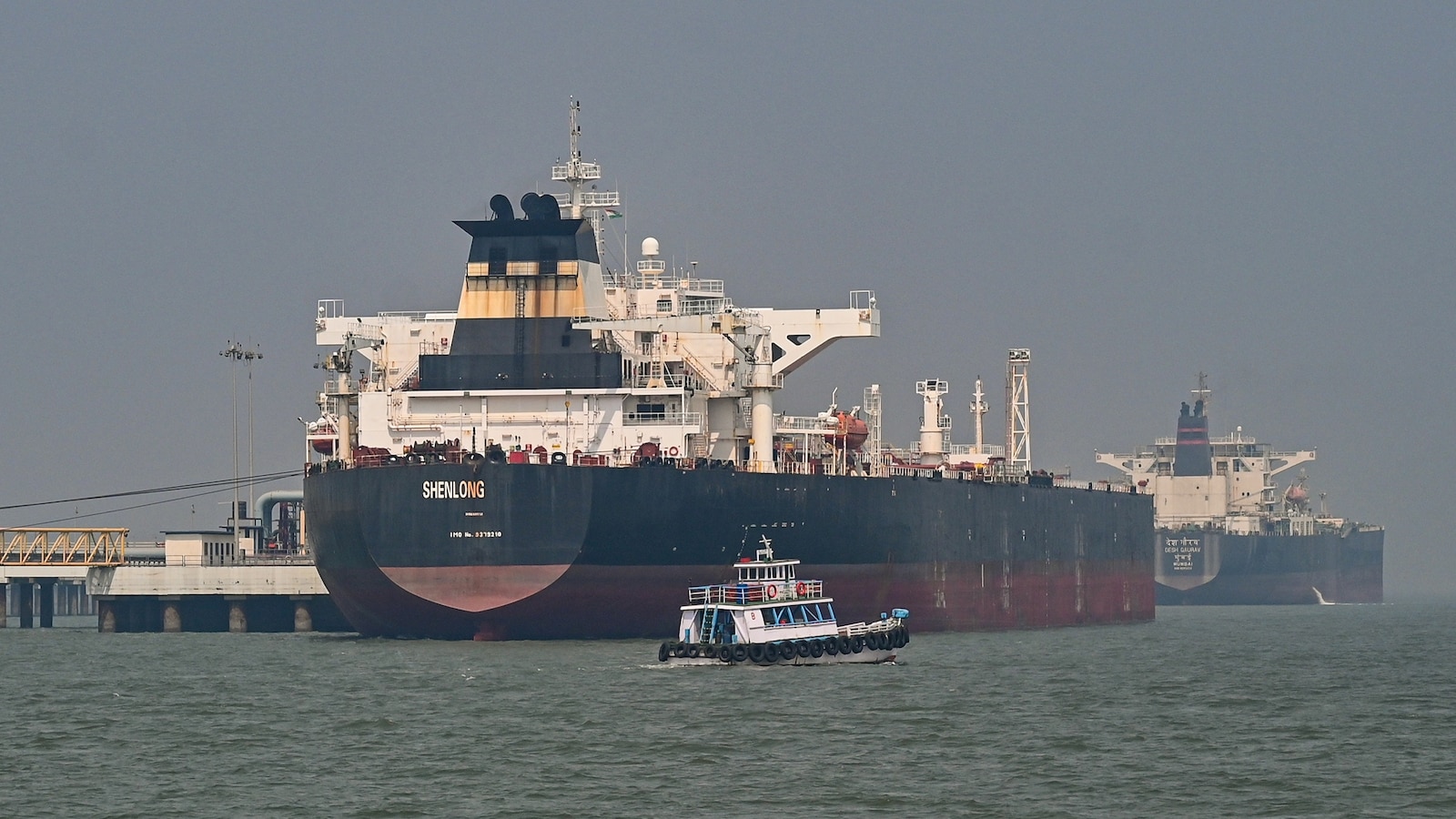
The Liberia-flagged crude oil tanker Shenlong Suezmax docked at Mumbai Port after navigating the Strait of Hormuz, March 11, 2026 in Mumbai, India.
Raju Shinde/Hindustan Times via Getty Images
The U.S. will likely make entreaties for Beijing to apply diplomatic pressure on Iran, the experts said. But China will likely be cautious and quiet in any involvement it takes in talks over Iran, and there are limits to its leverage over Tehran, they added.
The war, which has been paused since Trump announced a ceasefire more than a month ago, means Trump is “going to need China’s help,” a former senior U.S. government official told ABC News.
“He’s going to need Chinese help pressuring the Iranians to get to the deal that he envisions,” the former official said. “And so he’s going to be basically … going hat-in-hand into the summit as a result of what we’re dealing with here.”
But later, as Trump was leaving the White House for Joint Base Andrews, he went back and forth on whether he’d use that leverage.
Asked if the Chinese should intervene, Trump shrugged the question off, saying, “I don’t think we need any help with Iran.”
But minutes later, asked if Xi could help bring the ceasefire “back to life,” Trump said, “He could. I mean, it might be. I don’t think we need any help with Iran, to be honest with you, they’re defeated militarily, and they’ll either do the right thing or we’ll finish the job.”
He later appeared to say Iran wasn’t a primary topic of discussion.
“We have a lot of things to discuss. I wouldn’t say Iran is one of them, to be honest with you, because we have Iran very much under control. We’re either going to make a deal or they’re going to be decimated, one way or the other. We win. We’re going to be talking about, we’re going to be talking with President Xi.”
China has leverage on Iran, ‘but it’s not unlimited’
Xi will likely focus on the blocked Strait of Hormuz, where China holds energy and economic stakes, as opposed to a broader deal Trump seeks with Iran, experts said.

President Donald Trump shakes hands with Chinese President Xi Jinping as they hold a bilateral meeting at Gimhae International Airport, on the sidelines of the Asia-Pacific Economic Cooperation summit, in Busan, South Korea, October 30, 2025.
Evelyn Hockstein/Reuters
“China has real leverage [over Iran], but it’s not unlimited,” said Craig Singleton, who leads China program at the Foundation for Defense of Democracies (FDD), a nonpartisan think tank. Singleton noted China could support U.S. aims to open the strait as long as it doesn’t appear to be “doing Washington’s bidding.”
“I think they’re just going to keep calling for calm and broader deescalation, and the reason is I don’t think Beijing is going to stick its neck out to solve a war it didn’t start and it doesn’t control.”
Washington and Beijing have already traded blows over Iran. The U.S. Treasury Department last week sanctioned currency houses that it said help Iran finance its military in violation of U.S. sanctions. China told companies to defy the new U.S. enforcement, blocking such an action for the first time.
Since hostilities between the U.S. and Iran began, Chinese officials have publicly called for a return to freedom of navigation in the critical waterway and a durable ceasefire in the region. Iran dispatched its foreign minister to Beijing for high-stakes discussions after the ceasefire first took hold. Pakistan, the primary mediator between Washington and Tehran, did the same.
The U.S. and Iran have negotiated over an initial agreement, framed as a memorandum of understanding, by which the two sides would stand down in the strait — with the U.S. withdrawing its naval blockade and Iran clearing mines and other threats to mariners there.
China could conceivably help facilitate a deal of that nature, said a former senior U.S. official.

Taiwanese air force ground personnel check an AIM-120 air-to-air missiles, right, and an AIM-9M air-to-air missiles for a F-16V fighter jet during a military exercise in Chiayi County, Taiwan, Jan. 28, 2026.
Chiang Ying-ying/AP
The “main ask” the U.S. will likely bring to Beijing will be Chinese “pressure on [Iran] to adhere to any negotiated agreement,” they said.
“I think … we’re going to ask the Chinese to not do some things,” the former official said, including securing a promise from Beijing not to transfer Chinese weapons or targeting systems to Iran.
Trump has downplayed concerns China has supported Iran, including reports Beijing has transferred weapons and that Iran has utilized commercial technology and satellite data it purchases from China to advance its combat aims.
“I think the president should confront Xi and ask him if he gave intelligence support to the Iranians just to put him on his back foot,” said Retired Rear Adm. Mark Montgomery, a senior director at FDD. “That is the kind of guy Trump is.”
No breakthrough in US-Iran talks
Trump on Monday said the ceasefire was on “life support” after Iran rejected the U.S.’s latest proposal, but on Tuesday he predicted Iran would make a deal and give up its enriched uranium.
“One hundred percent. They’re going to stop. And they told me — the Iranians tell me, and I deal with them. And they said that we’re going to get the dust,” Trump told WABC Radio.
He repeated his claim that Iran had agreed to hand over its enriched uranium supply to the U.S., but went back on its promise.
Iran’s Foreign Ministry spokesperson Esmaeil Baghaei said Tuesday that Tehran would not accept the U.S. imposing its will on Iran. In an interview with India’s TV Today, Baghaei said talks needed “give and take” and criticized the U.S. for pushing “maximalist demands.”

Soldiers stand by to conduct a practice operation of a GDF-006 AHEAD 35 mm twin cannon during a military exercise in Chiayi County, Taiwan, Jan. 28, 2026.
Chiang Ying-ying/AP
Experts were not optimistic the Chinese would help develop a broader “mega-deal” to settle the conflict. Trump has said numerous times that any final resolution would have to involve Iran relinquishing its nuclear program, either by means of a diplomatic agreement or by force.
China is not likely to help on that central goal, said Elaine Dezenski, also a senior director at FDD.
“It doesn’t seem to me that there’s any signal from Beijing that they would be willing to go along with Trump’s real ask on Iran, which is no nuclear capability,” she said. “We’re not hearing that from Beijing. I think they’re fine to go along with the Iranian narrative on that.”
The nature of US-China competition has changed
Negotiations with Iran isn’t the only thing hanging over the summit: The movement of military assets — and expenditure of key munitions from America’s stockpile — have changed the nature of U.S.-China competition itself, some experts said.
Xi feels the deck has been reshuffled in his favor, largely as a result of the Iran war, China analysts said, citing a drawdown of U.S. assets in the region and what Beijing views as a fracturing network of American alliances worldwide.
“I think one of the big things that China watches is our ability to work closely with other countries,” said Dr. Kurt Campbell, who was deputy secretary of state under former President Joe Biden.
“And I think quietly, when we interact with Chinese strategists, they’re feeling pretty good right now. They’re feeling that the United States is largely operating alone,” in the Iran conflict, he said, where American allies have responded to Trump’s call for help clearing the Strait of Hormuz with a “resounding silence.”
“They see that as very much, both reinforcing Chinese power,” said Campbell, who is chairman and co-founder of The Asia Group, a consulting firm in Washington.

Defense Secretary Pete Hegseth, Chairman of the Joint Chiefs of Staff Gen. Dan Caine and Chief Financial Officer Jules Hurst testify at a House Appropriations subcommittee budget hearing for the Department of Defense, May 12, 2026, in Washington.
Jonathan Ernst/Reuters
Defense Secretary Pete Hegseth told lawmakers on Capitol Hill at the end of April that it would take “months and years” for the U.S. to replenish some of the munitions depleted in Iran.
Retired Col. Mark Cancian, a senior fellow at the Centers for Security and International Studies, studied the war’s effects on the U.S. stockpile, estimating that the military used half of its critical munitions, like Tomahawk missiles.
“The United States has enough munitions to fight this war if it stubs up again,” Cancian told ABC News. “But the risk is in a future war with China, where inventory levels are far below where war-planners would like them to be.”
U.S. commanders in Asia have privately expressed concern about the depletion of assets and munitions, an official familiar with the discussions told ABC News.
The U.S. maintains a footprint in the Indo-Pacific as a part of its efforts to deter China from taking offensive action in its neighborhood.
The so-called “balance of deterrence” pays special attention to Taiwan, which China considers a separatist island that must be “re-unified” under Beijing’s communist government.
Trump has said he expects Taiwan to come up at the summit. Some experts argue Xi sees the meeting as an opportunity to win public statements on Taiwan from the U.S. that China would see as important for its longer-term political strategy toward the island.


Leave a Reply