
An image of Mao Zedong in the style of a brightly colored Pop Art print catches the eye, even in a room committed to bright colors. Mao, the former Chinese leader, is wearing red lipstick and heavy eye shadow, à la Marilyn Monroe, his features feminized.
The oil painting of Mao by Yu Youhan, which hangs in a Hong Kong museum, could seem risqué in its choice of subject. In March, Gao Zhen, a Chinese artist known for creating provocative sculptures of Mao, stood trial in China. He has been accused by the authorities of slandering the country’s heroes and detained.
Though Hong Kong is not subject to the same laws as the Chinese mainland, freedom of expression in the semiautonomous city has been constricted since Beijing imposed a national security law in 2020, which was expanded on when the city’s government passed additional security legislation in 2024. Political cartoons and graphic art that skewered Beijing and its influence in the city, once a mainstay of newspaper columns and street protests in Hong Kong, have all but disappeared.
But to understand Yu’s colorful piece, “Untitled (Mao Marilyn)” (2005) — one of three of his paintings of Mao shown in the “M+ Sigg Collection: Inner Worlds” exhibition at M+ museum — as provocative is to misunderstand it, according to one of the exhibition’s curators, Wu Mo. The painting reflects what Wu called a “cultural trend” of the late 1990s when nostalgia for Mao surged and his likeness appeared on everything from T-shirts to tote bags.
“Mao, just like Marilyn Monroe, became a pop culture icon instead of a political symbol,” she said during a tour of the exhibition, which highlights works by 38 artists held in the M+ Sigg Collection.
The collection, which the museum says is the largest public collection of Chinese contemporary art in the world, was acquired by M+ in 2012 from the Swiss art collector Uli Sigg. But because of the significant changes that Hong Kong underwent before M+ opened in 2021, the museum has more often attracted attention for what it can — and cannot — show.
Building an encyclopedic collection
Sigg donated 1,463 works of contemporary Chinese art to M+ and the museum also purchased 47 works from his collection of about 2,000 items. It was the result of many years spent in China.
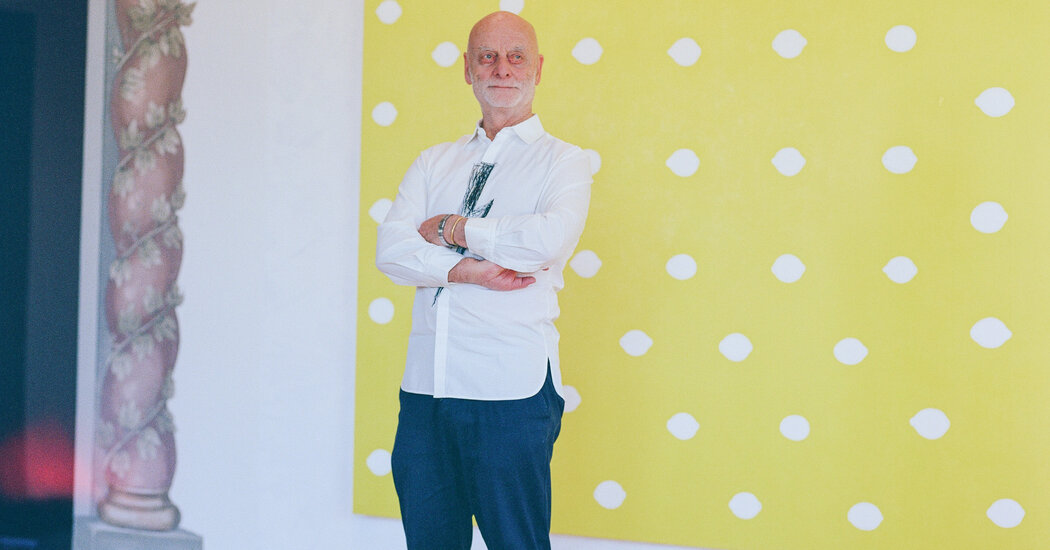
Sigg first visited the country in 1979 as a businessman and helped establish one of the first joint ventures between the Chinese government and a Western company the following year. He was interested in the country’s art scene “from the very beginning,” he said in a video interview from his home in Switzerland last month, a few days before his 80th birthday. But at first, he saw little that he liked. “I just thought, it’s nothing for me,” he said.
It was not until the 1990s, after he had left an executive position at the Schindler Group, that he acquired his first works. He began collecting in earnest around the time that he became the Swiss ambassador to China, North Korea and Mongolia, in 1995.
“When I bought a few pieces, you know, I realized no one is collecting Chinese contemporary,” he said. “In the first years, I was the market in China, because no one else bought art like I did.”
And so, Sigg, who had up to that point been buying works that appealed to his tastes, changed his approach.
“I gave myself the mission to do what a national museum ought to do, which is to build what I call an encyclopedic collection,” he said. “I thought, you know, this is the biggest cultural space in the world yet no one cares what the contemporary artists were contributing to their culture.”
His approach was welcomed by many Chinese artists.
Ai Weiwei, perhaps the best-known contemporary Chinese artist working today, credits Sigg for his international standing. “I call him ‘my maker,’” Ai said of the collector in an email interview.
“His collection covers a very wide range, not only reflecting his personal preferences but rather based on his understanding of what Chinese art is and how contemporary Chinese art differs” from the contemporary art of other places, Ai wrote.
“He is rooted in China,” he added. “His interest is not colonial, but rather that of a discoverer.”
The breadth of Sigg’s collection was intentional. He knew, almost from the outset, he said, that the works “would have to be given to China, so that the Chinese people could view their own art.”
It was in this spirit that he made the donation to M+, saying at the time that he had chosen an institution in Hong Kong for the city’s freedoms and for its proximity to mainland Chinese audiences.
“My first impulse was to think of the mainland,” he said during a news conference in 2012. “But the conditions are not such that art could be shown without limitations.”
Pulling at emotional threads
Sigg acknowledged that the way Hong Kong had changed since 2012 “implies there are limitations to what can be shown.”
What is uncommon is for any such limitations to be explicitly stated. In March 2021, before the museum’s opening that fall, a lawmaker singled out a photograph from Ai’s “Study of Perspective” series, in which the artist shows his middle finger to landmarks around the world. The image in question showed Ai’s finger raised in the direction of the Tiananmen Gate; the lawmaker, Eunice Yung, called it “vulgar” and asked why artworks that were an “insult to the country” would be displayed in Hong Kong.
The piece remains listed in the Sigg collection’s online catalog, but there is “No image available” of the photo. (Another work in the series, showing Ai giving the finger to the White House, remains visible.)
Other pieces by Ai — who was detained by the Chinese authorities for 81 days in 2011 and left the country in 2015 after years of surveillance — have been included in each of the three Sigg collection exhibitions shown so far at M+.
“Fragments” (2005), a monumental sculpture made of wood salvaged from Qing dynasty temples and constructed using traditional Chinese woodworking techniques, dominates the main hall of the “Inner Worlds” exhibition. Though it appears to have no formal structure, viewed from above, its edges trace the outline of China.
“It’s about how to revisit or reconsider the cultural heritage that we feel is so familiar,” Wu said of the work.
Wu, who curated “Inner Worlds” with Sigg, said they had sought to “unpack the story” of the time period covered by the exhibition, the mid-1990s to the 2010s, which was a time of rapid globalization and economic growth, “using emotional threads.”
In a room in which the wall text asks audiences to consider if there is “power in doubt,” a sculpture of the Potala Palace in Tibet titled “Don’t Touch!” (2010), made entirely from rawhide, hangs from the ceiling. According to Wu, Liu Wei, the artist who made it, was inspired by the aggression with which his dog set upon a rawhide chew.
“He thought, ‘Wow, this is actually a very good metaphor for humans’ greedy behavior to compete for power,’” she said.
In a room where the curatorial text invites introspection about whether “anxiety can be a source of creativity,” earlier works by Zhao Bandi that reference public service ads to highlight social issues are juxtaposed with some of his more recent oil paintings. In “China Lake C” (2015), people gather as if at a party, but the setting is incongruous with their suits and gowns.
“They’re standing in a pond, which kind of symbolizes the instability of their social status,” Wu said, adding that, despite it not being as explicit in its social commentary as Zhao’s earlier pieces, “it’s still a very critical work.”
“China Lake C,” which is on loan from Sigg’s private collection, also shows that Sigg has not stopped acquiring art since making his large donation to the museum.
But, he said on the phone, his recent birthday had prompted him to think about what would happen to his collection. “Because everyone knows how old I am, I have to find a solution for the works, and it is important to me that they are in the right places,” he said.
He called M+ “one of the right places,” saying it allowed Chinese audiences to experience Chinese contemporary art in a way that was not possible in mainland China.
“We have substantially more freedom in Hong Kong than one would have in mainland,” he said.
M+ said that it had recorded 2.6 million visitors in 2025, about 40 percent of whom were residents of Hong Kong. The rest came from mainland China and beyond. Sigg, who still visits several times a year and has led tours of the museum, said he had seen visitors become visibly moved by the artworks on display.
“They said, ‘We have no idea that this art exists, such width and breadth of Chinese art,’” he said. “They say, ‘Wow, I see my whole life mirrored in this art.’”
He continued: “It kind of confirms my original intent.”
As for Ai, who in December quietly returned to China for a visit for the first time in 10 years, he said he would one day like to go to M+ and see his works displayed there.
“I hope so,” he said of visiting the city and the museum, “but I don’t know how much will be permitted.”

Leave a Reply