
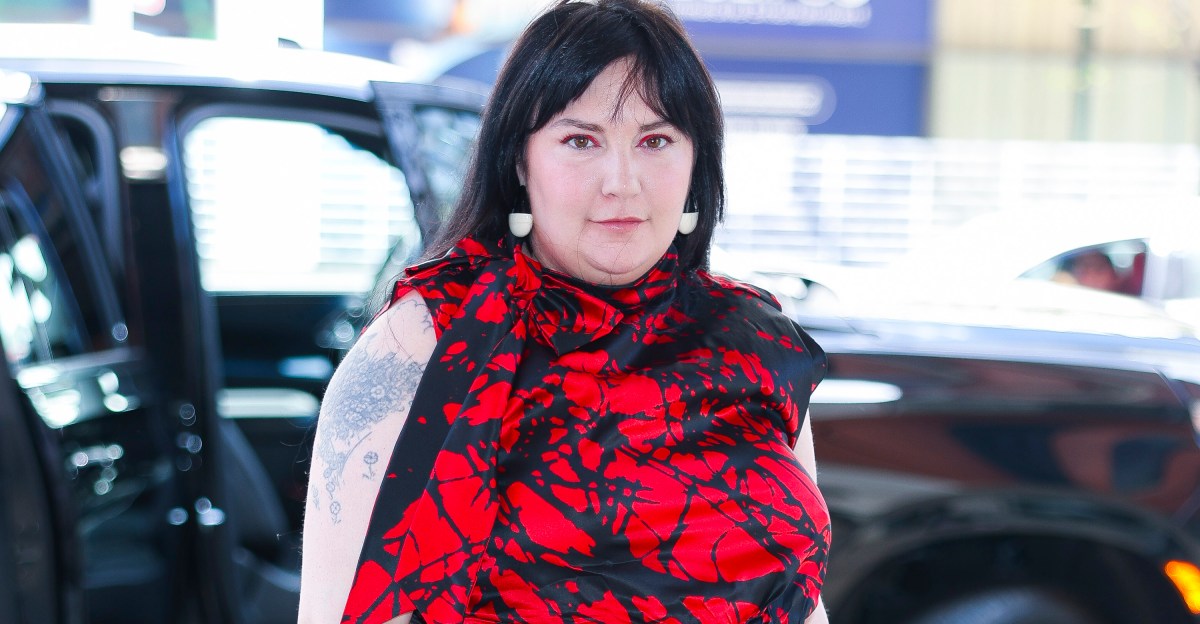
Lena Dunham, the subject of a thousand 2010s think pieces about whether or not she is problematic, has re-emerged from behind the curtain with her new memoir, Famesick. But this time around, the think pieces look different. Some of them are mea culpas addressed to Dunham.
“We owe Lena Dunham an apology,” declared Rachel Simon in a story for MS Now. The apology came with a caveat: “Dunham is, and always has been, a flawed figure. But she never deserved our hatred, nor the expectations placed on her to get everything right.”
“I was wrong about Lena Dunham,” proclaimed Sonia Soraiya at Slate. Soraiya argues that Dunham’s nervy, uncomfortable magnum opus Girls “activated” her own self-loathing, and that she and other critics of the era took it out on Dunham.
“I was one of Lena Dunham’s haters. I want to say I’m sorry,” wrote Dave Schilling at The Guardian. Dunham’s memoir, in which she writes vividly about how her early fame destroyed her mental and physical health, had Schilling rethinking the way he used to write about her. “Rarely did I think about the adverse effects of society turning her into a Wicker Man-style totem for us to set on fire,” he wrote. “To a lot of us, she stopped being a person and transformed into a symbol. I can’t think of anything more unfair.”
In Famesick, Dunham writes that the intensity of the public conversation about her when Girls premiered in 2012 exacerbated her chronic illness, which would be eventually diagnosed as endometriosis plus Ehlers-Danlos syndrome. The combination of the stress of fame and the stress of chronic illness drove her into an opioid addiction and self-destructive behavior, which would further fuel the discourse about her.
Even in the 2010s, at the height of Dunham’s fame, it was fairly evident that a number of the outcries over Dunham’s public presence were overblown. Now, with the distance of 15 years, and Girls reclaimed as a piece of important art, some of those controversies appear remarkably stupid. We should not have been so cruel to her, the consensus is developing, and we would not have been, had she arisen at any other historical moment.
With Dunham’s redemption cycle, we’re performing a sped-up version of the discourse cycle that saw the public reexamining the misogynistic witch hunts of Monica Lewinsky, Britney Spears, Paris Hilton, et al. in the 1990s and 2000s. It’s become clear, with the distance of 20 years, that the gossip press of the 2000s was driven primarily by misogyny, occasionally dressed up as concern trolling. Now, the oft-unspoken villain is cancel culture, the slew of social media shaming and chiding that became such a virulent force at the same time that Dunham was coming up in the 2010s. Apologizing to Dunham becomes a way of apologizing for and repudiating cancel culture, making the case that we are no longer in the cancel culture moment.
But 2010s cancel culture was a different beast than 2000s purity culture. The tactics of social media dogpiling and calls for deplatforming were sometimes misdirected at, say, recipe writers who misspoke in an interview, but they also helped push forward the Me Too movement and Black Lives Matter. Defenders of cancel culture used to say that it was less about canceling the sinful than it was about holding the powerful to account for their misdeeds — but it wasn’t always clear who was powerful enough to be worth targeting, and which misdeeds were all that bad.
Dunham, as the showrunner of a conversation-driving television show, had a fair amount of power, as well as a knack for saying the wrong things in public. The questions before us now are: Was anything she said in public bad enough to justify the treatment she received? And, by extension, just how destructive was cancel culture, really?
Cancel culture emerged from a specific moment in history that would be difficult to replicate. First, social media democratized discourse; suddenly elites were vulnerable to criticism by regular people in the public square. It also divided people into teams and made everyone angry all the time.
This was also the era of blogs — Gawker and its sister site Jezebel; The Awl and its sister site The Hairpin; Salon, Slate, and many more — which were so fun to read and so hard to work at. Blogs were content mills that needed to be fed. The key metric for digital newsrooms at the time was how many clicks any individual story got, which incentivized quickly written hot takes about polarizing figures who sparked audience outrage.
Meanwhile, the educated class was rapidly shifting the norms of acceptable public behavior and belief systems toward the left. In the post-Gamergate, post-Ferguson, post-Obama culture wars, everything must be understood as expressive of the shift in these norms, to be analyzed and evaluated for its fidelity and virtue. At its best, it was a valuable refocusing that helped people reprocess the hegemonic beliefs about the world they had inherited. It could also, at its worst, be reductive. Cancel culture was a tool that held the powerful to account. It was a weapon that punished disproportionately. It was bipartisan, vicious, frightening, bewildering, exhilarating.
Confessional-style women’s blogging was also in its heyday in those days — all the XOJane “it happened to me” stories, the Jezebel tampon posts — which were so prevalent that their gravitational pull warped any piece of fiction about the intimate lives of women, including Girls, into being understood as a confession. As such, it was evaluated religiously, praised for its radical political transparency, damned for its sins.
Lena Dunham controversies: A (non-comprehensive) timeline
Not that kind of pseudonym. In December 2014, Dunham publishes a memoir, Not That Kind of Girl, in which she describes her sexual assault. She gives her attacker a name and changes details of his identity, but the resulting character turns out to match an actual person whom Breitbart and the National Review both track down. They lambast Dunham for her “false” accusation ruining the man’s reputation.
Not that kind of scandal. Also in Not That Kind of Girl, Dunham describes examining her younger sibling’s genitals as a child. Conservative outlets accuse her of sexual assault.
That’s one way of putting it, part 2. On her podcast Women of the Hour in 2016, Dunham declares, “I still haven’t had an abortion, but I wish I had.” Backlash once again ensues.
Of all the people who were canceled in the 2010s, Lena Dunham was surely not the most deserving. She was the young showrunner of a critically acclaimed but little-watched HBO drama, with most episodes garnering well under 1 million viewers. How much influence could she possibly have wielded? But Girls became something bigger than itself; sometimes it felt that every one of the few hundred thousand people who watched it were writing essays about it.
Some of that criticism was straightforwardly misogynistic: People wrote angry screeds about how much they hated Dunham because she was naked on her show a lot and they thought she was ugly. Some of it was in bad faith. Dunham’s Girls alter ego, Hannah, was abrasive and entitled, and in the discourse, the distance between them collapsed. People were furious at Dunham for making them watch a character as unlikable as Hannah.
A great deal of the criticism of Dunham was plausibly in good faith, but it was extraordinarily loud. There was the criticism that Dunham and all the young women she cast were nepo babies. Then there was the way Dunham’s real-life presence sometimes evoked the same clueless arrogance as that of the character she played. Part of that involved her saying a lot of thoughtlessly provocative things, many of which displayed a consistent obtuseness toward class and race.
To begin with, Girls was set among young people in diverse Brooklyn, and yet all the main characters were white: Why? Some argued that Dunham’s blinkered, privileged characters were exactly the type of young New Yorkers who would surround themselves with other white people, while others argued Dunham’s refusal to engage with race was a sign of racism in and of itself.
Dunham responded with a characteristic mix of reason and hamfisted trollery. “If I had one of the four girls, if, for example, she was African American, I feel like — not that the experience of an African American girl and a white girl are drastically different, but there has to be specificity to that experience [that] I wasn’t able to speak to,” she told NPR in 2012, after the first season aired. “I did write something that was super-specific to my experience, and I always want to avoid rendering an experience I can’t speak to accurately.”
Dunham was right that the charm of Girls lay in its specificity, and it was reasonable for her to fear that she couldn’t bring that level of sensory, bodily detail to the life of a Black character. But the following season, she followed up the controversy by casting Donald Glover as Hannah’s short-lived Black boyfriend, who was revealed to be a Republican — a strange creative choice that tokenized what was, at that point, the show’s sole Black character.
In the meantime, outside the show, Dunham kept making unforced errors. “I still haven’t had an abortion, but I wish I had,” she said on a podcast in 2016. In 2019, she described sitting next to the NFL star Odell Beckham Jr. at the Met Gala, and feeling insecure that Beckham, who is Black, didn’t seem attracted to her. “The vibe was very much like, ‘Do I want to fuck it? Is it wearing a…yep, it’s wearing a tuxedo. I’m going to go back to my cellphone,’” Dunham said. Theoretically she was talking about her own insecurities, but in practice, the quote was so specific and bizarrely sexualized (truly the Lena Dunham story) that critics argued it played into a harmful narrative about how Black men respond to white women. (Dunham later apologized.)
While the criticisms of Dunham’s body and nudity were straightforward misogyny, the criticisms of her oversight around race were more reasonable. Still, few of them merited the intensity of response Dunham received in the 2010s: not just the polite and well-reasoned essays, but the vitriolic and unending Twitter posts accusing her of monstrous bigotry and evil thoughts. In some cases, it felt as though the social justice outrage around Dunham’s racism were giving cover to people who hated her because they thought she was ugly and annoying, like right-wing commenters who claim they’re criticizing white women as an act of allyship with people of color.
In Famesick, Dunham declines to apologize for any of her missteps — save for what was probably her greatest controversy: her 2017 defense of a white Girls writer accused of raping a Black woman.
In 2017, at the height of the Me Too movement, actress Aurora Perrineau filed sexual assault charges against Girls writer Murray Miller, saying that he raped her in 2012, when she was 17 years old. In response, Dunham and her Girls co-showrunner Jenni Konner sent a statement to the Hollywood Reporter defending Miller.
“While our first instinct is to listen to every woman’s story,” they wrote, “our insider knowledge of Murray’s situation makes us confident that sadly this accusation is one of the 3 percent of assault cases that are misreported every year.”
“I believe in a lot of things but the first tenet of my politics is to hold up the people who have held me up, who have filled my world with love,” Dunham added on what was then Twitter.
For an outspoken feminist like Dunham to accuse a woman of lying about her sexual assault, on the grounds that the man accused was someone she knew, was a betrayal of some of her most clearly stated principles. To make matters worse, the accused man was white, and the alleged victim was a woman of color, playing directly into one of Dunham’s biggest weaknesses.
In Famesick, Dunham describes her decision to publish this statement as “the narcissism of fame in its purest form.”
“I was so deep in my own distress — physical, emotional, existential — that I had ceased to be able to imagine anyone else’s,” she writes. She also says that the response went out the same day she returned home after a full hysterectomy, high on pain killers, under pressure from Konner, and she doesn’t remember drafting it.
Every time I read this apology, I find myself going back and forth on it. Dunham sounds genuinely contrite — but then Dunham always does sound genuinely contrite in all her apologies, which never seem to end.
The medical context from which she was writing her original statement sounds almost unimaginably difficult. Dunham evokes the physical and mental pain of the hysterectomy with brutal efficiency, likening her disease-ridden uterus to “the Chinatown Chanel purse of nightmares, full of both subtle and glaring flaws”; one of her doctors tells her later that he doesn’t know how she was able to keep walking. I am reluctant to tar someone forever for a poor decision made so soon after the trauma and pain of major surgery.
Yet there is also a slippery manipulative quality to the way Dunham writes about this statement, a subtle passing of blame. Konner becomes the chief agent in Dunham’s version of events, the woman of sound mind and sound health who pushes the fateful statement on a woozy, dissociating Dunham and supposedly publishes it over Dunham’s mother’s protests. Such villainous, boundary-crossing, ill-intentioned figures recur throughout this memoir at some of Dunham’s lowest moments: suddenly, we encounter people who whom Dunham tells us are cruel or unempathetic in a way she says that she is not.
“It is in these moments that I felt unsure whether Dunham is a victim or a narcissist,” wrote the essayist Eleanor Halls in her review of Famesick; “the truth is you can be both.” And isn’t it always both with Lena Dunham?
Knowing everything we do about Dunham, it feels reasonable to decide that she has crossed the line too many times and you are done with giving her second chances. It feels reasonable to conclude that you don’t want to pay attention to her public persona but are willing to give her consistently high-quality TV work another try. And it also feels reasonable to decide that you are willing to allow her the grace of her apology, even with caveats.
That, in the end, is where I end up. Dunham has a compelling voice, and I find that she hasn’t done anything so appalling that it interferes with my interest in seeing what she does next.
Part of the reason so many people are invested in parsing out how bad Dunham is or was, and how much she deserved her treatment in the 2010s, is because it is a way of working out by proxy how much we collectively need to feel ashamed of cancel culture. In the midst of the vicious backlash to progressive politics that supposedly led to Trump’s reelection, there’s a growing sense among many progressives that the eager, ugly, censorious glee of cancel culture was a tactical mistake, that it alienated supporters, that it was even immoral.
Looking back at Dunham’s career, though, reveals that cancel culture never went along any particular party lines. It was misogynistic: It attacked women with a specific glee, particularly women like Dunham, who was considered ugly yet still took her clothes off on TV. It was also feminist: Dunham’s biggest wave of backlash came after she defended an accused rapist whose accuser was a Black woman.
Cancel culture was an expression of what was new and exciting about both social media and digital media, and also what was monstrous and destabilizing about them. It was a tool used by people on both sides of the political aisle, and also people who did not identify as political at all. It devoured people like Lena Dunham, and it was also a source of attention she seemed to court, provoking and trolling and apologizing in an endless cycle of discourse.
Dunham was in the unique position to understand both the panicky horrors and the perverse thrills of cancel culture better than nearly anyone. Like the people apologizing to her, she, too, doesn’t seem to know if it was all that bad — only that she wishes it had not been so bad to her.

Leave a Reply