
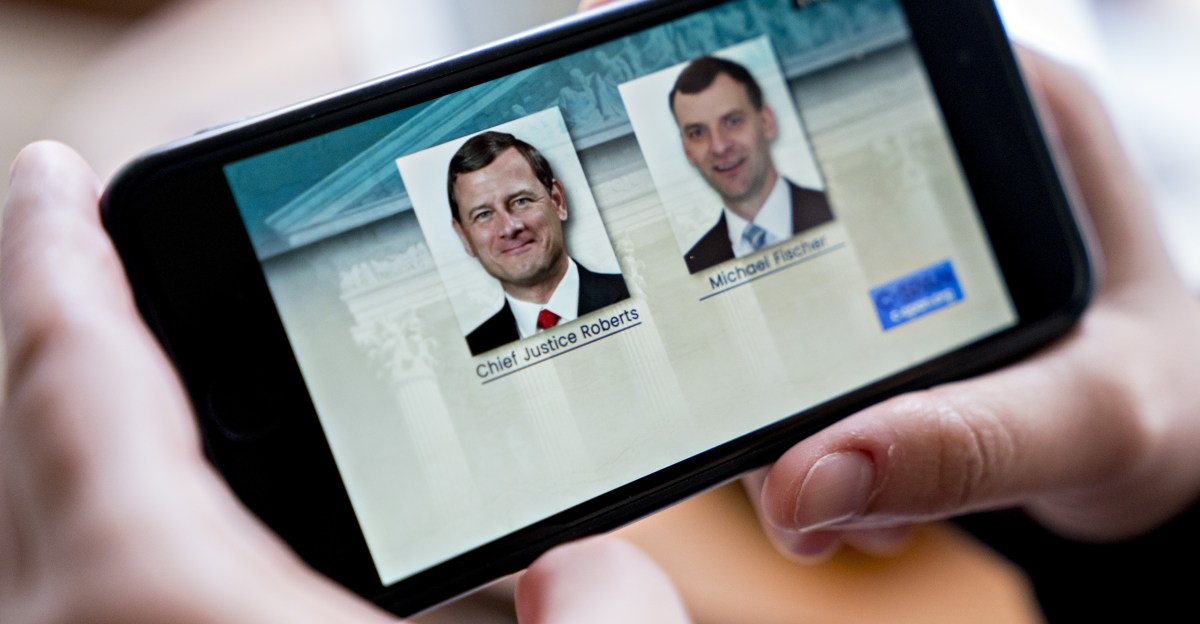
If I’d only listened to the first half of the Supreme Court’s Monday argument in Chatrie v. United States, a case asking when police can use cellphone data to determine who was present near the site of a crime, I would be convinced that the Court is about to drastically limit Americans’ right to privacy.
Most of the justices’ questions to Adam Unikowsky, the lawyer for a criminal defendant who was convicted of robbing a bank, appeared skeptical of Unikowsky’s claims that the Constitution places strict limits on the government’s ability to track people through their cellphones. Some of the justices even appeared likely to neutralize Carpenter v. United States (2018), a landmark case suggesting that police must obtain a warrant before they obtain cell phone data revealing where a person has been in the past.
But in the second half of the argument, after Justice Department lawyer Eric Feigin took the podium, most of the justices appeared even more concerned about some of the implications of Feigin’s arguments.
As Chief Justice John Roberts noted shortly after Feigin began his argument, if the government has too much ability to track people using their cellphones, it could potentially learn the identity of everyone who attended a particular religious service, or everyone who attended a particular political meeting. Meanwhile, several other justices appeared worried that the government lawyer’s arguments would permit police to comb through many people’s emails, or their personal calendar and photos, without first obtaining a warrant.
In light of these concerns raised by the justices, it appears likely that the Court will hand down a cautious decision in Chatrie — one that reads Carpenter to require police to always obtain a warrant before they attempt to track someone using their cellphone. That said, the police in Chatrie did, in fact, obtain a warrant. And the Court may very well rule that the warrant in this case complied with the Constitution.
Chatrie, in other words, is likely to be a fairly narrow decision. The Court appears likely to maintain existing privacy protections against police searches, but most likely will not extend them in any significant way.
“Geofence” warrants, briefly explained
The specific legal question in Chatrie involves “geofence” warrants, which are warrants permitting the government to learn who was in a particular location at a particular time. Typically, it is possible for police to discover this information because both cell phone companies and software vendors such as Google often track the location of individuals’ phones.
In Chatrie, police obtained a warrant requiring Google to turn over information about who was present near a bank in Midlothian, Virginia, within an hour of a robbery at that bank. The warrant drew a 150-meter radius around the crime site that included both the bank and a nearby church. Google had this information about some of its users because of an optional feature known as “location history,” which can be used to pinpoint users’ location with extraordinary precision – but only for users who have opted into this service.
The Court’s decision in Chatrie is likely to be fairly nuanced, and it is unlikely to significantly disturb existing law.
The warrant also laid out a three-step process that limited how much information police could obtain about each individual cell phone user who was inside this geofence. At the first stage, Google provided anonymized information on 19 individuals who were present near the bank during the relevant period. Police sought additional location information on nine of these individuals and, after reviewing that additional information, sought and received the identity of three of these people. One of the three was Chatrie.
So this warrant did place meaningful restrictions on what information could be obtained by police. The data was anonymized until the final stage of the investigation, and police only learned the identity of a small percentage of the total number of people who were present near the robbery.
At the same time, the warrant did not require a judge or magistrate to determine whether the police were justified in narrowing the original 19 individuals down to nine, or down to the three whose identities were ultimately revealed. Google was responsible for determining whether it would turn over this additional information. At least some of the justices appeared bothered by this fact on Monday, and they may rule that this warrant only would have been permissible if police had been required to go back to the judge and get permission to narrow the search.
Three ways the Court could decide Chatrie
Broadly speaking, the Court appeared to fracture into three factions in Chatrie. The most pro-police faction, which included Justices Clarence Thomas and Samuel Alito, seemed eager to diminish Carpenter and make it much easier for the government to track people without first obtaining a warrant.
As Alito noted, Carpenter involved a similar search, but one that was technologically distinct from the one at issue in Chatrie. In Carpenter, police determined a suspect’s location by tracking which cell phone towers or other “cell sites” their phone was communicating with at various times. This information is less precise than the GPS-tracking data that Google possessed in Chatrie, but it is also information that, in Alito’s words, a cellphone user has “no choice but to disclose.”
Alito’s argument was that Chatrie could have turned off the feature in many of Google’s apps that allowed Google to track his location, but no cell phone user can prevent their phone from communicating with cell sites unless they turn off the phone altogether. Carpenter, under Alito’s framework, would only require a warrant if police want to obtain information that a cell phone user cannot opt out of revealing.
As a practical matter, this would mean that the government would have virtually limitless ability to track people’s movements, so long as it relied entirely on services such as Google Maps or Uber, where users can prevent the service from tracking their precise location.
Shortly after Feigin began his argument, however, several key justices signaled that they do not buy Alito’s argument. Roberts raised his concern about police learning the identities of everyone who attends a particular church. Justice Neil Gorsuch pointed out that people also sometimes voluntarily share their emails, photos, and personal calendars with Google, and he expressed concern that the government’s legal arguments would allow police to access that information without a warrant as well.
Justice Amy Coney Barrett, who also asked some questions that seemed sympathetic to the government’s position, seemed to recoil when she realized that the Justice Department’s argument would not only permit the police to track when someone enters a private residence, but also specifically whether someone entered that residence’s bedroom.
That said, it seems unlikely that the Court will place sweeping restrictions on the government’s ability to obtain geolocation data provided that they first obtain a warrant. Justice Ketanji Brown Jackson, a former public defender who is often sympathetic to the rights of criminal defendants, said fairly explicitly that she does not see a problem with a warrant permitting police to learn which 19 individuals were near the bank robbery — although she likely would support additional restrictions once police seek more information on some of these individuals.
Justice Brett Kavanaugh, meanwhile, suggested that a geofence warrant is valid so long as it places “reasonable geographic and temporal” limits on the search. Police, in other words, can learn who was in a fairly narrowly defined location within a brief period of time, but the Constitution might not permit a sprawling search of, say, everyone at a political protest that encompassed many city blocks and that lasted an entire day.
All of which is a long way of saying that the Court’s decision in Chatrie is likely to be fairly nuanced, and it is unlikely to significantly disturb existing law. Police will still need to obtain a warrant before they can discover where someone was at a particular time in the past, but the Court is unlikely to place particularly strict restrictions on what that warrant should say.
Whether those restrictions are strict enough to prevent the government from identifying political dissidents and similar groups is unclear, and the question may remain open until a future case.




Leave a Reply